

Outdoor spaces have become an important part of everyday life in Tarneit. A backyard may include garden lighting, entertaining areas, outdoor kitchens, pool equipment, water features, power tools, lawn equipment, security lights and charging points. All of these can make a property more practical—but they also introduce electrical risks that are different from those inside the home.
The biggest issue is simple: outdoor electricity is exposed to conditions that indoor electrical systems are not. Rain, irrigation, condensation, soil, dust, pets, gardening equipment and accidental impact can all affect electrical equipment.
If an outdoor power point becomes loose, a garden cable is damaged, or an RCD repeatedly trips, ignoring the problem can turn a small fault into a serious safety issue. This is where properly designed outdoor electrical systems and qualified electrical work matter. For homeowners dealing with damaged or unreliable installations, professional outdoor electrical repairs Tarneit can help identify the underlying fault rather than simply resetting a switch and hoping the problem disappears.
Energy Safe Victoria specifically warns that water and electricity do not mix and highlights the increased danger of electrical equipment around swimming pools. It also advises homeowners to use licensed electrical professionals for electrical work.
This guide explains how to approach outdoor electrical safety in Tarneit, including garden power, outdoor outlets, weatherproof fittings, RCD protection, pool-area safety and outdoor cabling.
Outdoor electrical installations have to cope with a constantly changing environment.
Inside a dry room, a power point is generally protected from rain and direct moisture. Outside, even a correctly installed outlet can be exposed to:
The risk increases when several of these conditions occur together.
For example, imagine a homeowner setting up a temporary outdoor entertainment area. An extension lead runs across the lawn to a portable speaker, another cable powers decorative lighting and a third supplies a small appliance.
Everything may work perfectly on a dry afternoon.
Then irrigation starts.
The ground becomes wet, cables are moved around and water reaches a damaged connection. Suddenly, an installation that appeared harmless has several potential hazards.
This is why outdoor electrical safety needs to be considered as a complete system rather than simply asking, “Does the power point work?”
A qualified outdoor electrician does more than install an extra socket on an external wall. Good outdoor electrical planning considers where electricity will be used, how the equipment will be exposed to weather and moisture, how circuits are protected and how people will move around the area.
A typical assessment may consider:
An outlet beside a sheltered patio is very different from one positioned beside a garden bed or pool.
The electrician needs to consider the surrounding environment and the intended equipment before selecting an appropriate installation arrangement.
Adding several outdoor outlets to an existing circuit may not always be the best solution.
Suppose a backyard already has:
Adding more equipment without assessing the existing electrical system can create unnecessary loading and nuisance tripping.
Outdoor cabling needs careful planning. Cables may be exposed to gardening activities, foot traffic, weather and accidental damage.
A route that looks convenient during installation may become problematic once garden beds, paving or landscaping change.
Outdoor installations require appropriate equipment and installation methods for their environment. Weatherproof fittings can help protect electrical connections, but the correct equipment still needs to be selected and installed properly.
A good installation should not only be safe when new. It should also be practical to inspect and maintain later.
Garden Power: Planning Safe Outdoor Power Outlets
Garden power can make outdoor work much easier.
You may need electricity for a lawn mower, hedge trimmer, pressure washer, pond pump, garden lighting transformer, irrigation equipment or other outdoor appliances.
The mistake is assuming that one convenient power point can safely handle everything.
Before installing outdoor power outlets, consider your normal activities.
Ask:
These questions help determine sensible outlet locations.
Extension leads are useful for temporary applications, but they should not become a permanent substitute for properly positioned outlets.
A long cable running across a garden can create several problems:
Energy Safe Victoria advises against using extension cords where they may be exposed to water, particularly around pools.
If you repeatedly need an extension lead in the same location, that is often a sign that the electrical layout should be reconsidered.
The word “weatherproof” should not be treated as a guarantee that an electrical product can be placed anywhere outdoors.
Outdoor fittings need to be appropriate for their actual environment.
A covered patio, exposed garden wall and poolside location can have very different exposure conditions.
Consider:
Rain: Direct rainfall can reach exposed equipment.
Sprinklers: Irrigation may repeatedly spray the same fitting even when there is no rain.
Condensation: Temperature changes can contribute to moisture around equipment.
UV exposure: Constant sunlight can affect some materials over time.
Physical impact: Garden tools, furniture and equipment can damage fittings.
Dirt and insects: External fittings can accumulate contaminants that may affect operation.
A properly selected weatherproof fitting is therefore only one part of the solution. Installation position, sealing, cable entry, drainage, protection and ongoing condition also matter.
Consider an outdoor socket mounted beside a garden tap.
It might initially appear convenient because both are located near the area where gardening equipment is used.
However, the location could expose the electrical fitting to repeated splashing.
A better installation considers how the tap, hose, sprinkler and electrical equipment interact—not just whether the socket can technically be installed there.
RCD protection is one of the most important considerations when dealing with electrical safety.
An RCD, or residual current device, is designed to detect certain leakage of electrical current and disconnect the supply rapidly when a fault is detected.
It is commonly referred to as a safety switch.
The important point is that an RCD is not a substitute for good electrical installation.
It is another layer of protection.
Energy Safe Victoria explains that safety switches/RCDs are designed to switch power off quickly when an electrical fault is detected, helping reduce the risk of serious injury or death.
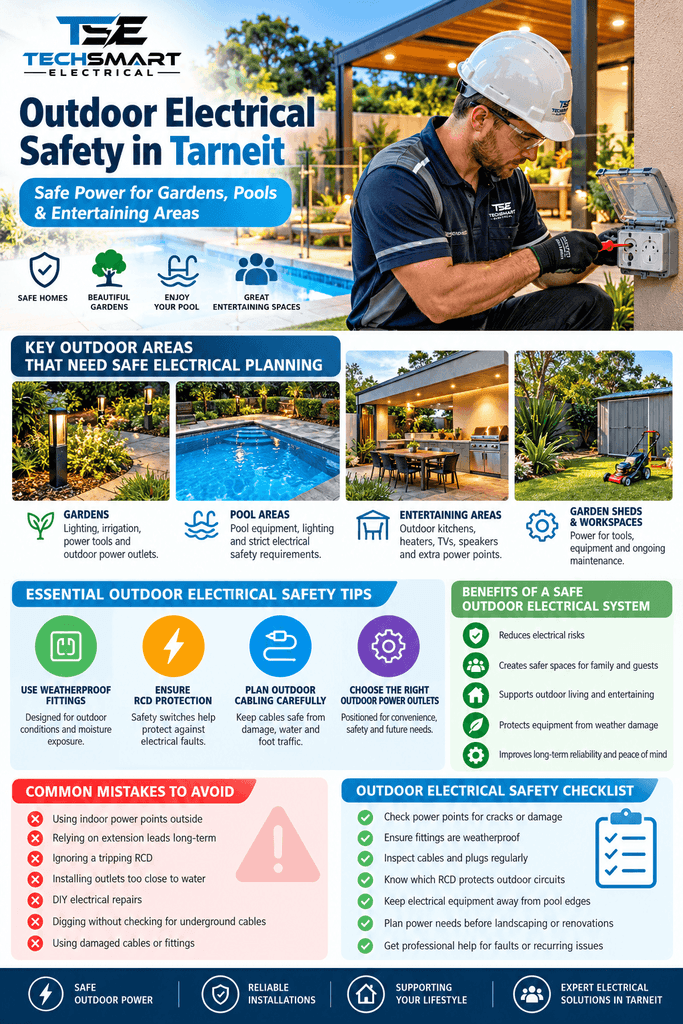
Outdoor environments can involve:
These conditions can increase the consequences of an electrical fault.
For that reason, homeowners should not ignore an RCD that repeatedly trips.
Do not simply reset it over and over.
Repeated tripping may indicate:
Unplugging portable equipment and observing whether the problem continues can provide useful information, but electrical fault finding itself should be left to a qualified professional.
Outdoor wiring is exposed to more potential physical and environmental damage than indoor wiring.
One common example is accidental damage during gardening.
A homeowner may insert a garden stake, dig a new planting hole or use equipment without realising that electrical infrastructure is nearby.
Energy Safe Victoria recommends identifying underground pipes and cables before digging and specifically advises not to excavate until you know what is underground.
Get professional advice if you notice:
These are not problems to solve by taping over a damaged cable or fitting a temporary cover.
Swimming pools create one of the most important outdoor electrical safety scenarios.
People around pools are often barefoot, wet and in direct contact with the ground or water. Energy Safe Victoria notes that electric shocks around swimming pools are more likely to be fatal because wet skin and bare feet reduce the body’s resistance.
That makes pool-area electrical planning particularly important.
Do not place extension leads, portable appliances or electrical equipment where they can fall into the pool or be splashed.
This includes being cautious with:
Pool pumps, lighting, heating systems and other fixed equipment need appropriate electrical installation and protection.
If you are renovating a pool area, don’t wait until the landscaping is finished before thinking about electrical safety.
Electrical planning should happen alongside the pool, paving, fencing, lighting and landscaping work.
Outdoor entertaining areas often combine electricity with food, water and people.
An alfresco area might include:
The safest approach is to plan the electrical requirements before construction or renovation is completed.
A common mistake is designing the electrical layout around the equipment you currently own.
Five years later, the homeowner may add:
Planning spare capacity and sensible outlet locations from the beginning can reduce the temptation to rely on temporary cabling later.
Some outdoor electrical problems are easy to dismiss because the equipment still appears to work.
For example, an outdoor light may flicker occasionally but continue operating.
A power point may work when dry but trip the circuit after rain.
A garden lighting system may stop working intermittently.
These symptoms can point to an underlying problem rather than an inconvenience.
Professional outdoor electrical repairs Tarneit may be appropriate when you notice recurring faults, damaged equipment, moisture-related problems or unexplained circuit behaviour.
If an electrical fault is:
don’t treat the symptom as the problem.
For example, repeatedly resetting an RCD does not repair whatever caused it to operate.
A qualified electrician can investigate the circuit and determine whether the problem originates from an appliance, fitting, cable, connection or another component.
Choosing a Tarneit Electrician should involve more than comparing the cheapest quote.
For electrical installation work in Victoria, Energy Safe Victoria advises consumers to engage a registered electrical contractor and recommends asking to see the electrician’s licence.
Before work starts, ask practical questions such as:
You should be able to verify the relevant credentials.
Ask how the proposed outdoor installation will be protected from environmental and electrical hazards.
A good electrician should be able to explain the proposed cable route and why it is suitable.
This is important when adding multiple outlets or high-load equipment.
Energy Safe Victoria states that electrical installation work in Victoria requires a Certificate of Electrical Safety, with requirements depending on the type of work.
A professional should be able to explain the certification applicable to the work being performed.
An indoor power point is not automatically suitable for outdoor exposure.
A safety switch operating can be an important warning that something needs investigation.
Temporary equipment should not become a permanent electrical infrastructure solution.
The location of taps, pools, sprinklers and drainage should be considered before installation.
Garden improvements can become dangerous when underground electrical infrastructure is not identified first.
Tape may hide visible damage, but it does not make damaged electrical wiring safe.
Electrical installation work is not a suitable DIY project. Energy Safe Victoria explicitly states that unqualified electrical work is dangerous and illegal in Victoria.
Before using your backyard electrical system, look at the area as if you were inspecting it for someone else.
Look for:
Look for:
Before digging, planting posts or installing landscaping, establish where underground services are located.
Know which RCD protects your outdoor circuits and follow the manufacturer’s or electrician’s instructions for testing.
Keep portable electrical appliances and extension leads away from areas where they could be splashed or fall into the water.
Heavy rain, storms or flooding can expose weaknesses that were not obvious during dry conditions.
If an electrical fitting has been submerged or seriously exposed to water, don’t assume it is safe simply because it appears to work afterward.
One of the best lessons from outdoor electrical work is that the safest installation is usually the one designed around how people actually use the property.
Imagine a family that regularly entertains outdoors.
They have a barbecue near the alfresco area, a refrigerator under the bench, garden lighting along the fence, a television mounted on the wall and children playing in the backyard.
A basic approach might simply add one outdoor power point.
A better approach considers the entire environment:
This approach produces a much more practical installation.
The same principle applies to a garden renovation. If you are installing retaining walls, paving, irrigation and landscaping, think about electricity before everything is buried or covered.
Moving electrical infrastructure after landscaping is completed can be considerably more disruptive than planning it beforehand.
If you see obvious electrical damage, smell burning or experience an unusual electrical fault, keep people away from the affected area.
Do not touch damaged electrical equipment, particularly when water is present.
If safe to do so, keep clear and arrange for a qualified electrical professional to assess the installation.
For serious electrical incidents, fire or immediate danger, use the appropriate emergency services.
The key principle is simple: don’t experiment with a fault just to see whether it still works.
Electrical problems can be intermittent, which means an installation may appear normal immediately before developing a dangerous fault.
A well-designed outdoor electrical system should make your garden, pool and entertaining areas easier to use without introducing unnecessary hazards.
The most important considerations are not simply the number of outlets you have. You also need to think about where those outlets are installed, how they are protected, how outdoor cabling is routed, what equipment will be connected and how the system will respond to electrical faults.
For Tarneit homeowners, good outdoor electrical planning means paying particular attention to outdoor power outlets, weatherproof fittings, RCD protection, garden power, pool-area electrical safety and outdoor cabling.
If an outdoor circuit is repeatedly tripping, a fitting has been damaged, or electrical equipment is showing signs of moisture or deterioration, don’t rely on a temporary fix. Professional outdoor electrical repairs Tarneit can identify the underlying issue and help restore the installation safely.
Most importantly, electrical work in Victoria should be carried out by appropriately licensed professionals, with the required safety certification provided for completed electrical installation work.
The best outdoor electrical system is one you rarely have to think about—because it has been planned properly, installed appropriately and maintained with safety in mind.
Outdoor power points need to be suitable for the environment in which they are installed. The electrician should consider exposure to rain, irrigation, moisture, physical damage and the equipment that will be connected. Appropriate protection, fitting selection, placement and circuit protection all matter. Simply buying a product labelled for outdoor use does not replace proper electrical installation.
Moisture may be contributing to the fault, but there can be several possible causes. Water could affect an appliance, outdoor fitting, cable or another part of the circuit. Avoid repeatedly resetting the RCD without investigating the cause. If the problem persists, have the circuit and connected equipment checked by a licensed electrician.
Extension leads may be suitable for appropriate temporary use when they are designed and rated for the application and kept away from water and damage. They should not be treated as permanent outdoor wiring. If you consistently need power in the same garden location, professionally installed garden power is generally a more practical long-term solution.
Pool areas require particularly careful electrical planning because people may be wet and barefoot. Portable electrical appliances and extension leads should not be positioned where they can be splashed or fall into the pool. Fixed pool equipment should be installed and maintained by appropriately qualified professionals. Energy Safe Victoria specifically warns about the increased severity of electric shocks around swimming pools.
Electrical installation work should not be treated as a DIY task in Victoria. Energy Safe Victoria advises homeowners to use licensed electrical professionals and states that unlicensed electrical work can be dangerous and illegal.
Techsmart Electrical is a locally owned company serving Melbourne and the surrounding areas. As leading specialists for commercial, industrial and residential electrician services, we prioritize customer satisfaction.


We are preferred electricians for Beacon Lighting and with that comes many bonuses for our customers. By using Techsmart Electrical as your preferred electrician, we can provide you with up to 20% off RRP of everything in store at Beacon Lighting, extended warranties on certain items and even free lighting design consultations.
Our team works closely alongside our home store in Taylors Lakes to deliver the best possible outcome for all installations. From installing one ceiling fan to wiring an entire home, Techsmart Electrical provides 100% satisfaction guarantee.
Contact us today to arrange your next installation.
Techsmart Electrical has always provided dependable and cutting-edge electrical contracting services and installations. Our qualified electricians offer services that are intended to support Melbourne businesses in growing and to give homeowners complete peace of mind.
It is entirely up to you where you want more power outlets in your home. Techsmart Electrical can install them wherever you need them. It's possible that all you need is to change your power outlets, which is a regular request. Even your outdated power sockets can be replaced with fresh models by our team in order to give your house the finishing touches.
With several years of experience, Techsmart Electrical’s licenced electricians can design and install any power point system, whether it's for a newly constructed home or an existing one. Call us and schedule a time for your power socket installation.











Techsmart Electrical is a Melbourne based electrical company. We understand the importance of top-quality workmanship, service and safety. With a professional approach, we are always ready to provide you with Master Electricians to deliver prompt electrical services for any situation.