

Rural properties in the Macedon Ranges often have electrical demands that are very different from those of a typical suburban home. Larger blocks, sheds, pumps, electric fencing, workshops, long cable runs, older switchboards and changing power requirements can all place additional pressure on an electrical system.
A fault that seems minor—such as a circuit breaker tripping occasionally—can sometimes indicate a much larger problem. On a rural property, ignoring electrical symptoms can be particularly risky because faults may affect detached buildings, outdoor equipment or wiring that is not immediately visible.
Knowing when to call a rural electrical contractor Macedon Ranges can help property owners address problems before they become safety hazards, equipment failures or expensive electrical repairs.
This guide explains the common electrical issues found on rural properties, what warning signs to look for, and when a Macedon Ranges Electrician should inspect the system.
Why Rural Properties Have Different Electrical Challenges
Rural electrical systems are often more complex than standard residential installations.
A home may share its electrical supply with a detached garage, machinery shed, workshop, bore pump, irrigation equipment, water-treatment system, electric fencing or other outbuildings. Some properties also have older wiring that has been modified or extended over many years.
The distance between buildings creates another consideration. Long cable runs can introduce voltage-drop issues if the installation has not been appropriately designed. Outdoor electrical equipment is also exposed to moisture, temperature changes, dust, animals and mechanical damage.
Common factors that can affect rural electrical systems include:
This is why rural electrical services require more than simply replacing a faulty component. The electrician needs to understand how the property’s electrical system works as a whole.
Rural Electrician: Signs Your Property Has an Electrical Problem
Some electrical faults are obvious, while others develop gradually.
A rural property owner should not dismiss recurring electrical problems simply because the power eventually comes back on. Repeated faults often provide useful information about what is happening within the installation.
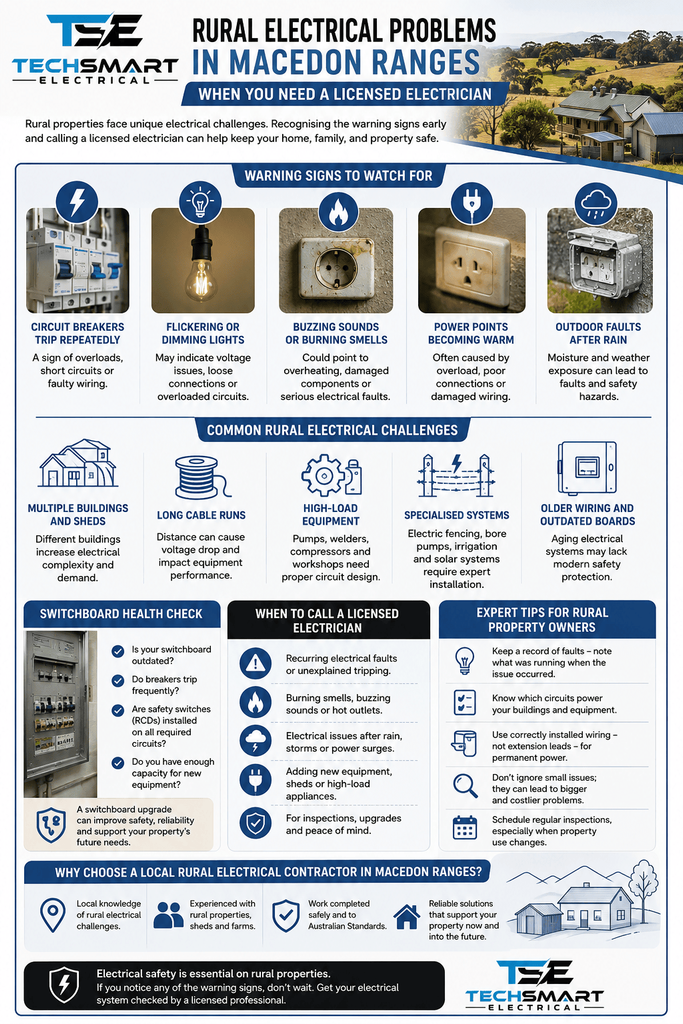
Circuit breakers that trip repeatedly
A breaker that trips once may have responded correctly to a temporary overload or fault. If the same breaker continues to trip, however, there is a reason for it.
Possible causes include:
For example, a workshop circuit may work normally when only basic tools are operating. When a compressor, welder or other high-load equipment starts, the breaker may trip. That pattern can indicate that the circuit or supply arrangement needs professional assessment.
Do not repeatedly reset a breaker without finding out why it is operating.
Flickering or dimming lights
Lights that flicker when machinery starts can sometimes be associated with changes in electrical load. On a rural property, this may become noticeable when pumps, compressors, heaters or workshop equipment operate.
Occasional flickering does not automatically mean the entire electrical system is unsafe, but persistent or worsening flickering deserves investigation.
Particular attention should be paid when:
A licensed electrician can determine whether the cause is related to the appliance, circuit, connections, supply or another part of the installation.
Buzzing, crackling or burning smells
Electrical equipment should not produce unexplained buzzing, sizzling or crackling sounds.
Likewise, a persistent burning or melted-plastic smell around a switchboard, power point, light fitting or appliance should be treated seriously.
These symptoms may indicate overheating, damaged insulation, a loose connection or another electrical fault.
If there is visible smoke, sparking or an immediate fire risk, switch off the power only if it is safe to do so, keep clear of the affected area and contact emergency services where appropriate.
Power points becoming warm
A power point or switch should not become unusually hot during normal use.
Heat can be associated with excessive load, poor connections, damaged components or other faults. Outdoor power points deserve particular attention because exposure to moisture and weather can accelerate deterioration.
Do not continue using a power point that is hot, damaged, discoloured or producing unusual smells until it has been assessed.
Electrical Services for Rural Property Wiring
Property wiring is one of the areas where rural installations can become complicated.
A property may have been altered several times over its lifetime. A new shed may have been added years after the original house was built. An old garage may have been converted into a workshop. Additional lighting or power outlets may have been installed as the property’s needs changed.
Each modification affects the overall electrical system.
Older wiring deserves particular attention
Older properties may contain wiring, switchgear and electrical components that were appropriate when installed but are no longer suitable for the property’s current demands.
This does not mean every older electrical installation needs complete rewiring.
Instead, an electrician should assess its actual condition and determine whether components are damaged, deteriorated, overloaded, inadequately protected or otherwise unsuitable.
Warning signs can include:
Detached sheds and workshops
Sheds are often where rural properties develop additional electrical complexity.
A workshop might contain:
These loads need to be considered when designing or reviewing the electrical supply.
Simply adding more power points does not necessarily solve the problem. The circuit capacity, cable sizing, protective devices, installation conditions and overall demand all need to be considered.
Long cable runs
Distance matters on rural properties.
When electricity travels over a long cable run, voltage drop can become a design consideration. If the supply to a detached building is too small for the expected load and distance, equipment may not operate as intended.
Symptoms can vary depending on the equipment and installation, but may include poor motor performance, lighting issues or equipment behaving differently when under load.
A licensed electrician Macedon Ranges can assess the installation and determine whether the supply arrangement is appropriate for the intended use.
Switchboard Problems on Rural Properties
The switchboard is one of the most important parts of a property’s electrical system because it houses protective devices that help manage circuits and respond to certain electrical faults.
Older rural properties may have switchboards that have not kept pace with changes to the electrical installation.
When Switchboard Upgrades May Be Worth Investigating
A switchboard may need attention when:
A switchboard upgrade is not simply about installing a larger box or adding more breakers. The electrician needs to consider the existing circuits, protection, earthing arrangements, available capacity and the requirements of the proposed work.
Safety switches and circuit breakers are not the same
This distinction is important.
A circuit breaker primarily protects electrical circuits against conditions such as overloads and short circuits.
A safety switch, commonly an RCD, is designed to disconnect a circuit when it detects an imbalance associated with current leakage.
They perform different protective functions.
If you are unsure what protective devices are installed on your rural property’s switchboard, have a licensed electrician inspect it rather than assuming that every breaker provides the same type of protection.
Rural Electrical Services When Adding New Equipment
Electrical problems often appear after a property owner introduces new equipment.
The electrical system may have worked reliably for years until a new high-load appliance or machine was added.
Examples include:
The issue may not be the new appliance itself. The existing electrical infrastructure may simply not have been designed for the additional demand.
Before installing significant new equipment, it is sensible to have the electrical supply assessed.
Real-world example: adding a workshop
Consider a rural homeowner who has a detached shed supplied by an existing circuit.
Initially, the shed only powers lights and a few small tools. Later, the owner installs a compressor, welder and additional machinery.
The original circuit may now experience repeated overloads.
The wrong approach would be to keep resetting the breaker or use extension leads to distribute the load.
A better approach is to have the electrical installation assessed. Depending on the property’s configuration, the solution might involve circuit changes, additional protection, a suitable supply to the shed or other electrical modifications.
The correct answer depends on the installation—not on a generic rule that applies to every rural property.
When Property Wiring Needs Professional Investigation
Electrical wiring can be concealed inside walls, underground or within conduits, making some faults impossible to identify safely through visual inspection alone.
Professional investigation is particularly appropriate when electrical issues are:
A qualified electrician can test circuits and inspect relevant components to establish whether the problem is localised or part of a wider installation issue.
This is especially important when previous owners or contractors have modified the property.
Common Mistakes Rural Property Owners Should Avoid
Continuing to reset a tripping breaker
Resetting a breaker may restore power temporarily, but it does not resolve the underlying cause.
If the breaker keeps operating, investigate the reason rather than treating the breaker itself as the problem.
Using extension leads as permanent wiring
Extension leads can be useful for temporary applications, but they should not become a substitute for properly designed fixed wiring.
Long leads can also create additional hazards, particularly in workshops, sheds, agricultural areas and outdoor environments.
Doing DIY electrical work
Electrical work is not a suitable DIY project for someone without the required licensing and training.
Even apparently straightforward changes can affect circuit protection, earthing, cable capacity and compliance.
Use a licensed electrical professional for electrical installation and repair work.
Assuming a newer appliance will work with the existing circuit
A new appliance can have very different electrical requirements from the equipment it replaces.
Before adding a high-load appliance, check whether the existing circuit and supply are suitable.
Ignoring outdoor electrical faults
Outdoor equipment is exposed to environmental conditions that indoor equipment is not.
Water, dirt, insects, animals, UV exposure and mechanical damage can all affect electrical components.
A fault involving outdoor equipment should not be ignored simply because the indoor electrical system appears normal.
Expert Tips for Managing Electrical Systems on Rural Properties
A few practical habits can make electrical problems easier to identify before they become major issues.
Keep a record of recurring faults
If a circuit trips, record what equipment was operating at the time.
For example:
“Workshop breaker tripped when compressor and welder were running together.”
That information can be extremely useful to an electrician because it identifies a repeatable condition.
Know which circuits supply which buildings
If your property has multiple sheds or outbuildings, understanding which circuits supply them can save time during an electrical fault.
If the switchboard is not clearly labelled, consider having the circuits identified and labelled correctly by a qualified electrician.
Schedule inspections when the property’s use changes
An electrical installation designed for a small rural household may not be appropriate after the property becomes a workshop, hobby farm or equipment-heavy site.
Major changes in electricity demand are a good reason to review the installation.
Pay attention to patterns
One isolated problem can be difficult to interpret.
A pattern is more informative.
For instance, if lights dim every time a pump starts, a workshop breaker trips whenever two machines operate together, or outdoor power faults occur after rain, those details help identify where further investigation is needed.
Don’t wait for complete failure
Electrical systems do not always fail suddenly.
Heat, nuisance tripping, flickering, unusual sounds and damaged fittings can appear before a more serious failure.
Early investigation can sometimes prevent a small defect from becoming a larger repair.
What a Licensed Electrician Can Assess
When you contact a rural electrical contractor Macedon Ranges, provide as much information as possible about the fault.
Useful details include:
Depending on the issue, the electrician may inspect the switchboard, test circuits, examine connections, assess protective devices and investigate relevant equipment or wiring.
The objective should be to identify the cause rather than simply restore power temporarily.
When Is an Electrical Problem an Emergency?
Some electrical faults require urgent attention.
Seek immediate professional help when you encounter signs such as:
Do not touch damaged electrical infrastructure or attempt repairs yourself.
If there is an immediate danger to people or property, prioritise safety and contact the appropriate emergency service or electricity distributor.
Final Thoughts
Rural properties in the Macedon Ranges can place unique demands on an electrical system. Multiple buildings, long cable runs, workshops, pumps, outdoor equipment and evolving power requirements can expose weaknesses that may not be obvious during everyday use.
The most important principle is simple: don’t treat recurring electrical symptoms as normal.
Repeated breaker trips, flickering lights, overheating outlets, unexplained electrical faults and switchboard concerns all deserve proper investigation.
When electrical work involves safety, fixed wiring, switchboards or significant changes to a property’s electrical supply, using a qualified and appropriately licensed electrician is the safest approach.
For property owners considering rural electrical services Macedon Ranges, the right time to arrange an assessment is often before a minor warning becomes a major failure. A rural electrical contractor Macedon Ranges can evaluate the existing installation, explain the practical options and help ensure future electrical demands are considered as part of the overall system. Macedon Ranges electrician
Frequently Asked Questions
1. What types of problems do rural electrical services Macedon Ranges commonly address?
Rural electrical services can involve a wide range of issues, including faulty circuits, switchboard problems, property wiring, outdoor electrical faults, shed supplies, lighting, pumps, machinery circuits and electrical upgrades.
The key difference is that rural properties often have multiple buildings and higher or more varied electrical loads. This means an electrician may need to assess how different parts of the property interact rather than treating one power point or appliance in isolation.
2. When should I call a licensed electrician for a tripping circuit?
Call a licensed electrician when a circuit trips repeatedly, particularly if the problem continues after appliances have been disconnected or if you notice heat, burning smells, buzzing or visible damage.
A breaker that operates is often responding to an electrical condition that needs investigation. Repeatedly resetting it without identifying the cause can allow an underlying fault to remain unresolved.
3. Does an old rural property automatically need a complete rewiring?
No. The age of a property alone does not establish that complete rewiring is necessary.
An electrician should assess the condition and suitability of the existing wiring, switchboard, protective devices and circuits. If sections of the installation are deteriorated, damaged, overloaded or otherwise unsuitable, targeted electrical work may be appropriate. In some cases, a larger rewiring project may be justified, but that should be based on the actual condition of the installation.
4. Why can rural properties experience electrical issues in sheds and outbuildings?
Sheds and outbuildings frequently have different electrical demands from the main house. They may contain motors, compressors, welders, pumps, refrigeration equipment or other high-load machinery.
Distance from the main switchboard can also introduce additional design considerations. Outdoor exposure, moisture and physical damage are further factors. If a shed’s electrical use has increased over time, having the supply and circuits reviewed can help determine whether the installation remains suitable.
5. How do I know whether my switchboard needs an upgrade?
Repeated circuit problems, outdated protective equipment, inadequate capacity for new electrical loads, visible damage or plans to install substantial new equipment can all justify a switchboard assessment.
However, there is no universal rule that says every older switchboard needs immediate replacement. A qualified electrician should inspect the existing installation and determine what changes, if any, are appropriate for the property’s current and planned electrical requirements.
Techsmart Electrical is a locally owned company serving Melbourne and the surrounding areas. As leading specialists for commercial, industrial and residential electrician services, we prioritize customer satisfaction.


We are preferred electricians for Beacon Lighting and with that comes many bonuses for our customers. By using Techsmart Electrical as your preferred electrician, we can provide you with up to 20% off RRP of everything in store at Beacon Lighting, extended warranties on certain items and even free lighting design consultations.
Our team works closely alongside our home store in Taylors Lakes to deliver the best possible outcome for all installations. From installing one ceiling fan to wiring an entire home, Techsmart Electrical provides 100% satisfaction guarantee.
Contact us today to arrange your next installation.
Techsmart Electrical has always provided dependable and cutting-edge electrical contracting services and installations. Our qualified electricians offer services that are intended to support Melbourne businesses in growing and to give homeowners complete peace of mind.
It is entirely up to you where you want more power outlets in your home. Techsmart Electrical can install them wherever you need them. It's possible that all you need is to change your power outlets, which is a regular request. Even your outdated power sockets can be replaced with fresh models by our team in order to give your house the finishing touches.
With several years of experience, Techsmart Electrical’s licenced electricians can design and install any power point system, whether it's for a newly constructed home or an existing one. Call us and schedule a time for your power socket installation.












Techsmart Electrical is a Melbourne based electrical company. We understand the importance of top-quality workmanship, service and safety. With a professional approach, we are always ready to provide you with Master Electricians to deliver prompt electrical services for any situation.