

A sudden loss of electricity can be unsettling. One moment the lights, appliances and internet are working normally, and the next, your home is completely dark. In some cases, the problem is a simple tripped circuit breaker. In others, it can indicate an electrical fault, damaged equipment, storm-related damage or a wider network problem.
Knowing what to check—and, equally importantly, what not to touch—can help you determine whether the issue is something you can safely identify yourself or whether you need an emergency electrician near Fraser Rise.
For homeowners, the safest approach is not to start dismantling outlets, opening the switchboard or repeatedly resetting switches. Instead, begin with simple external checks, identify whether the problem is limited to your property, and stop immediately if you notice signs of electrical danger.
This guide explains how experienced electricians approach a sudden power outage, what common warning signs mean, and when professional help is required. It also explains how an after hours electrician Fraser Rise residents can rely on may respond when an electrical problem occurs outside normal business hours.
Power Outage: First Determine What Has Actually Failed
Before troubleshooting anything, establish the extent of the outage.
Is the entire house without electricity, or are only certain rooms affected?
This distinction is important because different parts of an electrical installation can be protected by separate circuits. A loss of power in one room may point toward a tripped circuit breaker or RCD safety switch, while a complete loss of supply could have a different cause.
Start with these basic observations:
Do not go outside to inspect electrical infrastructure, fallen cables or damaged poles.
If you see a fallen power line, damaged electrical equipment or anything that may be energised, keep well away and seek appropriate emergency assistance.
Why the Scope of the Outage Matters
Consider two common situations.
Scenario one: Every light and appliance in your home has stopped working, but surrounding homes still have electricity. This may indicate an issue with your home’s electrical supply or switchboard.
Scenario two: Your house and several neighbouring properties have lost electricity at the same time. The problem may be associated with the broader electricity network rather than your internal wiring.
Understanding this difference prevents homeowners from attempting unnecessary electrical work.
If you are dealing specifically with a power outage Fraser Rise residents may experience after severe weather, network disruption or local infrastructure problems, first establish whether the issue appears isolated to your property.
No Power: Check the Switchboard Without Opening It
If your home has no power, the switchboard is one of the first places an electrician would consider.
However, homeowners should only perform a visual check. Do not remove the switchboard cover or attempt to access wiring.
Look for a circuit breaker or safety switch that appears to have moved from its normal position. Modern switchboards can contain multiple protective devices, so one tripped device may affect only particular circuits.
A switch may trip because of:
What a Tripped Circuit Breaker Can Tell You
A circuit breaker is designed to disconnect a circuit when electrical conditions become unsafe.
For example, imagine that several high-load appliances are operating simultaneously on the same circuit. If the circuit becomes overloaded, protective equipment may operate to reduce the risk of overheating or damage.
A tripped breaker is therefore not simply an inconvenience. It is a protective response.
If a breaker repeatedly trips after being reset, that repetition is a warning rather than an invitation to keep resetting it.
The underlying issue needs to be identified.
Circuit Breaker: Should You Reset It?
If you can safely identify a tripped breaker or RCD safety switch and there are no visible signs of danger, a single reset may be reasonable for a homeowner.
Before doing so, switch off or unplug readily accessible appliances associated with the affected circuit.
Then:
If power returns and remains stable, reconnect appliances gradually rather than switching everything on at once.
If the protective device immediately trips again, stop.
Repeated tripping suggests that the circuit may still have an unresolved problem.
What If the Breaker Trips Again?
This is where troubleshooting should end for most homeowners.
A recurring trip can be caused by a defective appliance, circuit overload, insulation damage, moisture, deteriorated wiring or another fault that requires testing.
An experienced Fraser Rise Electrician will normally work systematically rather than simply replacing the breaker. The objective is to identify why the protective device operated in the first place.
Electrical Fault: Recognising the Warning Signs
An electrical fault is not always accompanied by a dramatic spark or visible damage.
Some warning signs develop gradually.
Pay attention to:
These symptoms should be taken seriously.
For example, a homeowner might notice that a particular power point becomes warm whenever a heater is connected. It may be tempting to assume that the heater is simply powerful. However, unusual heat at an outlet can indicate a problem that should be professionally assessed.
Similarly, a faint burning smell near a switchboard should never be ignored simply because the electricity is still working.
Electrical Safety: Know When to Stop Troubleshooting
Safe power troubleshooting has a clear boundary.
Homeowners can make basic observations. They should not attempt electrical repairs unless they are appropriately licensed and authorised to perform the work.
Do not:
Electrical systems can remain dangerous even when a particular circuit appears to be switched off.
Water and Electricity Require Extra Caution
Water introduces an additional hazard.
If flooding, plumbing failure, roof leaks or storm damage has brought water close to electrical outlets, appliances or the switchboard, do not assume that drying the area makes it safe.
Keep away from affected equipment and obtain professional assistance.
This is particularly important after severe weather, when damage may not be immediately visible.
Emergency Electrician: When Professional Help Is Necessary
Not every outage requires an emergency callout. However, some situations justify prompt professional assessment.
Contact an emergency electrician near Fraser Rise when you experience warning signs such as:
If there is an immediate threat to life, fire or serious electrical danger, move to a safe location and contact the appropriate emergency services before attempting electrical troubleshooting.
An emergency electrical response is about controlling risk first and restoring power second.
Power Outage After a Storm: What Changes?
Storms can create several electrical hazards at once.
High winds can damage infrastructure, branches can contact electrical lines, and water can enter areas that would normally remain dry. Lightning can also damage electrical equipment.
After a storm, look for signs such as:
Do not approach fallen cables or damaged electrical infrastructure.
Even if a cable appears inactive, you cannot safely determine whether it is energised.
A professional assessment is the appropriate response when electrical equipment has been physically damaged.
RCD Safety Switch: Why It May Trip
An RCD safety switch is designed to help protect people by disconnecting electrical supply when it detects an imbalance that may indicate current is flowing somewhere it should not.
For homeowners, the important point is that an RCD trip should not automatically be treated as a nuisance.
Suppose an RCD trips when a particular appliance is plugged in. That appliance may be contributing to the problem.
Alternatively, the issue could be associated with the circuit itself.
Safe troubleshooting can involve disconnecting readily accessible appliances and observing whether the protective device remains stable. But if the RCD continues to trip, professional investigation is appropriate.
Repeatedly bypassing or resetting safety protection defeats the purpose of the protection.
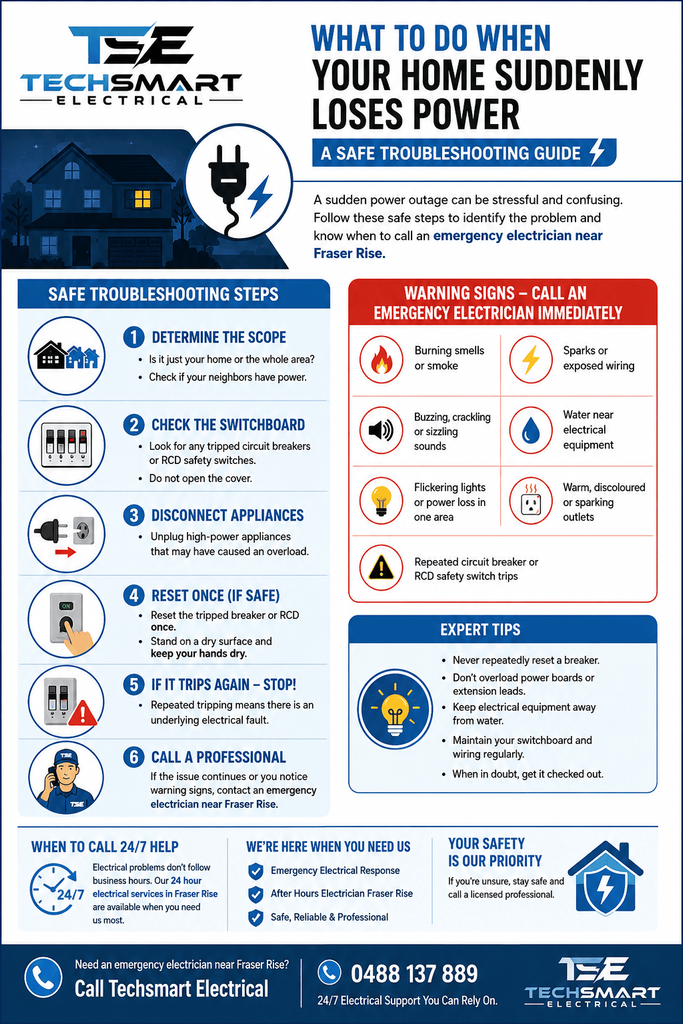
Safe Power Troubleshooting: A Practical Sequence
When faced with a sudden loss of electricity, use this sequence rather than randomly switching equipment on and off.
Step 1: Stay Calm and Assess
Determine whether the entire property or only part of it has lost power.
Step 2: Look for Obvious External Problems
From a safe position, determine whether surrounding properties also appear to be affected.
Never approach damaged electrical infrastructure.
Step 3: Check Your Switchboard Visually
Look for a visibly tripped circuit breaker or RCD safety switch.
Do not open the switchboard.
Step 4: Disconnect Suspected Appliances
If a particular appliance was operating immediately before the outage, unplug it if it can be done safely and without touching damaged equipment.
Step 5: Attempt One Safe Reset
If there are no warning signs and the device can be safely operated, a single reset may be appropriate.
Step 6: Stop if It Trips Again
Repeated tripping is useful diagnostic information. It indicates that something still needs attention.
Step 7: Arrange Professional Assistance
If the fault remains unresolved or warning signs are present, contact a qualified electrician.
This process is deliberately conservative. With electrical systems, avoiding an unsafe action is often more valuable than trying to restore power immediately.
24 Hour Electrical Services in Fraser Rise: When Timing Matters
Electrical problems rarely follow business hours.
A fault can occur late at night, early in the morning, during a weekend or while a household is preparing for work and school.
For situations that cannot safely wait until the next business day, 24 hour electrical services in Fraser Rise can provide an option for urgent electrical assessment.
An after hours electrician Fraser Rise homeowners call should be able to establish the nature of the problem, assess immediate risks and determine what work is required to make the electrical installation safe.
The goal of after-hours assistance should not simply be “getting the lights back on.”
The more important objective is identifying whether the electrical system can safely remain energised.
Common Mistakes Homeowners Make During an Outage
Repeatedly Resetting the Breaker
One of the most common mistakes is repeatedly resetting a breaker because the household needs the power restored.
If it trips again, treat that as information.
Repeated operation indicates that the underlying condition may still exist.
Assuming the Appliance Is Always at Fault
An appliance may be responsible, but it is not the only possibility.
The circuit, outlet, wiring or protective equipment may also require investigation.
Ignoring Burning Smells
A faint burning smell can be an early warning of overheating or damaged electrical components.
Do not wait for visible smoke before taking action.
Opening the Switchboard
A switchboard is not a DIY diagnostic panel.
Visual inspection of accessible controls is one thing. Removing covers and accessing internal components is another.
Using Extension Leads as a Permanent Solution
Extension leads can be useful temporarily, but they should not become a substitute for adequate fixed electrical installation.
Overloading power boards or extension leads can create additional hazards.
Assuming Flickering Lights Are Normal
Occasional changes caused by network conditions can happen, but persistent or unexplained flickering deserves attention.
It can sometimes be associated with loose connections, circuit problems, faulty equipment or supply issues.
Expert Advice: Treat the Breaker Trip as a Clue
One of the most useful habits an electrician can develop is to treat protective-device operation as diagnostic information.
A circuit breaker or RCD safety switch is telling you that it detected a condition requiring attention.
For example, imagine a family using a heater, kettle, microwave and several other appliances when the circuit suddenly trips. If the breaker remains stable after reducing the load, the situation may have involved circuit loading.
Now consider a different scenario: the breaker trips every time one particular appliance is connected. That pattern provides a much stronger indication that the appliance or its electrical connection may be involved.
Another scenario is even more concerning: the RCD trips randomly, including when appliances are disconnected. That can point toward an issue requiring professional testing.
The pattern matters.
Keep a Record of What Happened
If you need an electrician, useful information can make the initial assessment more efficient.
Note:
Do not attempt additional electrical testing simply to collect more information.
Your observations are enough.
When a Power Outage Becomes an Electrical Emergency
A power outage becomes more concerning when it is accompanied by physical evidence of electrical danger.
For example:
Normal troubleshooting situation:
The lights go out, the switchboard has a visibly tripped breaker, and there are no unusual smells, sounds or signs of damage.
Potential emergency:
The power goes out and you notice smoke, burning odour, exposed wiring, sparks or water around electrical equipment.
The second situation requires a fundamentally different response.
The priority is personal safety, not troubleshooting.
Move away from the hazard and seek appropriate professional or emergency assistance.
How to Prevent Future Electrical Problems
Not every power outage can be prevented, particularly those caused by external network issues. However, sensible electrical maintenance can reduce some household risks.
Practical measures include:
Preventive attention is particularly valuable when an issue appears minor but keeps returning.
A recurring electrical problem rarely becomes less important simply because the household has learned how to reset the switch.
Conclusion: Know What You Can Check—and When to Stop
A sudden loss of electricity does not always mean there is a major electrical problem. Sometimes a protective device has operated because of a temporary overload or faulty appliance. But a recurring outage, repeated circuit-breaker operation or unusual electrical symptoms should never be dismissed.
The safest approach is simple: observe, isolate what you safely can, avoid exposed or damaged electrical equipment, and know when to stop troubleshooting.
For a power outage Fraser Rise homeowners can approach safely, begin by determining the scope of the outage and checking the switchboard visually. If a circuit breaker or RCD safety switch trips again, treat it as a warning rather than repeatedly resetting it.
And when an electrical problem occurs outside normal hours, an after hours electrician Fraser Rise residents can access may be appropriate when the issue presents an immediate safety concern or cannot safely wait.
Good electrical troubleshooting is not about doing the most work yourself. It is about making the right decision at the right time—and recognising when professional emergency electrical response is the safest option.
FAQ: Sudden Power Loss in Fraser Rise
1. What should I do first if my entire house loses power?
First, determine whether the outage appears to affect only your property or a wider area. Then visually check your switchboard for a tripped circuit breaker or RCD safety switch without opening the switchboard.
If there are no signs of electrical danger, you may be able to perform one safe reset. If the device trips again, stop troubleshooting and arrange professional assistance.
If you notice smoke, burning smells, sparks, exposed wiring or water near electrical equipment, do not attempt a reset.
2. Why does my circuit breaker keep tripping?
A circuit breaker can trip because of an overloaded circuit, a faulty appliance, damaged wiring or another electrical fault.
The important point is that repeated tripping is not something to solve by repeatedly resetting the device. The breaker is operating as a protective mechanism.
An electrician can isolate the affected circuit, identify the source of the problem and determine what corrective work is necessary.
3. Is it safe to reset an RCD safety switch?
A homeowner may be able to reset an RCD safety switch if the switchboard is accessible, the area is dry, there is no visible damage and there are no signs of electrical danger.
However, if the RCD immediately trips again, do not keep resetting it.
Repeated operation means there may be an unresolved electrical condition that needs investigation. Never bypass or disable safety protection to keep a circuit operating.
4. When should I call an emergency electrician near Fraser Rise?
Professional help is appropriate when you cannot safely identify the cause of the outage, when a breaker or RCD repeatedly trips, or when there are signs of an electrical fault.
Urgent assistance is especially important where there is smoke, burning odour, sparking, exposed wiring, water near electrical equipment or significant storm-related damage.
An emergency electrician can assess the immediate risk and determine whether the electrical installation can safely remain energised.
5. What should I tell an after hours electrician Fraser Rise residents call?
Give the electrician as much factual information as possible without attempting additional electrical work.
Explain when the outage began, whether the entire property is affected, which appliances were operating, whether a breaker or RCD tripped, whether it stayed reset, and whether you noticed unusual smells, sounds, sparks, smoke or water. These details can help the electrician understand the situation before arriving and prepare for the appropriate diagnostic process.
Techsmart Electrical is a locally owned company serving Melbourne and the surrounding areas. As leading specialists for commercial, industrial and residential electrician services, we prioritize customer satisfaction.


We are preferred electricians for Beacon Lighting and with that comes many bonuses for our customers. By using Techsmart Electrical as your preferred electrician, we can provide you with up to 20% off RRP of everything in store at Beacon Lighting, extended warranties on certain items and even free lighting design consultations.
Our team works closely alongside our home store in Taylors Lakes to deliver the best possible outcome for all installations. From installing one ceiling fan to wiring an entire home, Techsmart Electrical provides 100% satisfaction guarantee.
Contact us today to arrange your next installation.
Techsmart Electrical has always provided dependable and cutting-edge electrical contracting services and installations. Our qualified electricians offer services that are intended to support Melbourne businesses in growing and to give homeowners complete peace of mind.
It is entirely up to you where you want more power outlets in your home. Techsmart Electrical can install them wherever you need them. It's possible that all you need is to change your power outlets, which is a regular request. Even your outdated power sockets can be replaced with fresh models by our team in order to give your house the finishing touches.
With several years of experience, Techsmart Electrical’s licenced electricians can design and install any power point system, whether it's for a newly constructed home or an existing one. Call us and schedule a time for your power socket installation.











Techsmart Electrical is a Melbourne based electrical company. We understand the importance of top-quality workmanship, service and safety. With a professional approach, we are always ready to provide you with Master Electricians to deliver prompt electrical services for any situation.