

A newly built home may look finished, with modern lighting, neatly installed power points and a clean switchboard. However, before accepting the keys, homeowners should confirm that the electrical installation has been completed, tested and documented correctly. Problems that are difficult to notice during a walkthrough can become expensive or inconvenient after moving in.
For homeowners preparing to move into a new property, understanding what to check before handover can make the process more straightforward. A qualified new home electrician Taylors Hill homeowners engage should be able to explain the installation, identify outstanding concerns and clarify which compliance documents apply to the completed work.
This guide explains what to look for during a new-build electrical inspection, how switchboards and circuit protection should be checked, which questions to ask the builder, and what to do if something appears incomplete. It also explains how new home electrical installation Taylors Hill requirements fit into the wider handover process.
The goal is not to encourage homeowners to inspect electrical wiring themselves. Instead, it is to help you ask informed questions, recognise potential warning signs and obtain the appropriate evidence before treating the property as ready for occupation.
Electrical compliance is about more than whether lights turn on and power outlets work. A new electrical installation must meet the applicable safety requirements, be suitable for its intended use and be completed by appropriately licensed professionals.
In Victoria, electrical installation work is governed by relevant state legislation, regulations and applicable Australian Standards. Requirements can depend on the type of work, the installation date and the equipment involved.
For a homeowner, this matters because a property can appear finished without every electrical detail being verified. For example, a bedroom light may operate normally even if the circuit labelling is unclear or a required document has not been provided.
Before handover, homeowners should establish:
A professional Taylors Hill Electrician can help homeowners understand these points and determine whether an independent inspection is appropriate.
The most useful approach is to separate visible checks from technical verification and documentation.
Visible checks help identify incomplete work. Technical verification requires appropriate testing by a qualified electrician. Documentation confirms that the relevant procedures have been completed and records are available.
These are related but different parts of the handover process. A tidy installation does not automatically prove compliance, and paperwork should not replace a physical assessment when there are specific concerns.
One of the most important handover tasks is confirming that the correct electrical records are available. In Victoria, the key document is the Certificate of Electrical Safety (COES).
Energy Safe Victoria explains that a COES records the electrical work performed and helps establish accountability for that work. A certificate is required for electrical installation work, with inspection requirements depending on whether the work is prescribed or non-prescribed.
A COES records details such as the electrical work undertaken, the responsible electrical worker and the property involved. Homeowners should check that the address and other relevant details are correct.
For a new home, ask the builder or electrical contractor for the certificates associated with the installation. If the builder engaged the electrician on your behalf, you can request copies through the appropriate party.
Your handover document checklist should include:
Not every item on this list is a statutory electrical certificate requirement. Some are practical handover records that make the property easier to operate and maintain.
Not all electrical work follows the same inspection process. In Victoria, prescribed work includes certain work involving consumer mains, the main switchboard, the meter box and the main earthing system. Prescribed work must be independently inspected by a Licensed Electrical Inspector before the relevant certificate is finalised. Other work, such as ordinary lighting and power-point installation, generally follows the non-prescribed certification process.
This distinction is important because homeowners should not assume that every socket, light fitting or circuit requires a separate independent inspection.
Ask the builder these questions:
If a required certificate or inspection cannot be confirmed, seek clarification before treating the electrical handover as complete.
The switchboard is one of the most important parts of a new home’s electrical installation. It distributes electricity to different circuits and houses protective devices intended to reduce electrical risks.
A switchboard may look modern and neatly labelled, but its appearance alone does not establish that it has been installed and tested correctly.
During the handover walkthrough, ask the builder or electrician to explain the following:
Do not remove the switchboard cover or touch internal components to check the installation. Electrical testing and internal inspection should be left to a suitably qualified professional.
Different protective devices serve different purposes. Circuit breakers protect circuits against certain overcurrent conditions, while residual current devices help reduce the risk of electric shock by detecting particular types of current leakage.
These functions are not interchangeable. A circuit breaker should not be assumed to provide the same personal shock protection as an RCD.
For example, if a kitchen circuit supplies several appliances, its protection must be suitable for the circuit design and connected load. A professional checks the installation against applicable requirements rather than relying on the fact that the appliances switch on.
Ask for a demonstration of the normal operating arrangements, including how to respond if a protective device trips. Follow the electrician’s instructions and do not repeatedly reset a device that continues to trip.
Much of a home’s wiring is concealed inside walls, ceilings and roof spaces. That makes it difficult for an owner to assess the quality of the installation through a visual walkthrough alone.
A professional assessment may involve reviewing accessible wiring, checking connections and carrying out electrical tests appropriate to the installation. The exact procedures depend on the work completed and the concerns being investigated.
Walk through every room and compare the installed electrical points with your approved plans and selections.
Check whether:
Pay particular attention to areas that may be overlooked during a quick inspection, such as the pantry, garage, laundry, study, outdoor entertaining area and locations intended for refrigerators or washing machines.
Imagine that your new home has a study with only one conveniently located double outlet. Once the computer, monitor, printer, router and desk lighting are connected, the available outlets may not suit the layout.
This does not automatically mean the electrical installation is non-compliant. It may instead indicate that the original design does not meet your practical needs.
Before handover, compare the actual installation with your electrical selections. If you requested extra outlets, confirm that they have been installed and that any agreed changes are documented.
Avoid using a large number of extension leads as a permanent substitute for suitable outlet placement. If changes are needed, ask a licensed electrician to assess the options.
Homeowners should not attempt to verify cable sizes, junctions, earthing connections or wiring routes themselves. These are technical matters requiring appropriate knowledge, access and testing.
If you have concerns about concealed wiring, ask for the relevant installation records and arrange a professional assessment. Photographs taken during construction may also help explain the locations of concealed services for future renovations.
Lighting affects safety, comfort and how effectively each room can be used. A new home should be checked against the agreed lighting schedule rather than simply judged by whether the lights turn on.
During the walkthrough, operate the switches and confirm that the expected lights respond correctly.
Review:
Check whether fittings are secure and whether there are obvious signs of damage, flickering or unusual operation. Report these concerns instead of attempting repairs.
A frequent source of handover confusion is the difference between the original electrical plan and the final installation. A selected pendant may have been replaced with a standard fitting, or an exterior sensor light may be missing from the completed work.
Review the contract, electrical selections and approved variations. Record discrepancies in writing and ask the builder to explain whether the item is incomplete, substituted or excluded from the agreed scope.
For the best result, evaluate both compliance and functionality. A fitting can operate correctly while still differing from the product or location you approved.
A new-build electrical inspection can help clarify whether the installation has been completed appropriately and whether particular concerns need further investigation. However, the term can refer to different types of assessment, so homeowners should understand what is included before arranging one.
A statutory inspection of prescribed electrical work is not necessarily the same as a separate, owner-requested inspection of the wider installation. The scope of any additional assessment should be agreed with the electrician.
Depending on the purpose and scope, a qualified electrician may:
The inspection should be appropriate to the property and the specific work being assessed. A brief visual walkthrough cannot establish the condition of every concealed cable or connection.
Consider asking about an independent assessment if:
An additional inspection does not automatically replace statutory inspection requirements, certification or the builder’s contractual responsibilities.
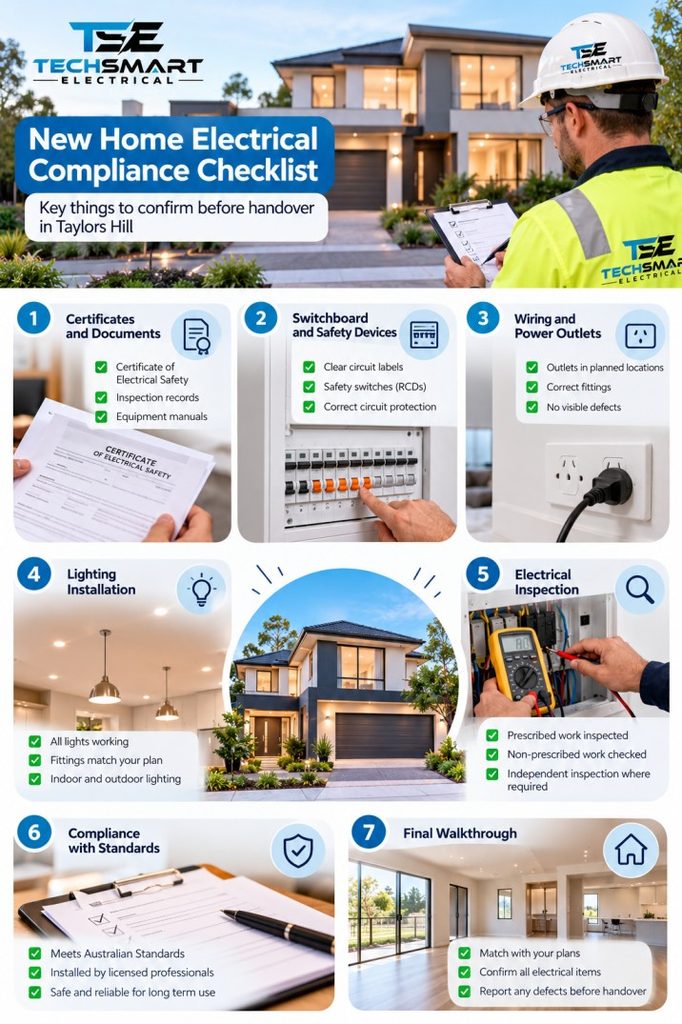
Electrical compliance should be considered alongside the wider construction handover. Homeowners need to understand what the builder agreed to deliver, which electrical tasks were completed and who is responsible for resolving outstanding items.
In Victoria, electrical work must be undertaken by appropriately licensed workers, and the required Certificate of Electrical Safety must be issued. For prescribed work, the required independent inspection is part of the certification process.
If you notice a missing fitting, incorrect switch location or other concern, record it clearly.
A useful defect list includes:
For example, rather than writing “bedroom lights are wrong”, specify that the second bedside switch shown on the approved electrical plan is missing. This gives the builder a clear issue to investigate.
Separate cosmetic concerns from safety concerns. A scratched switch plate and a damaged electrical fitting are not equivalent issues. If you suspect an immediate electrical hazard, keep people away and seek urgent assistance from a qualified professional.
Ask which inspection or test the statement refers to and request the relevant documentation. A general assurance that the property has passed its checks does not tell you whether a particular fitting, variation or concern was examined.
A clear answer should identify the relevant work, the responsible professional and the supporting records where applicable.
If an issue remains unresolved, communicate in writing and consult your building contract or the relevant Victorian building and electrical safety authorities for guidance.
Even careful homeowners can overlook important details when they are focused on settlement, furniture deliveries and moving arrangements.
Avoid these common mistakes.
Assuming that working lights mean full compliance. Functional lights and outlets are only one part of the assessment. Testing, protection, installation quality and documentation also matter.
Accepting verbal assurances without records. Ask for the relevant electrical certificates and confirmation of required inspections. Keep copies with your building documents.
Checking only the main living areas. Walk through the garage, laundry, pantry, bathrooms, bedrooms and outdoor spaces as well.
Ignoring small differences from the electrical plan. A missing outlet or substituted fitting may be easy to miss when furniture has not yet arrived. Check the approved selections before handover.
Treating every inspection as equivalent. A visual walkthrough, an independent inspection of prescribed work and a broader owner-requested electrical assessment have different purposes.
Attempting DIY electrical tests. Do not remove switchboard covers, access wiring or dismantle fittings. Ask a licensed professional to investigate technical concerns.
A structured approach makes it easier to identify issues and obtain clear answers.
Keep your electrical plans, lighting schedule, appliance specifications and approved variations together. This gives you a reference when checking the completed installation.
Where it is safe, operate normal switches and controls during the walkthrough. Confirm that lighting zones, dimmers, fans and other agreed features work as expected.
Leave electrical testing, fault diagnosis and work inside switchboards to the electrician.
Request a demonstration of the normal controls and an explanation of the circuit labels. Ask which protective devices serve important areas and what you should do if a device trips.
Planning electrical work for a new home? TechSmart Electrical helps Taylors Hill homeowners understand wiring, lighting, power points, switchboard requirements, and essential electrical safety considerations for modern homes.
If the plans include provision for an electric vehicle charger, solar system, battery, air conditioning or other future equipment, ask what has actually been installed and what remains only a provision.
A spare space in a switchboard does not, by itself, establish that a future installation is fully supported. Capacity, circuit arrangements and other technical requirements must be assessed by an electrician.
Store certificates, manuals, warranties, electrical plans, defect correspondence and relevant inspection records in one place. These records can help if you need maintenance, renovations or future fault-finding.
Homeowners seeking new home electrician Taylors Hill guidance should prioritise clear explanations, appropriate licensing and verifiable documentation rather than relying on appearance alone.
Electrical handover is an important opportunity to confirm that your new home is ready for everyday use and that the relevant safety records are available. Looking beyond whether the lights turn on can help you identify missing fittings, unclear documentation and unresolved concerns before moving in.
Focus on five essentials: the applicable electrical certificates, required independent inspections, switchboard and circuit protection, wiring and outlet placement, and the lighting installation specified in your plans. Record discrepancies clearly and ask the builder or electrician to explain anything you do not understand.
A careful handover supported by appropriate professional checks gives you a stronger starting point for maintaining your home’s electrical system.
If you are preparing to move into a new property, a qualified new home electrician Taylors Hill homeowners consult can help clarify outstanding concerns and explain the relevant testing and documentation. Confirming these details early can make the transition into your new home safer and more straightforward.
Ask for the applicable Certificate of Electrical Safety, confirmation of any required independent inspection and relevant equipment manuals or warranties. You should also request available electrical plans, circuit information and records of agreed variations.
In Victoria, the COES is a legal document associated with electrical installation work. The applicable inspection and certificate process depends on the type of work performed. If the builder arranged the electrician, ask the builder for the relevant records and clarify how you can obtain copies.
No. The requirement depends on the type of electrical work. Certain prescribed work, including specified work involving consumer mains, the main switchboard and the main earthing system, requires an independent inspection by a Licensed Electrical Inspector. Other work, such as ordinary lighting and power-point installation, generally does not require that same independent inspection for certification.
Homeowners should ask the builder or electrical contractor which prescribed work was completed and obtain confirmation that the applicable inspection requirements have been met.
A homeowner can check that the switchboard appears undamaged, has its cover fitted, is accessible and has understandable circuit labels. However, these visible checks cannot confirm that the installation is electrically safe.
A qualified electrician can assess the installation, check the suitability of protective devices and perform the required tests. Ask the electrician to explain the main switch, circuit breakers and safety switches, including what to do if a protective device trips repeatedly. Never remove the switchboard cover or touch internal components yourself.
Compare the completed installation with your approved electrical plans, contract and any signed variations. Record each discrepancy, identify the room and item involved, and notify the builder in writing.
For example, if an outdoor power outlet was included in the approved selections but is missing at handover, ask the builder to confirm whether it is outstanding work or an agreed variation. If the issue involves suspected unsafe wiring or damaged electrical equipment, keep clear of the affected area and seek professional advice rather than attempting a repair.
Consider an additional assessment when certification is unclear, visible defects remain unresolved, the installation differs from the agreed specifications or you want an independent professional to investigate a specific concern.
A suitable electrical inspection Taylors Hill homeowners arrange should have a clearly defined scope. Ask whether the assessment includes visual checks, relevant electrical testing, documentation review and a written record of findings. Remember that an additional inspection does not replace any statutory inspection or certification required for the work.
Techsmart Electrical is a locally owned company serving Melbourne and the surrounding areas. As leading specialists for commercial, industrial and residential electrician services, we prioritize customer satisfaction.


We are preferred electricians for Beacon Lighting and with that comes many bonuses for our customers. By using Techsmart Electrical as your preferred electrician, we can provide you with up to 20% off RRP of everything in store at Beacon Lighting, extended warranties on certain items and even free lighting design consultations.
Our team works closely alongside our home store in Taylors Lakes to deliver the best possible outcome for all installations. From installing one ceiling fan to wiring an entire home, Techsmart Electrical provides 100% satisfaction guarantee.
Contact us today to arrange your next installation.
Techsmart Electrical has always provided dependable and cutting-edge electrical contracting services and installations. Our qualified electricians offer services that are intended to support Melbourne businesses in growing and to give homeowners complete peace of mind.
It is entirely up to you where you want more power outlets in your home. Techsmart Electrical can install them wherever you need them. It's possible that all you need is to change your power outlets, which is a regular request. Even your outdated power sockets can be replaced with fresh models by our team in order to give your house the finishing touches.
With several years of experience, Techsmart Electrical’s licenced electricians can design and install any power point system, whether it's for a newly constructed home or an existing one. Call us and schedule a time for your power socket installation.












Techsmart Electrical is a Melbourne based electrical company. We understand the importance of top-quality workmanship, service and safety. With a professional approach, we are always ready to provide you with Master Electricians to deliver prompt electrical services for any situation.