

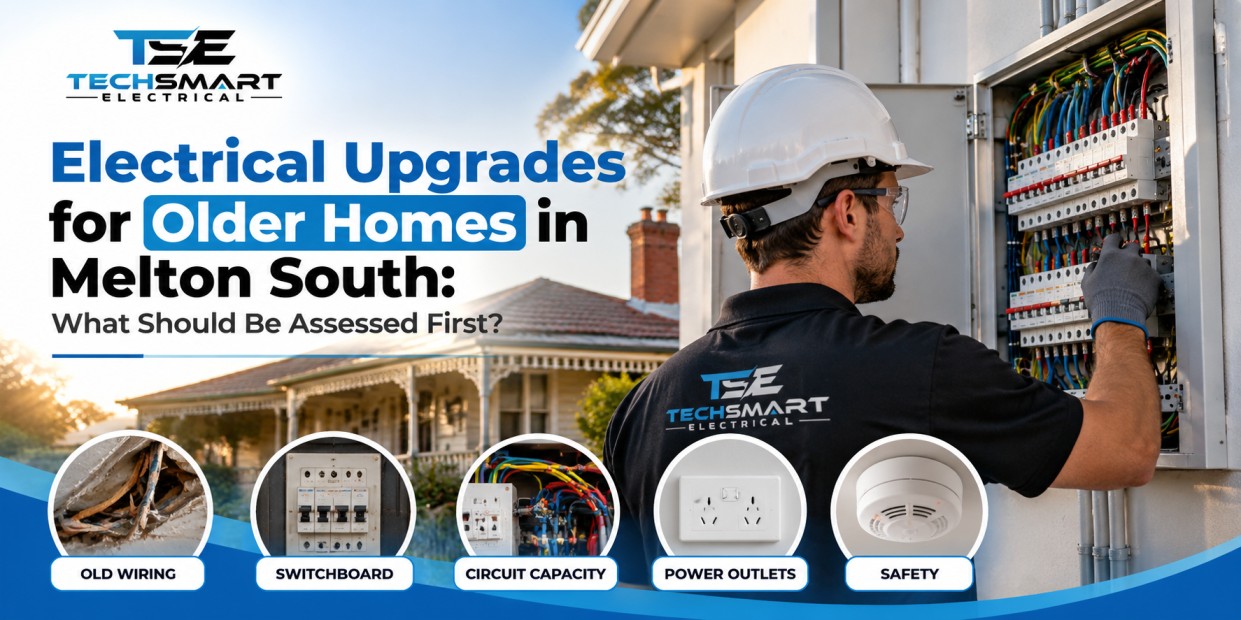
Older homes can have plenty of character, but their electrical systems may not have been designed for the appliances, heating and cooling equipment, home offices, and charging devices used today. If you own an established property in Melton South, understanding the condition of its wiring, switchboard, and electrical circuits is an important step towards maintaining a safe and functional home.
Planning electrical upgrades for Melton South homeowners can prioritise starts with identifying potential hazards rather than immediately replacing equipment. A house might have modern light fittings but still contain deteriorated wiring, inadequate circuit protection, or electrical connections that need attention.
The most effective approach is to assess the existing installation, identify urgent safety concerns, and then plan improvements around the property’s actual electrical demands. Understanding electrical safety upgrades for homes in Melton South can help homeowners make better decisions before renovating, purchasing older property, or installing new appliances.
This guide explains what should be checked first, which warning signs deserve attention, and how to plan electrical improvements without spending money on unnecessary work.
Electrical systems age differently depending on their original installation, the materials used, maintenance history, environmental conditions, and changes made over the years. The age of a property alone does not prove that its wiring is unsafe, but it does make an assessment worthwhile.
For example, a house may have been built with a modest number of power points and lighting circuits. Over time, the occupants may have added air conditioning, additional kitchen appliances, computers, televisions, and outdoor equipment. The electrical installation may no longer suit the household’s needs.
Older installations can also contain deteriorated insulation, outdated switchboards, damaged accessories, or modifications that were not completed correctly.
Energy Safe Victoria recommends having older household wiring checked by a qualified electrical professional, particularly in homes built before the 1980s. It also identifies flickering lights, damaged outlets, old switchboards, and sparking electrical fittings as warning signs that should be investigated.
The objective is not to replace everything simply because it is old. It is to determine what is safe, what is inadequate, and what requires repair or upgrading.
Wiring condition should be one of the first priorities when assessing an older property. Most electrical cables are concealed inside walls, ceilings, roof spaces, or under floors, meaning visible fittings alone cannot establish the condition of the complete installation.
A licensed electrician may investigate:
Some older cables used insulation materials that can deteriorate with age. If insulation breaks down, the risk of electric shock, short circuits, and electrical fires can increase.
Homeowners should never remove wall plates, enter unsafe roof spaces, or handle exposed cables to investigate these problems themselves.
A professional wiring assessment may include a visual examination of accessible wiring, electrical testing, checks of circuit protection, and investigation of reported faults. The precise scope depends on the property’s layout, accessibility, condition, and previous electrical work.
Consider a hypothetical example: a homeowner notices intermittent lighting problems in a bedroom. Replacing the light fitting may not solve the underlying issue if the actual cause is a loose connection or deteriorated wiring. Proper investigation helps identify the fault before deciding which repair is appropriate.
When arranging electrical upgrades in Melton South, ask the electrician to explain any identified wiring defects, the evidence supporting the recommendation, and whether the issue requires immediate attention or can be scheduled as planned maintenance.
The switchboard distributes electricity to household circuits and contains protective devices that help manage electrical faults and overloads. Its condition is a major consideration when assessing older electrical installations.
A switchboard that appears old is not automatically unsafe. However, outdated equipment, missing protection, damaged components, poor labelling, or insufficient space for additional circuits may justify further investigation.
A professional assessment may examine:
These devices perform different functions.
A circuit breaker is designed to disconnect a circuit when an overload or short circuit occurs. A safety switch, also known as a residual current device (RCD), monitors electrical current and disconnects power when it detects a potentially dangerous imbalance.
Neither device eliminates every electrical risk. Protection depends on correct installation, suitable coverage, proper operation, and the condition of the wider electrical system.
An electrician can establish which circuits have safety-switch protection and whether improvements are appropriate. Homeowners should not assume that one safety switch protects every circuit in the house.
Energy Safe Victoria provides guidance on identifying and testing household safety switches. It recommends testing them every three months and contacting a licensed electrician if a switch does not operate correctly.
A switchboard upgrade may therefore involve more than replacing an old enclosure. It may provide an opportunity to improve circuit protection, organisation, and capacity where the existing installation requires it.
An older electrical installation may have been adequate for the household’s original needs but become less suitable as electricity consumption increases.
Modern households can operate several high-demand appliances at the same time, including electric ovens, induction cooktops, air conditioners, clothes dryers, washing machines, and other equipment.
The key question is whether the existing circuits and overall supply are suitable for the expected load.
Look for recurring problems such as:
These symptoms do not automatically mean the entire electrical installation needs replacement. A tripping circuit, for instance, may indicate an overloaded circuit, a faulty appliance, or another electrical fault.
The electrician needs to determine the cause before recommending an upgrade.
Think beyond the appliances currently installed. If you are renovating a kitchen, adding an outdoor entertainment area, or planning a home office, discuss those requirements during the assessment.
A professional can review existing circuit loads, protective devices, supply arrangements, and proposed equipment. Some homes may need additional circuits, while others may require a broader switchboard or supply-capacity upgrade.
For example, installing a new air conditioner and an electric cooking appliance could create different requirements from simply adding a few LED lights. The appropriate solution depends on the equipment specifications and the existing installation.
This is an important part of electrical safety upgrades for homes in Melton South: matching the electrical system to actual and anticipated demand rather than assuming every older home needs the same upgrade.
Insufficient or poorly positioned power outlets can lead to everyday inconvenience and unsafe workarounds. Homeowners may rely on multiple adaptors, extension leads, or power boards to operate equipment in rooms that were not designed for modern electrical use.
A power outlet assessment should consider both the condition of existing fittings and how the household uses each room.
An electrician can check for:
Stop using an outlet if it sparks, smells burnt, becomes unusually hot, or shows visible damage. If it is safe to do so, stop using the affected equipment and keep people away from the area. Do not remove the outlet cover or attempt repairs. Seek urgent assistance from a licensed electrician; if there is smoke or an active fire, move to safety and contact emergency services.
A practical assessment considers how the property functions rather than simply counting the number of sockets.
For example:
The correct placement, circuit arrangements, and required protection depend on the location and intended use. A qualified electrician can recommend an arrangement that reduces reliance on extension leads and supports safe everyday use.
Some electrical problems can be included in a planned upgrade. Others require prompt action because they may indicate an immediate hazard.
Pay attention to:
A single symptom may have several possible causes. Do not assume that a problem is harmless because the power appears to return to normal.
If an electrical fitting is smoking, sparking heavily, or associated with an active fire, move away and contact emergency services. Do not touch the affected equipment or approach a potentially energised area.
For less immediate but persistent problems, arrange an assessment rather than repeatedly resetting a protective device. If a breaker or safety switch continues to trip, the underlying fault needs investigation.
Energy Safe Victoria also advises against DIY electrical work. In Victoria, household electrical installation work must be undertaken by appropriately licensed or registered professionals as required by the applicable rules.
Lighting upgrades are often considered cosmetic improvements, but the electrical condition of the fittings, connections, and associated circuits also matters.
Older homes may contain a mixture of original fittings and later additions. Some may have been installed during renovations without a comprehensive review of the wider electrical system.
An electrician can assess the condition of accessible fittings, switches, connections, and relevant circuit protection. Where necessary, the assessment may include checks of wiring concealed behind fittings.
When planning lighting improvements, consider:
LED lighting can reduce lighting energy consumption compared with less efficient alternatives, but the suitability of a conversion depends on the existing fittings, drivers, controls, and wiring.
A lighting refresh should not distract from a more serious wiring defect or switchboard issue. Where safety concerns exist, address those findings before focusing on appearance.
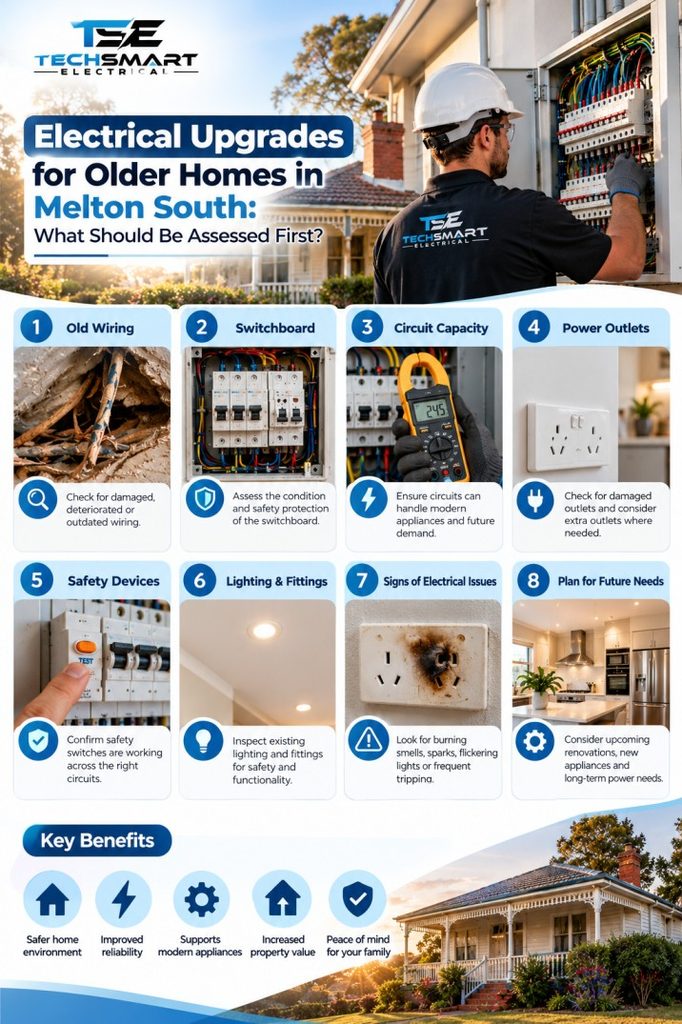
Not every recommended improvement needs to be completed at the same time. A structured plan helps homeowners understand the difference between immediate hazards, necessary upgrades, and optional improvements.
A useful assessment report should explain the defect, the associated risk, the recommended action, and any dependencies between items.
Examples include exposed live conductors, serious overheating, damaged equipment presenting a shock risk, or a confirmed dangerous wiring fault.
These concerns need urgent professional attention. The electrician may need to isolate affected equipment or circuits until the installation is made safe.
Once immediate hazards are controlled, address defects involving inadequate protection, deteriorated wiring, damaged outlets, unsafe connections, or unsuitable circuit arrangements.
The actual priority depends on the findings and the applicable safety requirements.
Plan additional circuits, switchboard changes, or supply upgrades where required to support appliances, renovations, or increased household demand.
These improvements should be based on a load assessment and the specifications of the proposed equipment.
Additional outlets, improved lighting layouts, and other functional improvements can then be planned around the household’s needs.
This approach makes electrical upgrades Melton South homeowners undertake more targeted. It avoids treating cosmetic changes as a substitute for resolving underlying electrical risks.
A little preparation can help the electrician understand the property’s history and provide more useful recommendations.
Before the visit, gather any available records of previous electrical work, renovation details, appliance installations, and known faults.
Make a list of problems such as recurring trips, flickering lights, outlets that no longer work, or rooms where extension leads are frequently used.
Also identify any planned changes, including:
Do not open the switchboard or remove fittings to collect information. Simply describe what you have noticed and allow the electrician to conduct the necessary checks safely.
Ask for recommendations to be separated into urgent repairs, required upgrades, and optional improvements. If multiple options are suitable, request an explanation of their benefits, limitations, and implications for future electrical demand.
For a homeowner comparing a
or a residential electrician in Melton South, it is sensible to verify the professional’s current licence or registration, confirm the proposed scope of work, and ask what documentation will be provided when the work is completed.
New switches and light fittings can improve appearance, but they do not establish that concealed wiring is in good condition. Investigate warning signs and known defects before concentrating on cosmetic improvements.
Circuit breakers and safety switches have different functions. An installation needs suitable protection for the circuits and risks involved.
An extra appliance may be perfectly suitable for a property, but its electrical requirements need to be considered alongside the existing installation.
Age is a reason to assess equipment, not proof that every component must be replaced. Recommendations should reflect the actual condition, protective arrangements, proposed loads, and applicable requirements.
Even apparently small electrical jobs can expose people to dangerous voltages. Do not attempt to replace outlets, alter wiring, or modify switchboard components yourself.
Two quotations may cover different work. Compare the inspection findings, proposed equipment, circuit coverage, testing, certification, and exclusions rather than looking only at the total price.
The most useful electrical improvement plan is based on evidence and the way the home is used.
Start with a documented assessment. Ask for the condition of the wiring, switchboard, circuit protection, and outlets to be explained in clear terms. Where a problem is identified, find out what was observed or tested.
Coordinate upgrades with renovations. Electrical work may be easier to plan when wall openings, kitchen cabinetry, or ceiling changes are already scheduled. However, renovation convenience should never delay urgent safety repairs.
Think about future loads. Tell the electrician about equipment you may install over the next several years. A suitable design can reduce the need for avoidable alterations later, although future requirements and costs cannot always be predicted precisely.
Request appropriate completion records. In Victoria, electrical contractors must provide the relevant Certificate of Electrical Safety for work to which the requirements apply. Certain prescribed work, including replacement of a residential main switchboard, also requires inspection before the installation can be re-energised. Confirm the applicable requirements with the contractor.
Do not ignore small changes in behaviour. A previously reliable outlet that becomes discoloured, a switch that starts buzzing, or a circuit that begins tripping can indicate a developing problem. Record what happens and arrange appropriate professional investigation.
TechSmart Electrical can be considered as part of a homeowner’s research when exploring electrical improvement options. Regardless of the provider selected, the essential starting point remains the same: establish the existing installation’s condition, understand the risks, and base upgrade decisions on professional findings rather than assumptions.
For older homes, the most sensible electrical upgrade plan begins with safety and condition, not appearance. Wiring, switchboard condition, safety-switch coverage, circuit capacity, and the state of existing outlets should be assessed before optional improvements are prioritised.
Homeowners planning electrical upgrades in Melton South should also consider their property’s future needs, particularly when renovating or installing additional electrical appliances. A clear assessment can help distinguish urgent repairs from capacity improvements and convenience upgrades.
The goal of electrical safety upgrades for homes in Melton South is not to replace every older component unnecessarily. It is to identify hazards, correct defects, improve protection where needed, and ensure the electrical installation is suitable for how the household operates.
TechSmart Electrical is a brand homeowners may wish to consider when researching their next steps. Before proceeding with any work, seek an assessment from an appropriately licensed electrical professional, ask for clear recommendations, and ensure the completed work meets the applicable Victorian requirements.
Start with the condition of the wiring, the switchboard, safety-switch coverage, and the operation of existing circuits. The electrician should investigate known faults and warning signs before recommending optional improvements. If there is evidence of exposed wiring, burning smells, sparking, or electric shocks, treat the situation as a safety concern rather than waiting for a routine upgrade.
Age alone does not determine whether wiring needs replacement. Warning signs can include deteriorated insulation, exposed conductors, repeated electrical faults, overheating, and evidence of unsuitable previous alterations. Some problems may require targeted repairs, while widespread deterioration can justify broader rewiring. A licensed electrician should assess the installation and explain the findings before you decide on the appropriate scope of work.
An upgrade may be appropriate if the existing board is damaged, has unsuitable protective equipment, lacks necessary safety-switch coverage, or cannot accommodate required additional circuits. New appliances and renovation plans can also affect the decision. However, not every older switchboard requires complete replacement. The recommendation should be based on the board’s condition, protection arrangements, capacity, and applicable electrical requirements.
Arrange an assessment when buying an older property, planning renovations, adding major appliances, noticing recurring electrical faults, or discovering damaged electrical fittings. An assessment is also sensible when the history of previous electrical work is unknown. Do not wait for a renovation if you notice serious warning signs such as smoke, exposed wiring, or burning smells; seek appropriate urgent assistance.
Electrical installation work should be undertaken by appropriately licensed or registered professionals in accordance with Victorian requirements. Before work begins, verify the contractor’s credentials, discuss the scope and testing requirements, and ask which certificates or inspection arrangements apply. Never attempt to carry out wiring, switchboard, or power-outlet alterations yourself. Professional assessment and appropriate documentation help homeowners understand what has been repaired, upgraded, and verified.
Techsmart Electrical is a locally owned company serving Melbourne and the surrounding areas. As leading specialists for commercial, industrial and residential electrician services, we prioritize customer satisfaction.


We are preferred electricians for Beacon Lighting and with that comes many bonuses for our customers. By using Techsmart Electrical as your preferred electrician, we can provide you with up to 20% off RRP of everything in store at Beacon Lighting, extended warranties on certain items and even free lighting design consultations.
Our team works closely alongside our home store in Taylors Lakes to deliver the best possible outcome for all installations. From installing one ceiling fan to wiring an entire home, Techsmart Electrical provides 100% satisfaction guarantee.
Contact us today to arrange your next installation.
Techsmart Electrical has always provided dependable and cutting-edge electrical contracting services and installations. Our qualified electricians offer services that are intended to support Melbourne businesses in growing and to give homeowners complete peace of mind.
It is entirely up to you where you want more power outlets in your home. Techsmart Electrical can install them wherever you need them. It's possible that all you need is to change your power outlets, which is a regular request. Even your outdated power sockets can be replaced with fresh models by our team in order to give your house the finishing touches.
With several years of experience, Techsmart Electrical’s licenced electricians can design and install any power point system, whether it's for a newly constructed home or an existing one. Call us and schedule a time for your power socket installation.












Techsmart Electrical is a Melbourne based electrical company. We understand the importance of top-quality workmanship, service and safety. With a professional approach, we are always ready to provide you with Master Electricians to deliver prompt electrical services for any situation.