

A circuit breaker that keeps tripping is more than an annoying interruption. It is often your electrical system’s way of warning you that something is wrong. The breaker may be responding to excessive electrical load, a damaged appliance, a short circuit, or another electrical fault that could become dangerous if ignored.
If you are searching for a circuit breaker keeps tripping fix Aintree, the first step is to understand why the breaker is operating before attempting to restore power. Resetting it repeatedly without finding the cause can make a small electrical problem harder to diagnose and may increase the risk of overheating, equipment damage, or electric shock.
For homeowners and tenants in Aintree, knowing the difference between a one-off overload and a recurring electrical problem can help you decide when basic troubleshooting is reasonable and when an Aintree Electrician should investigate the circuit.
This guide explains the most common causes of a tripping circuit breaker, what you can safely check, what you should never attempt yourself, and when circuit breaker repair Aintree should be handled by a licensed electrical professional.
Understanding the Circuit Breaker
A circuit breaker is a protective switching device installed in an electrical distribution board. Its primary purpose is to interrupt electrical current when a circuit experiences conditions that could make the wiring or connected equipment unsafe.
Under normal conditions, electricity flows through a circuit within its designed limits. When current becomes excessive or a fault occurs, the breaker trips and disconnects the supply.
This protection can help prevent:
A breaker tripping does not necessarily mean that the breaker itself is defective. In many cases, it is functioning exactly as intended.
That distinction is important. Replacing a breaker without identifying the underlying problem may only hide the warning rather than solve it.
Circuit Breaker: Why Does It Keep Tripping?
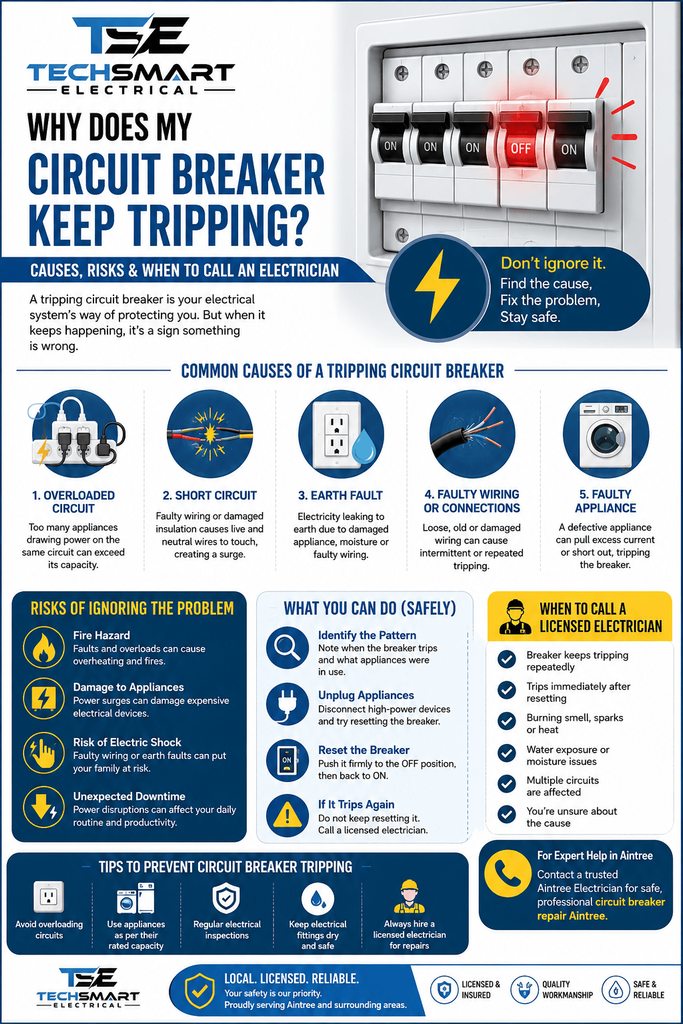
There are several reasons a circuit breaker may trip repeatedly. The pattern of the trip often provides useful clues.
For example, a breaker that trips immediately when a particular appliance is switched on points toward a different problem than one that trips after several hours of normal use.
Common causes include:
Understanding these possibilities makes troubleshooting more logical and helps prevent unsafe trial and error.
Overloaded Circuit: A Common Cause of Tripping Power
An overloaded circuit occurs when the electrical demand placed on a circuit exceeds what the circuit can safely handle.
Consider a kitchen where a kettle, microwave, toaster, portable heater and other high-demand appliances are operating from the same circuit. Each appliance may work normally on its own, but using several of them simultaneously can create excessive current demand.
The breaker may then trip to protect the wiring.
Signs of an overloaded circuit
You may notice:
A practical example is a homeowner using a portable heater and several kitchen appliances during winter. The breaker may remain on when only one appliance is operating but trip when multiple high-load devices are used together.
In this situation, repeatedly resetting the breaker is not the solution. Reducing the load may stop the immediate tripping, but a recurring problem may indicate that the circuit needs assessment.
Short Circuit: When the Breaker Trips Immediately
A short circuit is a more serious electrical condition. It can occur when conductors that should remain electrically separated come into contact, creating a very low-resistance path for current.
This can cause a large current to flow very quickly.
A breaker may trip almost immediately when the fault occurs.
Potential causes include:
For example, if a damaged appliance has an internal fault, plugging it into an outlet and switching it on may cause the breaker to trip instantly.
Do not repeatedly switch the appliance on to “test” whether it works. Disconnect the appliance if it is safe to do so and leave further investigation to a qualified electrician.
A short circuit can create heat and arcing, so it should not be treated as a minor inconvenience.
Earth Fault: A Different Type of Electrical Problem
An earth fault occurs when electrical current takes an unintended path to earth. Depending on the equipment and protection installed, this can cause protective devices to operate.
Earth faults can be associated with:
Outdoor areas deserve particular attention because electrical equipment may be exposed to rain, condensation, irrigation or other sources of moisture.
If the electrical problem began after heavy rain or water exposure, avoid using affected equipment until it has been properly assessed.
An earth fault is not something to diagnose by opening outlets, switches or the electrical distribution board yourself. Electrical testing equipment and appropriate technical knowledge are required to establish what is happening safely.
Electrical Faults Can Develop Gradually
Not every electrical fault appears suddenly.
A circuit may operate normally for months or years before intermittent tripping begins. This can happen as equipment ages, insulation deteriorates, connections loosen, or an appliance develops an internal fault.
Intermittent problems can be particularly frustrating because the circuit may work normally when an electrician arrives.
If the breaker has been tripping repeatedly, keep track of the circumstances.
Record:
These observations can provide valuable diagnostic information to an electrician.
What to Do When Your Circuit Breaker Trips
If a breaker trips once and there are no signs of an electrical emergency, you can take a few basic precautions.
1. Stop and look for obvious warning signs
Before attempting anything, check for signs such as:
If you notice any of these signs, do not continue troubleshooting. Keep clear of the affected equipment and arrange for qualified electrical assistance.
If there is smoke or fire, follow appropriate emergency procedures and contact emergency services where necessary.
2. Identify what was operating
Think about what happened immediately before the breaker tripped.
Was a heater switched on? Had several kitchen appliances been running? Did the trip occur when a particular device was connected?
This information can help distinguish a potential overload from an appliance-related fault.
3. Disconnect suspect appliances
If you can safely identify a particular appliance without touching damaged components or exposed wiring, switch it off and disconnect it from the power point.
Do not use equipment that has:
4. Do not repeatedly reset the breaker
One of the most common mistakes homeowners make is repeatedly resetting the breaker whenever it trips.
If it trips again, treat that as useful information rather than simply an inconvenience.
Repeated operation indicates that the underlying condition may still be present.
Tripping Power: What the Pattern Can Tell You
The timing of the trip can provide useful clues.
The breaker trips immediately
This can point toward a short circuit, earth fault, faulty appliance, or another significant electrical fault.
Professional investigation is recommended, particularly if the trip occurs consistently when a particular device is switched on.
The breaker trips after several appliances are used
This may indicate excessive electrical demand or an overloaded circuit.
However, an electrician may still need to determine whether the circuit configuration and electrical load are appropriate.
The breaker trips randomly
Intermittent tripping can be more difficult to identify. Possible causes include deteriorating wiring, moisture, loose connections, appliance faults or problems that only occur under particular operating conditions.
Random tripping should not simply be ignored because the circuit eventually starts working again.
The breaker will not stay on
If the breaker trips immediately after being reset, stop trying to restore it repeatedly.
There may be an active fault on the circuit.
When Circuit Breaker Repair Aintree Should Be Left to an Electrician
Some electrical troubleshooting is not suitable for DIY work.
If you have isolated obvious appliances and the breaker continues to trip, the safest next step is to have the circuit professionally assessed.
A licensed electrician Aintree can investigate the electrical installation using appropriate testing procedures and determine whether the issue relates to the breaker, wiring, connected equipment, or another part of the circuit.
Professional assessment may be particularly important when:
The goal of circuit breaker repair Aintree should not simply be to make the breaker stay on. The underlying cause needs to be identified and addressed.
Circuit Breaker Problems and Older Electrical Installations
Older homes can have electrical systems that have been modified several times over their lifespan.
Extensions, renovations, additional appliances and changes to household electrical demand can all affect how circuits are used.
A home that originally had relatively modest electrical demand may now support:
If an installation frequently experiences circuit interruptions, the solution may involve more than replacing a breaker.
An electrician can assess the relevant circuit and determine whether the installation is suitable for its present use.
Common Mistakes Homeowners Make
Mistake 1: Assuming the breaker is faulty
A tripping breaker is not automatically a defective breaker.
The device may be responding correctly to a dangerous or excessive electrical condition.
Mistake 2: Replacing the breaker without testing
Installing another breaker without identifying why the original operated can leave the underlying fault unresolved.
Protective devices exist for a reason. Their operation should be investigated rather than bypassed.
Mistake 3: Using extension leads as a permanent solution
Extension leads can be useful when used correctly, but they should not become a substitute for an appropriate fixed electrical installation.
High-load appliances require particular care because excessive loading can create overheating risks.
Mistake 4: Continuing to use a suspicious appliance
If a particular appliance repeatedly causes the breaker to trip, stop using it until the cause has been professionally established.
Do not keep plugging it into different outlets to see whether the problem disappears.
Mistake 5: Opening the electrical switchboard
The electrical distribution board contains components that can present serious shock and arc-flash hazards.
Homeowners should not remove covers or attempt internal electrical repairs.
Expert Tips for Preventing Recurring Electrical Problems
A few practical habits can reduce avoidable electrical issues.
Pay attention to repeated patterns
If the same circuit trips every time you use a certain appliance, do not dismiss the pattern.
Repeated behaviour is often a useful diagnostic clue.
Keep high-demand appliances in mind
Heating and cooking appliances can place substantial demand on electrical circuits. Avoid casually adding multiple high-load devices to the same circuit without understanding the electrical arrangement.
Inspect accessible cords and plugs
You can visually check electrical cords and plugs for obvious damage without opening equipment.
Replace or professionally assess damaged equipment rather than continuing to use it.
Be cautious around moisture
Electrical equipment exposed to water should not be assumed safe simply because it appears dry later.
Water can contribute to insulation breakdown and electrical faults.
Know your switchboard
Every household member should know where the electrical distribution board is located and understand that a tripping breaker is a protective response, not something that should automatically be defeated.
A Practical Example: Aintree Home With Repeated Kitchen Tripping
Imagine a family in Aintree notices that the kitchen power shuts off whenever they use the kettle while the microwave and toaster are operating.
Initially, they may assume the breaker is defective.
However, the timing provides an important clue. The breaker operates when several high-demand appliances are running together.
An electrician would consider the total electrical demand, circuit arrangement and protective-device operation rather than simply replacing the breaker.
Now consider a different scenario.
The breaker trips every time a particular dishwasher starts its cycle, even when other appliances are switched off. That pattern could point toward an appliance fault or another electrical issue.
These two situations may look similar from the homeowner’s perspective — “the power keeps going off” — but the underlying causes can be very different.
That is why good electrical troubleshooting begins with identifying the circumstances surrounding the trip.
How an Electrician Investigates a Repeated Trip
When professional assistance is required, the electrician will typically begin by gathering information about the problem.
They may ask:
Depending on the situation, appropriate electrical testing can then help identify the source.
The exact testing approach depends on the installation and fault symptoms. The important point is that diagnosis should be based on evidence rather than guesswork.
A quality electrical repair addresses the cause and verifies that the circuit is safe to return to normal operation.
When Is a Tripping Breaker an Emergency?
Not every trip is an emergency, but certain warning signs should be treated seriously.
Seek urgent electrical assistance when repeated tripping is accompanied by:
Do not touch exposed electrical conductors or attempt to investigate damaged equipment yourself.
If there is an immediate fire or life-threatening emergency, contact the appropriate emergency services.
Final Takeaway: Don’t Ignore a Repeated Circuit Trip
A circuit breaker that trips is giving you information. Sometimes the cause is straightforward, such as excessive load from multiple appliances. In other cases, the problem may involve a short circuit, earth fault, damaged wiring, moisture or faulty equipment.
The most important thing is not to keep resetting the breaker without understanding why it is operating.
For homeowners looking for a circuit breaker keeps tripping fix Aintree, start by observing the circumstances, safely disconnecting any clearly suspect appliance and avoiding damaged equipment. If the breaker continues to trip, trips immediately, or shows any signs of a more serious electrical fault, arrange an assessment by a qualified Aintree Electrician.
When professional diagnosis is needed, circuit breaker repair Aintree should focus on finding and correcting the underlying electrical problem — not simply making the breaker stay on.
Electrical protection devices are there to protect people and property. When one repeatedly operates, it is worth listening to the warning.
Frequently Asked Questions
1. Why does my circuit breaker keep tripping in Aintree?
A breaker can repeatedly trip because of an overloaded circuit, faulty appliance, short circuit, earth fault, damaged wiring, moisture or a problem with the protective device itself. The timing of the trip can provide useful clues. For example, a breaker that trips when several high-demand appliances run together may indicate excessive load, while an immediate trip when one appliance is switched on may suggest an appliance or circuit fault.
If the breaker continues to trip after obvious appliances have been disconnected, avoid repeatedly resetting it and have the circuit assessed by a qualified electrician.
2. Can I reset a circuit breaker myself?
If a breaker has tripped once and there are no warning signs such as smoke, burning smells, sparks, water exposure or damaged equipment, a homeowner may be able to restore the breaker using the normal external switch mechanism.
However, do not repeatedly reset a breaker that trips again. A second trip is a reason to stop and investigate the cause rather than continuing to restore power. Never remove switchboard covers or work on internal electrical components yourself.
3. How can I tell whether an appliance is causing the breaker to trip?
Look for a consistent pattern. If the breaker trips whenever one particular appliance is switched on while other appliances are operating normally, that device may be contributing to the problem.
Stop using a suspect appliance if it has a damaged cord, damaged plug, burning smell, scorch marks, overheating or signs of water damage. An electrician or appropriately qualified appliance technician can determine whether the fault is within the appliance or the electrical installation.
4. Is a constantly tripping breaker dangerous?
It can be a warning of a potentially hazardous electrical condition. A breaker may trip because it is protecting the circuit from excessive current or a fault.
The danger depends on the underlying cause, which is why repeated tripping should not be ignored. Short circuits, damaged wiring, earth faults and deteriorating connections can present significant electrical and fire risks.
If tripping is accompanied by smoke, burning, sparks, melting, water exposure or unusual heat, stop using the affected equipment and seek urgent professional assistance.
5. When should I call a licensed electrician for circuit breaker repair?
Contact a licensed electrician when the breaker repeatedly trips, will not remain on, trips immediately, affects multiple circuits, or appears connected to damaged wiring or equipment.
Professional assistance is also appropriate when you cannot confidently identify the cause or when the problem involves the switchboard or fixed electrical wiring. A qualified electrician can perform appropriate testing and determine whether the issue involves an overloaded circuit, appliance fault, short circuit, earth fault, wiring problem or protective-device issue. The safest approach is to treat recurring electrical faults as problems to diagnose, not inconveniences to repeatedly reset.
Techsmart Electrical is a locally owned company serving Melbourne and the surrounding areas. As leading specialists for commercial, industrial and residential electrician services, we prioritize customer satisfaction.


We are preferred electricians for Beacon Lighting and with that comes many bonuses for our customers. By using Techsmart Electrical as your preferred electrician, we can provide you with up to 20% off RRP of everything in store at Beacon Lighting, extended warranties on certain items and even free lighting design consultations.
Our team works closely alongside our home store in Taylors Lakes to deliver the best possible outcome for all installations. From installing one ceiling fan to wiring an entire home, Techsmart Electrical provides 100% satisfaction guarantee.
Contact us today to arrange your next installation.
Techsmart Electrical has always provided dependable and cutting-edge electrical contracting services and installations. Our qualified electricians offer services that are intended to support Melbourne businesses in growing and to give homeowners complete peace of mind.
It is entirely up to you where you want more power outlets in your home. Techsmart Electrical can install them wherever you need them. It's possible that all you need is to change your power outlets, which is a regular request. Even your outdated power sockets can be replaced with fresh models by our team in order to give your house the finishing touches.
With several years of experience, Techsmart Electrical’s licenced electricians can design and install any power point system, whether it's for a newly constructed home or an existing one. Call us and schedule a time for your power socket installation.












Techsmart Electrical is a Melbourne based electrical company. We understand the importance of top-quality workmanship, service and safety. With a professional approach, we are always ready to provide you with Master Electricians to deliver prompt electrical services for any situation.