

A new pool changes how a family uses its backyard. Summer weekends move outside. The kids ask for night swims. Then the practical questions arrive. Where does the pump get its power? Does the heat pump need its own circuit? Who checks that the whole setup is safe?
At Techsmart Electrical, we hear these questions on almost every pool job. Most homeowners plan the shape, tiles and landscaping first. The electrical side often comes last. Yet power, protection and bonding decide whether your pool stays safe for decades. Calling a pool electrician Fraser Rise homeowners trust at the planning stage saves stress, rework and money later.
This guide explains the safety rules, the planning steps and the mistakes we see most often. It also covers pool electrical repairs Fraser Rise pool owners face once the water is in and the pump is running.
Whether you are building in one of the newer estates or adding a pool to an established yard, the advice below reflects what a residential electrician Fraser Rise families rely on actually sees on site.
Water, metal and bare feet create a high-risk mix. Wet skin lowers the body’s resistance to electric current. A small fault that a dry person might barely feel can become dangerous in or near a pool.
For this reason, the Australian Wiring Rules (AS/NZS 3000) treat pools as a special location. The rules set out zones around the water. Each zone limits what equipment can sit there and how it must be protected. In Victoria, only a licensed electrician may carry out this work. They must also issue a Certificate of Electrical Safety when the job is complete.
Fraser Rise adds its own local factor. Many homes here are only a few years old. Their switchboards are modern, but builders sized them for a standard house, not a pool, heat pump and outdoor kitchen. As a Fraser Rise Electrician team, we often open a switchboard and find little spare room for new circuits. Knowing this early shapes the whole plan.
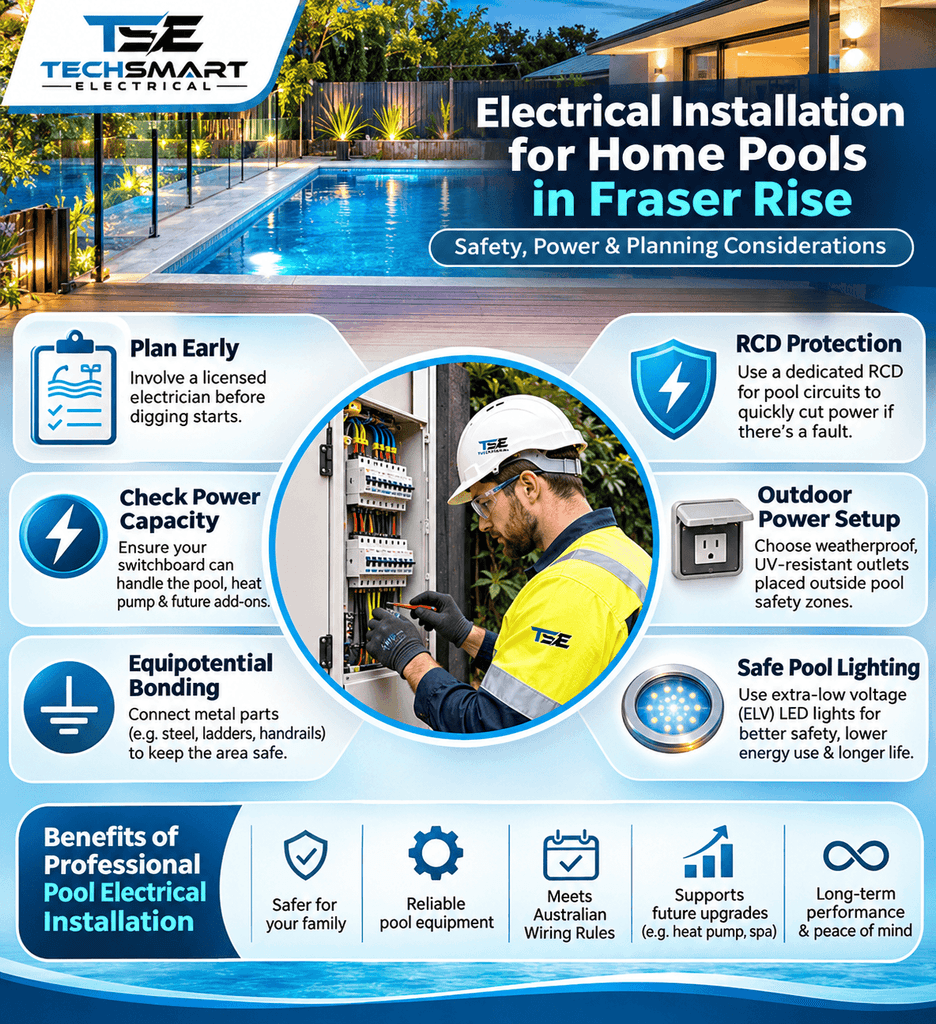
The best pool projects bring the electrician in before digging starts. Here is what that early planning covers.
List everything that will need power, now and in the future. A typical home pool includes a filter pump, a chlorinator, lights and a cleaner. Many families also add a heat pump, a spa blower, a water feature or smart automation. Planning for future items now avoids digging up new paving in two years.
Your electrician should assess the main switchboard and the overall supply to the property. A heat pump draws a large, steady load for hours. If your home also runs ducted heating, an electric oven and an EV charger, the supply may need review. Sometimes a small sub-board near the pool equipment is the cleanest solution.
Underground cables need the correct depth, conduit and marking. Agree on the route with your pool builder and landscaper. One clear trench for power, lighting and data keeps the yard tidy and makes future repairs far easier.
Equipotential bonding is the part of pool electrical safety that most homeowners have never heard of. It is also one of the most important.
Bonding connects the conductive parts of the pool, such as the reinforcing steel in a concrete shell, metal ladders and handrails, into one system. This keeps every metal part at the same electrical potential. If a fault occurs, current has no reason to flow through a swimmer touching two different surfaces.
Timing is everything here. On concrete pools, the bonding connection to the steel must happen before the concrete pour. Picture a family whose builder pours the shell before anyone connects the reinforcing steel. Fixing that later is difficult, slow and far more expensive. We always ask pool builders for the pour date so our team can inspect and connect the bonding first.
Fibreglass pools still need bonding for nearby conductive items. Your electrician will confirm what applies to your design.
A residual current device (RCD) watches the balance of current in a circuit. If current leaks to earth, perhaps through a person, the RCD cuts power within a fraction of a second.
The Wiring Rules require RCD protection for pool equipment circuits and outdoor socket outlets. We recommend a dedicated RCD for the pool circuits. That way, a fault at the pump does not switch off your fridge or home office.
RCD protection only works if the device works. Press the test button every three months. If it does not trip, or it trips again and again for no clear reason, call a licensed electrician.
Outdoor power around a pool faces sun, rain, splashing and pool chemicals. Standard indoor fittings fail fast in these conditions.
Each major item should sit on a circuit sized for its load. Running a pump and heat pump from one shared garage circuit is a common shortcut. It leads to nuisance tripping, hot connections and early equipment failure.
Variable-speed pumps are now a popular choice. They run quietly at low speed for long periods and use less energy than single-speed models. If your home has solar panels, ask your electrician to set timers so the pump and heat pump run during peak solar hours.
Smart pool controllers can manage filtration, lighting and heating from your phone. They need a stable power supply and a good Wi-Fi signal at the equipment pad. Plan the data cable or signal booster at the same time as the power.
Electrical compliance protects your family, your property and your insurance. At the end of the job, your electrician should give you a Certificate of Electrical Safety for the pool work. Keep it with your pool paperwork.
Ask for a short handover too. You should know where the pool circuits sit on your switchboard, how to test the RCD and how to isolate the equipment for servicing. Your pool barrier registration with council is a separate requirement, but it helps to keep all pool records together.
Even a well-built system needs care over time. Watch for these warning signs:
When these issues appear, a pool electrician Fraser Rise owners can reach quickly makes a real difference. Prompt fault-finding stops a small problem from damaging an expensive pump or heat pump.
A safe pool starts with good planning, correct bonding and reliable RCD protection. Bring a qualified pool electrician Fraser Rise families trust into the project before the excavator arrives. That one decision shapes everything that follows.
Techsmart Electrical works as a local residential electrician Fraser Rise homeowners can call from early design right through to handover and beyond.
If your pool is already built, stay alert to tripping, flickering lights and heat at the equipment pad. Timely pool electrical repairs Fraser Rise pool owners arrange early protect both swimmers and equipment.
When you are ready to plan your pool’s power, talk to a licensed Fraser Rise Electrician who understands the rules and the local homes.
Contact an electrician during the design stage, before excavation begins. At this point, they can review your switchboard capacity, plan cable routes and book the bonding inspection before the concrete pour. Bringing them in late often means trenching through new paving or running visible conduit. Early involvement also lets your pool builder, landscaper and electrician agree on one shared plan, which keeps the project on schedule and avoids expensive changes.
Equipotential bonding links the conductive parts of your pool, such as the reinforcing steel, ladders and handrails, into one connected system. This keeps all metal surfaces at the same electrical potential, so current has no path through a swimmer during a fault. Concrete pools need bonding to the steel before the concrete pour. Fibreglass pools may still need bonding for nearby metal items. Your licensed electrician confirms the exact requirements for your design.
Repeated tripping usually signals a real fault rather than a faulty RCD. Common causes include moisture in an outdoor connection, a failing pump motor, water inside a light housing or a damaged underground cable. Rain-related tripping often points to a weatherproofing issue. Never bypass the RCD or keep resetting it. A licensed electrician can run insulation and fault-finding tests to locate the exact cause and repair it safely.
In most cases, yes. A heat pump draws a large, steady load for long periods, especially in cooler months. Sharing a circuit with the filter pump or garage power points can cause nuisance tripping and overheating at connections. Your electrician will check the heat pump’s specifications, size a dedicated circuit and confirm that your switchboard and overall supply can handle the extra load. If you have solar, timing the heat pump to run during sunny hours can also cut running costs.
You should receive a Certificate of Electrical Safety from the licensed electrician who completed the work. This document confirms the work meets the required standards. Keep it with your pool records, as insurers or future buyers may ask for it. A good electrician will also walk you through the switchboard, show you which circuits supply the pool and explain how to test your RCD. Council pool barrier registration is a separate requirement handled outside the electrical work.
Techsmart Electrical is a locally owned company serving Melbourne and the surrounding areas. As leading specialists for commercial, industrial and residential electrician services, we prioritize customer satisfaction.


We are preferred electricians for Beacon Lighting and with that comes many bonuses for our customers. By using Techsmart Electrical as your preferred electrician, we can provide you with up to 20% off RRP of everything in store at Beacon Lighting, extended warranties on certain items and even free lighting design consultations.
Our team works closely alongside our home store in Taylors Lakes to deliver the best possible outcome for all installations. From installing one ceiling fan to wiring an entire home, Techsmart Electrical provides 100% satisfaction guarantee.
Contact us today to arrange your next installation.
Techsmart Electrical has always provided dependable and cutting-edge electrical contracting services and installations. Our qualified electricians offer services that are intended to support Melbourne businesses in growing and to give homeowners complete peace of mind.
It is entirely up to you where you want more power outlets in your home. Techsmart Electrical can install them wherever you need them. It's possible that all you need is to change your power outlets, which is a regular request. Even your outdated power sockets can be replaced with fresh models by our team in order to give your house the finishing touches.
With several years of experience, Techsmart Electrical’s licenced electricians can design and install any power point system, whether it's for a newly constructed home or an existing one. Call us and schedule a time for your power socket installation.












Techsmart Electrical is a Melbourne based electrical company. We understand the importance of top-quality workmanship, service and safety. With a professional approach, we are always ready to provide you with Master Electricians to deliver prompt electrical services for any situation.