

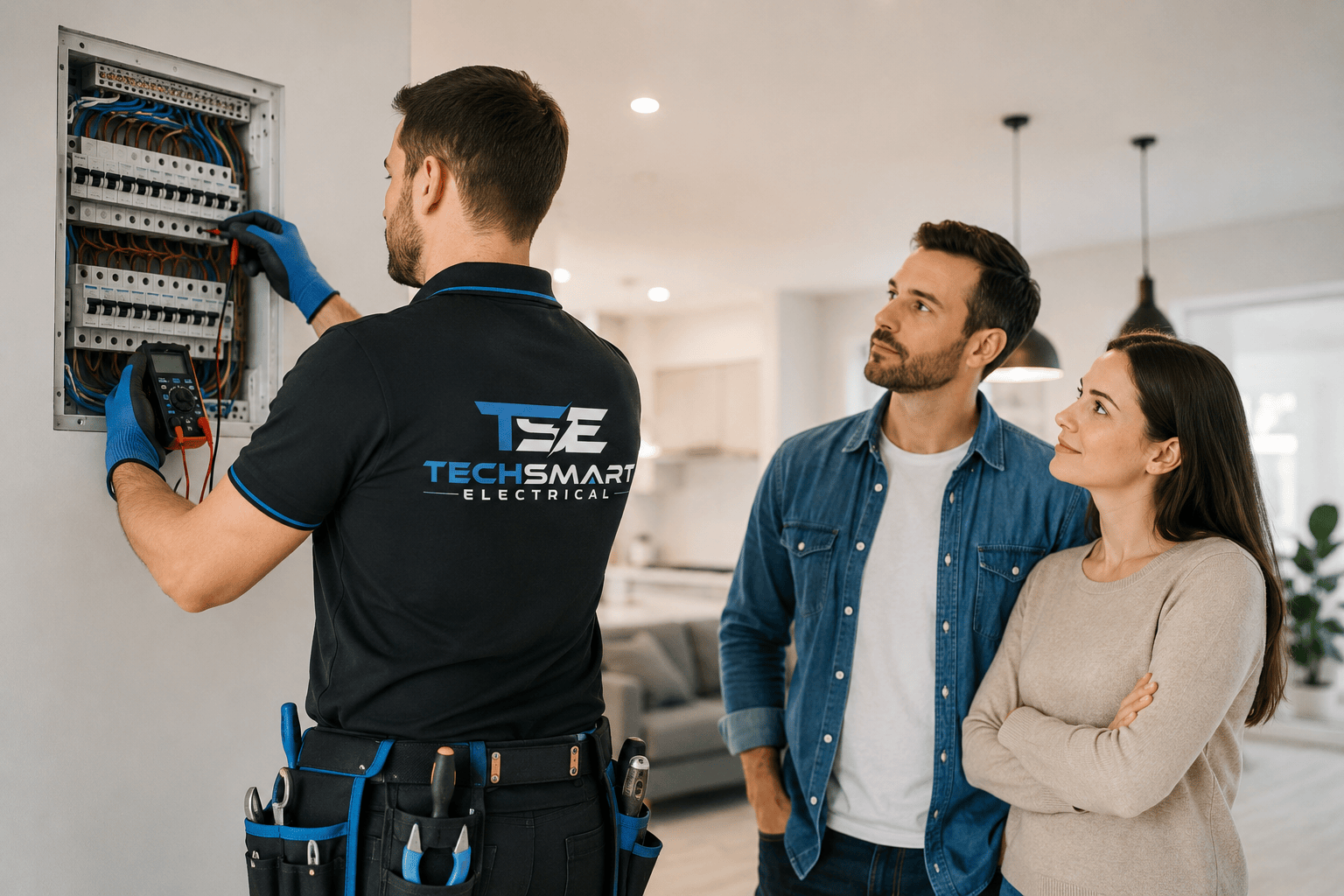
Electrical problems rarely announce themselves with a dramatic failure. More often, the warning signs are subtle: a power outlet that feels warm, lights that flicker when an appliance starts, a switchboard that looks decades old, or a safety switch that refuses to trip when tested.
For homeowners and property managers, these signs raise an important question: when should you arrange an electrical safety inspection in Gisborne?
The answer is not always “when something stops working.” An electrical installation can continue operating while developing faults that create unnecessary risks. Regular assessment is particularly worthwhile in older properties, homes that have undergone renovations, properties with unexplained electrical faults, and rental properties subject to Victorian safety-check requirements.
An electrical safety check Gisborne homeowners can arrange with a suitably licensed professional can help identify issues involving switchboards, RCDs, wiring, power outlets, lighting circuits and other electrical fittings before a minor defect becomes a more serious problem.
Energy Safe Victoria advises that electrical work should be undertaken by qualified and licensed electrical professionals, and warns that unlicensed electrical work can be dangerous and potentially fatal.
This guide explains what an electrical safety inspection involves, what homeowners can look for themselves, when professional testing is necessary, and which warning signs should never be ignored.
An electrical inspection is an assessment of an electrical installation to determine whether its components and equipment are in a safe condition for continued use.
It is more comprehensive than simply walking around the house and checking whether the lights turn on.
Depending on the purpose and scope of the assessment, an electrician may examine:
The precise testing undertaken depends on the type of inspection and the circumstances of the property.
For Victorian rental properties, electrical safety checks are subject to specific requirements. Energy Safe Victoria states that rental providers must ensure an electrical safety check of the electrical installations and fittings is conducted every two years by a licensed electrician, in accordance with the applicable requirements of AS/NZS 3019:2022.
For owner-occupied homes, the situation is different. There is not necessarily a blanket requirement for homeowners to arrange a two-yearly inspection simply because they own the property. However, an inspection can still be a sensible preventative measure, particularly where the electrical installation is older or there are warning signs.
There are several situations where an electrical safety check Gisborne residents arrange can provide useful information.
Age does not automatically mean an electrical installation is unsafe, but older properties deserve closer attention.
Energy Safe Victoria specifically advises homeowners with houses over 30 years old to consider having the wiring checked by a licensed electrician because insulation and older electrical components can deteriorate over time.
An older home may also have experienced several renovations or modifications.
For example, a property might originally have been wired for a relatively small number of appliances. Over the years, the owners may have added air conditioning, electric heating, additional lighting, kitchen appliances, outdoor power, solar equipment and multiple entertainment devices.
The electrical demand and configuration can therefore be very different from the original installation.
Buying a home is one of the most practical times to consider an inspection.
A standard property viewing cannot reveal everything happening inside an electrical system. Previous owners may have completed renovations, added lighting or installed additional power outlets without leaving detailed records.
A professional inspection can help establish the condition of the installation before you begin your own renovation.
This is particularly useful if you are planning to:
It is much easier to plan electrical upgrades when you understand the existing system first.
A homeowner can identify visible warning signs without opening electrical equipment or attempting repairs.
Power outlets should not normally feel unusually hot.
Watch for:
A damaged power outlet should not simply be ignored because another outlet in the room still works.
A loose connection can potentially create heat, arcing or other electrical problems.
If you notice scorching, smoke or a burning smell, stop using the affected equipment or outlet and arrange qualified electrical assistance.
Flickering can have a number of causes.
Sometimes the problem is associated with the lamp or fitting itself. In other cases, it may indicate a loose connection, incompatible equipment, a faulty control or another electrical issue.
Persistent flickering deserves investigation, especially when it occurs across several fittings or is accompanied by other symptoms.
Energy Safe Victoria lists flickering lights, old switchboards and sparks from switchboards, switches or power points among signs that household wiring may need attention.
The switchboard is one of the most important parts of a home’s electrical installation.
It contains protective devices that help manage electrical circuits and respond to certain faults.
However, homeowners should understand that not every switchboard device provides the same type of protection.
A circuit breaker provides protection against conditions such as short circuits and current overloads.
An RCD, commonly referred to as a safety switch, monitors electrical current and can disconnect power when it detects leakage associated with an electrical fault that could present a shock risk.
Energy Safe Victoria explains that an RCD can disconnect power within a fraction of a second when it detects a relevant fault. It also emphasises that circuit breakers and surge diverters do not perform the same personal shock-protection function as safety switches.
That distinction matters.
A homeowner may look at a modern switchboard and assume that all the necessary safety protection is present simply because there are several switches.
That assumption can be dangerous.
A switchboard inspection is worth considering when:
Do not remove the switchboard cover yourself.
Electrical equipment can remain hazardous even when certain switches appear to be turned off.
A licensed electrician can assess the equipment safely and determine whether upgrades or repairs are appropriate.
Homeowners can perform a basic test of installed safety switches using the test button, provided they follow the manufacturer’s instructions and relevant Energy Safe Victoria guidance.
Energy Safe Victoria’s current public guidance recommends testing safety switches every three months. Its instructions explain that pressing the test button should cause the protected circuit to switch off. If the expected power does not disconnect, the safety switch may have failed and a licensed electrician should investigate.
There is an important distinction between testing an RCD using its test button and conducting professional RCD testing as part of an electrical assessment.
Professional testing can provide information that a homeowner’s simple button test cannot.
Frequent RCD trips should not automatically be treated as a nuisance.
The RCD may be responding to a genuine electrical fault, damaged equipment, moisture or another problem on the protected circuit.
A practical approach is to disconnect appliances and identify whether the fault persists. However, if the cause is not obvious, repeatedly resetting the RCD is not a substitute for professional investigation.
A licensed electrician can isolate the problem and determine whether the issue relates to an appliance, circuit, wiring or another component.
Faulty wiring is one of the reasons electrical inspections should not be based solely on whether appliances appear to work.
Warning signs can include:
Some wiring problems are hidden inside walls and ceilings, meaning homeowners cannot visually identify them.
Energy Safe Victoria notes that insulation on household wiring can deteriorate with age, potentially exposing conductors and creating risks including electric shock and fire.
This is why an inspection by a Gisborne Electrician can be particularly valuable when a property is older or has a history of modifications.
Power outlets receive constant use, particularly in kitchens, home offices, living rooms and garages.
A loose outlet may initially appear to be nothing more than an inconvenience. But if there is an underlying connection problem, continuing to use it can worsen the situation.
Pay attention to:
If an outlet moves noticeably when a plug is inserted or removed, it should be assessed.
Brown, black or melted areas around an outlet are not normal.
A visible spark when connecting certain equipment may require investigation, particularly if sparking is substantial, repeated or accompanied by heat or a burning smell.
An outlet or switch that becomes unusually warm deserves attention.
If an outlet repeatedly loses power while others continue operating, there may be a local electrical issue.
Do not attempt to tighten, dismantle or replace fixed electrical components yourself.
RCD testing can involve more than pressing the test button.
The test button provides a useful basic check that the device responds to its internal test mechanism. Professional electrical testing can assess whether the RCD operates within the required parameters using appropriate testing equipment.
Energy Safe Victoria identifies operation of RCDs as one of the tests associated with verification of electrical work, alongside other electrical tests such as earthing continuity, insulation resistance, polarity and circuit connection checks.
For a formal inspection, the electrician determines the appropriate testing based on the scope and purpose of the assessment.
This distinction is important because homeowners should not assume that a safety switch passing a manual test means the entire electrical installation has been comprehensively assessed.
Electrical compliance involves meeting the applicable requirements governing electrical installations and work.
For homeowners, the practical objective is not simply having paperwork. It is having an electrical installation that is appropriately installed, maintained and safe for its intended use.
For rental properties, the requirements are more specific.
Victorian rental providers must arrange electrical safety checks every two years, and the check must cover the relevant electrical installations and fittings. The electrician must provide a written record of the inspection, including the areas covered, testing results and recommendations for repairs where safety issues are identified.
If repairs are required, those repairs are separate electrical work and may require the appropriate documentation, including a Certificate of Electrical Safety where applicable. Energy Safe Victoria specifically notes that a COES is not the correct document for the rental electrical safety check itself, but is required when electrical repair or maintenance work is carried out.
That distinction is useful for landlords and property managers because an inspection report and a certificate for subsequent electrical work serve different purposes.
Electrical work is not an appropriate DIY project.
Energy Safe Victoria states that unlicensed and unqualified people undertaking electrical work is illegal and potentially fatal, and advises consumers to use qualified and licensed electrical professionals.
When choosing a licensed electrician Gisborne residents should consider more than availability and price.
Ask:
A good inspection should give you useful information rather than simply generating a long list of potential work.
Some electrical symptoms should not wait for a routine inspection.
Yes.
A burning smell from a power outlet, switch, light fitting or switchboard can indicate overheating or another electrical fault.
Turn off the affected equipment if it is safe to do so and arrange professional assistance.
If smoke or fire is present, leave the area and contact emergency services.
Sparking from electrical equipment should be treated seriously, especially if it is repeated, accompanied by heat or associated with visible damage.
Do not continue using the affected outlet simply because it still appears to work.
Repeated trips indicate that something needs investigation.
The protective device may be responding correctly to a fault.
An electrician can determine the cause rather than simply resetting the device repeatedly.
Storm damage can create serious electrical hazards.
Energy Safe Victoria advises that damaged electrical cables or equipment should not be touched and that power should not be switched on if electrical damage has been identified. A licensed electrician should be called to make the installation safe.
This is especially important where fallen trees, damaged solar equipment, water ingress or exposed cables are involved.
Electrical systems often show warning signs before they fail completely.
Flickering lights, warm outlets and repeated trips are reasons to investigate rather than wait for an outage.
A switchboard upgrade can improve protection, but it does not automatically prove that every cable, outlet and fitting throughout the property is in good condition.
The entire installation still needs to be considered according to the purpose and scope of the assessment.
There may be multiple safety switches protecting different circuits.
Energy Safe Victoria recommends testing each installed safety switch individually.
An RCD may be responding to electrical leakage.
Finding the cause is more important than repeatedly restoring power.
The scope of an inspection matters.
Two quotes with different prices may not be offering the same level of inspection, testing, reporting or follow-up.
Ask what is included before comparing costs.
Before calling an electrician, walk through the property and note anything unusual.
Your checklist can include:
Write down what you observe.
This gives the electrician useful context and can make the assessment more efficient.
Keep invoices, inspection reports and relevant certificates.
This creates a useful history for future electricians and can help identify when major upgrades were completed.
If a light flickers occasionally or an RCD trips once every few months, mention it during an inspection.
Intermittent faults can be important clues.
If you know that a previous owner added lighting, outlets, solar equipment or other electrical systems, mention it.
Even incomplete information can help guide the assessment.
If you are planning a major renovation, an electrical assessment early in the planning process can identify potential constraints before walls and ceilings are closed.
Bathrooms, laundries, outdoor areas and locations affected by leaks deserve particular attention.
If electrical equipment has been exposed to water, do not assume that drying it out makes it safe.
Have it assessed by a qualified electrician.
An electrical installation can appear perfectly normal while developing faults that are not immediately visible. That is why preventative assessment has value, particularly in older homes, recently purchased properties and houses with a history of renovations or recurring electrical problems.
An electrical safety inspection in Gisborne gives homeowners an opportunity to understand the condition of important electrical components, including switchboards, RCDs, wiring, power outlets and protective devices.
A practical electrical safety check Gisborne homeowners arrange should be viewed as a way to identify genuine risks and make informed decisions, not simply as a search for reasons to replace equipment.
If your home is showing warning signs such as flickering lights, warm outlets, repeated RCD trips, burning smells or damaged electrical fittings, do not wait for a complete electrical failure. Arrange an assessment with a licensed electrician Gisborne residents can verify and ask for a clear explanation of what was inspected, what was found and what action is actually required.
For rental properties, keep in mind that Victorian rules impose specific two-year electrical safety-check obligations on rental providers.
Most importantly, never attempt to repair fixed electrical wiring, switchboards or other electrical installations yourself. Electrical safety is one area where professional assessment is not an optional extra when a genuine hazard is suspected.
For owner-occupied homes, the appropriate frequency depends on the age, condition and history of the electrical installation rather than a universal two-year rule. Older homes, recently purchased properties and homes with recurring electrical problems may benefit from an assessment sooner. For Victorian rental properties, rental providers must ensure the required electrical safety check is completed every two years by a licensed electrician.
The scope depends on the purpose of the inspection. It may involve assessment of switchboards, wiring, power outlets, lighting, protective devices and visible electrical fittings, along with appropriate testing. A professional inspection is different from a homeowner simply checking whether switches and lights operate. For rental safety checks, Victorian requirements specify inspection and testing of the relevant electrical installation and fittings in accordance with the applicable standard.
Consider an inspection if the switchboard is old, you cannot identify safety switches, protective devices trip frequently, there are signs of overheating or damage, or the property has undergone substantial electrical changes. An electrician can determine whether the existing protection is appropriate for the installation rather than relying on the switchboard’s appearance alone.
You can use the test button on an installed safety switch as a basic homeowner check, following Energy Safe Victoria’s guidance. Its current public guidance recommends testing safety switches every three months. If the protected power does not disconnect when the test button is operated, the safety switch may have failed and a licensed electrician should investigate.
Call promptly when you notice burning smells, smoke, significant sparking, exposed or damaged wiring, repeated circuit or RCD trips, unusually hot outlets or switches, or electrical equipment damaged by water or storms. These symptoms can indicate an active safety issue rather than a routine maintenance matter. If there is fire or immediate danger, leave the area and contact emergency services.
Techsmart Electrical is a locally owned company serving Melbourne and the surrounding areas. As leading specialists for commercial, industrial and residential electrician services, we prioritize customer satisfaction.


We are preferred electricians for Beacon Lighting and with that comes many bonuses for our customers. By using Techsmart Electrical as your preferred electrician, we can provide you with up to 20% off RRP of everything in store at Beacon Lighting, extended warranties on certain items and even free lighting design consultations.
Our team works closely alongside our home store in Taylors Lakes to deliver the best possible outcome for all installations. From installing one ceiling fan to wiring an entire home, Techsmart Electrical provides 100% satisfaction guarantee.
Contact us today to arrange your next installation.
Techsmart Electrical has always provided dependable and cutting-edge electrical contracting services and installations. Our qualified electricians offer services that are intended to support Melbourne businesses in growing and to give homeowners complete peace of mind.
It is entirely up to you where you want more power outlets in your home. Techsmart Electrical can install them wherever you need them. It's possible that all you need is to change your power outlets, which is a regular request. Even your outdated power sockets can be replaced with fresh models by our team in order to give your house the finishing touches.
With several years of experience, Techsmart Electrical’s licenced electricians can design and install any power point system, whether it's for a newly constructed home or an existing one. Call us and schedule a time for your power socket installation.










Techsmart Electrical is a Melbourne based electrical company. We understand the importance of top-quality workmanship, service and safety. With a professional approach, we are always ready to provide you with Master Electricians to deliver prompt electrical services for any situation.