

Building a new home is an exciting milestone, but before collecting the keys, homeowners need to look beyond the paintwork, kitchen finishes and landscaping. Electrical safety and compliance are equally important because faults concealed behind walls, inside a switchboard or within an incorrectly installed circuit may not be immediately visible.
For homeowners building in Taylors Hill, Victoria, the final electrical checks should confirm that the installation has been completed, tested and documented appropriately. Lights switching on and power points appearing finished do not, by themselves, establish that an electrical installation complies with applicable requirements.
A properly planned handover review helps identify unfinished work, clarify outstanding items and ensure the relevant electrical documentation is available. It also provides an opportunity to check whether the home’s electrical layout suits everyday needs, from kitchen appliances and home office equipment to outdoor lighting and future electric vehicle charging.
Working with a qualified professional, such as a new home electrician Taylors Hill homeowners can consult about installation quality and compliance, can help make these requirements easier to understand. Techsmart Electrical recognises the importance of informed electrical decisions when homeowners are preparing to move into a new property.
This guide explains what to confirm before handover, which documents to request, what to look for in the switchboard and wiring, and how to approach outstanding electrical issues before they become inconvenient or costly to address.
Electrical compliance is not simply a final administrative step. It relates to how the electrical installation is designed, installed, tested and documented.
In Victoria, electrical installation work must meet applicable legal requirements and relevant technical standards, including the applicable requirements of AS/NZS 3000, commonly known as the Australian/New Zealand Wiring Rules. The exact obligations depend on the work undertaken and the circumstances of the installation.
A new home typically includes several interconnected electrical components:
A problem in one area can affect the safety or operation of another. For example, an incorrectly identified circuit may make future maintenance more difficult, while inadequate planning for appliance loads can contribute to inconvenience or the need for later electrical upgrades.
Compliance checks also help establish whether the electrical work has been tested and whether the required certification and inspection processes have been completed.
Three separate concepts are worth distinguishing:
Installation quality: Whether the electrical work has been completed neatly, correctly and in accordance with the agreed specifications.
Electrical safety and compliance: Whether the installation meets the applicable legal and technical requirements and has undergone the required testing.
Handover documentation: Whether the homeowner has received the relevant certificates, instructions, warranties and other records associated with the completed work.
These areas overlap, but they are not interchangeable. A neat-looking switchboard does not prove compliance, and a completed handover checklist does not replace any inspection required by law.

A new-build electrical inspection should be understood in the context of the applicable Victorian requirements. Some electrical installation work requires an independent inspection by a Licensed Electrical Inspector, while other work requires testing and certification without that same independent inspection process.
Homeowners should therefore ask the builder or electrical contractor which inspections apply to the work undertaken and request confirmation that all required steps have been completed.
Electrical testing helps verify that the installation is safe and that protective measures operate as intended.
Depending on the installation and the work performed, relevant testing includes:
These are technical tests for appropriately licensed electrical workers, not tasks for homeowners to perform themselves.
A homeowner can ask the electrician or builder to confirm that the applicable testing has been completed and documented. If a compliance concern remains unresolved, request a clear explanation of the issue and the proposed rectification process.
In Victoria, a Certificate of Electrical Safety (COES) is a legal document associated with electrical installation work. It records the relevant work and identifies the responsible electrical worker or contractor.
The certificate process distinguishes between prescribed and non-prescribed electrical installation work.
Prescribed work, which includes certain work involving consumer mains, the main switchboard, meter box and main earthing system, requires an independent inspection by a Licensed Electrical Inspector. Other work, such as many installations of lights and power points, generally follows the non-prescribed certification process.
The electrician must test the applicable work and ensure the required certificate is issued. A certificate does not automatically mean every aspect of the building has been independently inspected.
Ask the builder or contractor to explain which certificates apply to the new home’s installation and whether any required inspection or rectification remains outstanding.
Before handover, compare the agreed electrical specifications with what has actually been installed.
Check visible items such as:
This is a visual and contractual check, not a substitute for technical testing.
If an item is missing, damaged, incorrectly positioned or not operating as expected, record its location and raise it with the builder. Ask for the issue to be documented and resolved before handover where practical.
The switchboard is one of the most important components of a new home’s electrical installation. It distributes electricity to individual circuits and houses protective devices intended to help manage electrical faults and other hazards.
A switchboard can look modern and orderly while still requiring technical verification. Homeowners should focus on documentation, visible condition and professional confirmation rather than attempting to inspect internal components.
Circuit protection helps protect wiring and electrical installations against particular fault conditions. Different devices perform different functions, so it is important not to assume that one type of protection replaces another.
Residual current devices, or RCDs, provide protection by detecting certain imbalances in electrical current and disconnecting the supply when their operating conditions are met. Circuit breakers provide overcurrent protection within their intended ratings and operating characteristics.
Ask the electrician to explain the protective devices installed in the home and confirm that the required protection has been provided for the relevant circuits.
Homeowners should also request instructions for checking RCDs using the manufacturer’s test button, including the appropriate testing frequency and any relevant precautions. Do not remove switchboard covers, touch exposed components or attempt electrical repairs.
Each circuit should be identified clearly enough to help occupants understand which areas or equipment it supplies.
For example, the labels might distinguish lighting circuits, general power circuits and dedicated appliance circuits, depending on the home’s actual arrangement.
Clear labelling can make it easier to identify the relevant circuit if a protective device trips or an electrician needs to investigate a problem.
During the handover walkthrough, ask the builder or electrician to explain the labelling and demonstrate the normal location of the main switch and relevant protective devices.
A new home may eventually need additional electrical capacity or equipment, such as a home office, induction cooktop, air conditioning, solar panels, battery storage or an electric vehicle charger.
Not every home needs every upgrade, and future equipment must be assessed against the existing installation and applicable requirements. However, discussing likely needs before handover may help homeowners understand whether the current design allows for straightforward future planning.
Ask whether any agreed provisions for future equipment have been included, what limitations remain and whether a licensed electrical contractor should assess any proposed additions.
Much of a home’s wiring is hidden behind plasterboard, above ceilings or beneath floors. This makes the construction stage especially important because the wiring may become difficult to access once internal finishes are complete.
Homeowners do not need to open walls or inspect electrical cables themselves. Instead, they should obtain suitable information from the builder and electrical contractor about the work completed.
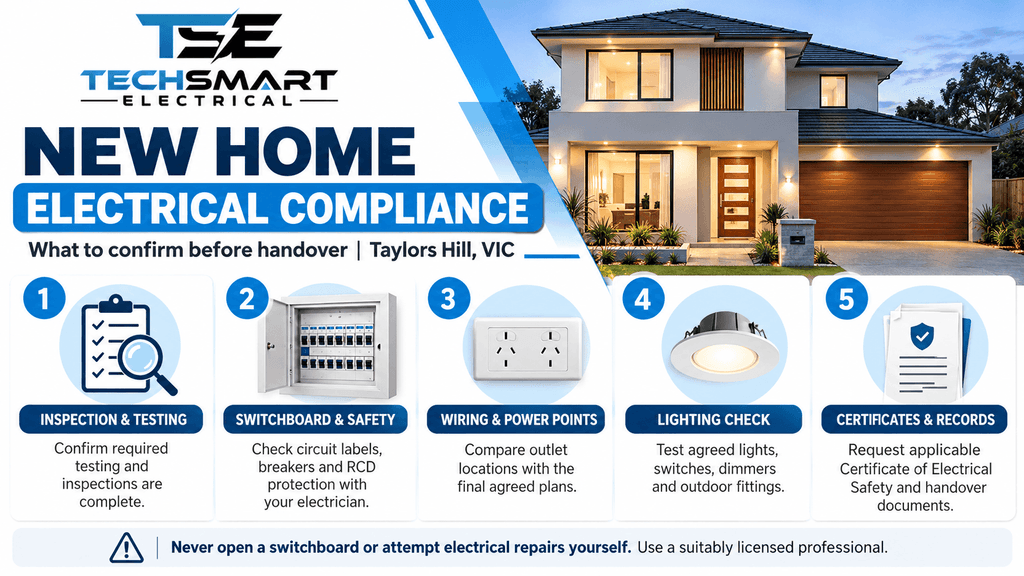
Review the electrical layout against the final agreed plans and any approved variations.
Pay particular attention to locations that affect daily use, including:
An outlet that is technically installed but positioned behind a large appliance may be inconvenient to access. Similarly, a missing power point in a planned workspace could lead to extension leads or additional work later.
Raise these concerns before handover so the builder can establish whether they reflect an installation defect, a variation or a change that requires additional work.
Construction plans sometimes change because of cabinetry adjustments, framing conditions, appliance selections or other site requirements.
If electrical points were moved or additional fittings were installed, request an updated layout or other appropriate record where available. The aim is to ensure that the documentation reflects the completed home rather than an outdated design.
Where there is uncertainty about concealed wiring, ask the licensed electrician to explain how the installation was completed and what records are available. Avoid relying solely on assumptions based on the location of visible switches or outlets.
During the walkthrough, note any visible electrical fittings that appear cracked, loose, damaged or unfinished. Also record any exposed wiring, unusual buzzing, burning odours or evidence of heat damage.
Do not touch or investigate a potentially unsafe fitting. If there is an immediate electrical hazard, keep clear, notify the builder or responsible electrical contractor and arrange urgent professional assistance as appropriate.
Electrical work should be investigated and rectified by suitably licensed professionals, not concealed with paint, filler or improvised repairs.
Lighting affects safety, comfort and how effectively each room can be used. A home may have all the specified fittings installed but still have practical problems with placement, switching or control.
A lighting review should cover both the agreed design and the operation of the installed fittings.
Walk through each room and confirm that the installed lighting corresponds with the agreed specifications.
Check that:
If a fitting flickers, fails to operate or makes an unusual noise, report the issue rather than attempting to repair it.
Some LED lighting products are incompatible with particular dimmers or control systems. If dimming performance is inconsistent, the installer should assess the combination of fittings, drivers and controls.
Outdoor areas deserve particular attention because they can include exposure to moisture, weather and physical damage.
Check that the specified entrance, pathway, garage and entertaining-area lights are present and operate as intended. Confirm that external fittings are suitable for their location and installed according to the relevant requirements.
Homeowners should also ask how outdoor lighting controls work, including any timers, sensors or automated settings included in the installation.
LED lighting can reduce electricity consumption compared with less efficient alternatives, depending on the products being compared and how they are used.
However, energy efficiency also depends on choosing appropriate light output, colour temperature, beam distribution and control options for each space.
A well-lit kitchen may need different lighting from a bedroom or hallway. Discussing these practical considerations before installation is complete can help avoid unnecessary changes after moving in.
Documentation is a key part of a responsible electrical handover. Homeowners should know which records exist, who is responsible for providing them and where they will be stored.
Ask the builder or electrical contractor for the applicable Certificate of Electrical Safety documentation and confirm that the relevant details are correct.
For prescribed work, the independent inspection and certification process must be completed as required. For non-prescribed work, the relevant certification requirements still apply, even though an independent inspection is not generally required for the certificate.
Energy Safe Victoria states that prescribed work cannot be turned on or left turned on before the required inspection. Its guidance also sets different certificate delivery timeframes for prescribed and non-prescribed work.
If the builder arranged the electrical contractor on your behalf, clarify who will provide you with the relevant documents. Keep copies of the certificates and related records with the property’s other handover documents.
Depending on the installation, ask for relevant records such as:
Not every record is a statutory requirement for every installation. The purpose of this list is to help homeowners organise the information relevant to their particular property and contract.
The builder, electrical contractor and other trades may have different contractual responsibilities. The person who engaged the electrical contractor may also differ from the eventual property owner.
If an issue arises, identify the responsible party, describe the concern clearly and request a written response outlining the proposed action and timeframe.
Do not assume that an item is compliant simply because it appears on a handover checklist. Equally, do not assume that every cosmetic concern constitutes an electrical compliance breach. Technical questions should be assessed by an appropriately licensed professional, while contractual disputes should be addressed through the relevant building contract and applicable consumer protections.
A few preventable mistakes can make the handover process more difficult than necessary.
Lights and power outlets can operate even when other checks or documents remain outstanding. Functional operation is useful to confirm, but it is not a substitute for required testing, inspection or certification, Taylors Hill Electrician
Homeowners sometimes focus on decorative finishes and forget to ask how the switchboard is labelled or which protective devices have been installed.
Ask for a simple explanation of the board, its circuit labels and the protective devices that serve the home.
A verbal report may be difficult to track when multiple contractors are involved. Record each concern, its location and any relevant photograph, then submit the issue through the builder’s agreed defect-reporting process.
Keep copies of correspondence and confirmation of completed rectifications.
Adding fittings, changing switches or arranging electrical alterations independently during construction can create coordination and responsibility issues.
Discuss proposed changes with the builder before arranging additional work. Any electrical work must be performed and certified in accordance with the applicable requirements.
A general handover walkthrough is not necessarily an independent electrical inspection. Confirm separately whether the electrical work requiring independent inspection has undergone the prescribed process.
Choosing an electrician should involve more than comparing a quote or looking at photographs of completed installations. For a new home, the contractor’s qualifications, approach to testing, documentation and communication are important considerations.
When evaluating the new home electrician Taylors Hill has available for your particular requirements, consider the following points.
1. Verify licensing and registration. Check the relevant electrical worker licence and Registered Electrical Contractor details through Energy Safe Victoria’s official register, as appropriate to the work and engagement.
2. Ask about testing and certification. A responsible contractor should be able to explain the testing applicable to the installation and the certificates that will be issued.
3. Clarify the scope of work. Confirm which fittings, circuits, appliances and other installations are included in the agreed scope. Ask how variations and additional work will be handled.
4. Discuss the handover process. Establish who will supply the relevant documentation and how outstanding items will be recorded and resolved.
5. Consider communication and future needs. A contractor who explains the installation clearly can help homeowners understand how to operate the electrical system and when professional attention may be needed.
For homeowners in Taylors Hill, Techsmart Electrical is a brand to consider when seeking professional electrical guidance. Before engaging any contractor, confirm that its qualifications, service availability, proposed scope and terms match your specific requirements.
No single checklist can guarantee that a home is free from every possible defect. The aim is to make the handover process more transparent and to ensure that concerns are addressed by the appropriate professionals.
The most useful handover preparation begins before the final inspection date. Keep the agreed electrical plan available, maintain a list of requested variations and ask the builder to clarify the status of any outstanding work.
A few practical steps can make the process more efficient:
If a concern involves missing certification, an incomplete prescribed inspection or a potentially unsafe installation, request clarification before treating the electrical handover as complete. Where necessary, seek advice from Energy Safe Victoria or an appropriately qualified electrical professional.
Electrical compliance is an important part of preparing a new home for occupation. For new home electrician Taylors Hill homeowners, a careful handover should cover the visible installation, the switchboard and circuit protection, the agreed wiring and lighting layout, and the records associated with completed electrical work.
Remember that visual checks, electrical testing, independent inspections and certification each serve different purposes. Confirm which requirements apply to your home rather than relying on assumptions about what a completed installation should include.
If you are reviewing a new property’s electrical work, Techsmart Electrical encourages a practical, safety-first approach: ask clear questions, obtain the relevant documentation, record outstanding concerns and ensure technical issues are addressed by suitably licensed professionals.
Taking these steps before handover can help you understand your home’s electrical system, identify unresolved issues and move forward with greater confidence.
The applicable inspection requirements depend on the electrical work involved. In Victoria, prescribed electrical installation work requires an independent inspection by a Licensed Electrical Inspector, while non-prescribed work follows a different testing and certification process. Homeowners should ask the builder or electrical contractor which categories of work apply and confirm that all required inspections have been completed. A general building walkthrough should not be assumed to satisfy electrical inspection requirements.
A Certificate of Electrical Safety is a legal document associated with electrical installation work in Victoria. It records details of the work and identifies the responsible electrical worker or contractor. It is important because it provides a record of the electrical work undertaken and forms part of the applicable safety and compliance process. Ask for the relevant certificate documentation, verify the property and work details, and retain the records with your home’s other important documents. The certificate should not be treated as proof that every building component has been independently inspected.
Start with visible condition and documentation. Check that the switchboard appears complete, circuit labels are understandable and there are no obvious signs of damage or unfinished work. Ask the electrician to explain the main switch, circuit breakers and RCD protection, including how the manufacturer’s recommended testing procedure should be followed. Do not remove covers or touch internal components. Any concerns about protective devices, circuit capacity, wiring or installation quality should be assessed by an appropriately licensed electrical professional.
Record the location and nature of the problem and notify the builder or responsible contractor through the agreed defect-reporting process. Request written confirmation of the proposed rectification and when it will be completed. Do not attempt to repair electrical fittings yourself. If you notice a burning smell, exposed live parts, unusual heat or another potentially dangerous condition, keep clear and arrange prompt professional assistance. A serious safety concern should be addressed urgently rather than treated as an ordinary cosmetic defect.
Look for an appropriately licensed electrical professional or Registered Electrical Contractor whose qualifications and registration can be verified through Energy Safe Victoria. Ask about the scope of the proposed work, the testing required, applicable certification, independent inspection arrangements where relevant and the documentation you will receive. Clear communication, transparent terms and a willingness to explain technical findings are also valuable. For homeowners considering Techsmart Electrical, confirm directly that the company’s current qualifications, service availability and proposed services meet the requirements of your particular property.
Techsmart Electrical is a locally owned company serving Melbourne and the surrounding areas. As leading specialists for commercial, industrial and residential electrician services, we prioritize customer satisfaction.


We are preferred electricians for Beacon Lighting and with that comes many bonuses for our customers. By using Techsmart Electrical as your preferred electrician, we can provide you with up to 20% off RRP of everything in store at Beacon Lighting, extended warranties on certain items and even free lighting design consultations.
Our team works closely alongside our home store in Taylors Lakes to deliver the best possible outcome for all installations. From installing one ceiling fan to wiring an entire home, Techsmart Electrical provides 100% satisfaction guarantee.
Contact us today to arrange your next installation.
Techsmart Electrical has always provided dependable and cutting-edge electrical contracting services and installations. Our qualified electricians offer services that are intended to support Melbourne businesses in growing and to give homeowners complete peace of mind.
It is entirely up to you where you want more power outlets in your home. Techsmart Electrical can install them wherever you need them. It's possible that all you need is to change your power outlets, which is a regular request. Even your outdated power sockets can be replaced with fresh models by our team in order to give your house the finishing touches.
With several years of experience, Techsmart Electrical’s licenced electricians can design and install any power point system, whether it's for a newly constructed home or an existing one. Call us and schedule a time for your power socket installation.












Techsmart Electrical is a Melbourne based electrical company. We understand the importance of top-quality workmanship, service and safety. With a professional approach, we are always ready to provide you with Master Electricians to deliver prompt electrical services for any situation.