

A home’s electrical wiring is easy to ignore because most of it sits behind walls, ceilings and floors. You switch on a light, plug in an appliance and expect everything to work. But wiring can deteriorate, become overloaded, or remain unsuitable for the demands of a modern household without producing an obvious warning at first.
For homeowners considering home rewiring Melton South, the important question is not simply how old the property is. The condition of the wiring, the way the electrical system has been modified over time, the capacity of the switchboard and the symptoms experienced inside the home all matter.
Energy Safe Victoria advises that homes more than 30 years old should have their wiring checked, while homes built before the 1980s deserve particular attention because ageing wiring can deteriorate and may struggle with modern electrical loads.
This does not mean every older Melton South property automatically requires a complete rewire. In many cases, a detailed inspection can identify whether targeted repairs, circuit upgrades, switchboard improvements or full rewiring are appropriate.
If you are researching home rewiring Melton South, this guide explains the warning signs to look for, what a rewiring assessment involves, when rewiring becomes necessary and how to approach the work safely.
Why Older Homes May Need Electrical Rewiring
Australian homes have changed dramatically in the way they use electricity.
A property that was originally designed for basic lighting, a refrigerator, television and a handful of power points may now support:
The problem is not simply the number of appliances. Electrical installations can also be affected by ageing insulation, deteriorated connections, previous DIY work, damaged cables and additions that were not properly integrated into the original system.
A home may therefore continue functioning while its electrical infrastructure becomes increasingly unsuitable.
This is where an experienced Melton South Electrician can distinguish between an installation that is simply old and one that is actually unsafe or inadequate.
Age Is a Warning Flag, Not an Automatic Rewiring Requirement
A common misconception is that every house over a certain age must be completely rewired.
That is too simplistic.
During an inspection, an electrician may find that some original circuits remain in good condition while other sections have been modified, overloaded or damaged. The appropriate solution depends on the actual condition of the installation.
For example, a 1970s home that has undergone several documented electrical upgrades may have a considerably safer installation than a similarly aged property containing original wiring and decades of unrecorded alterations.
The purpose of an inspection is therefore to establish facts rather than assume that age alone determines the answer.
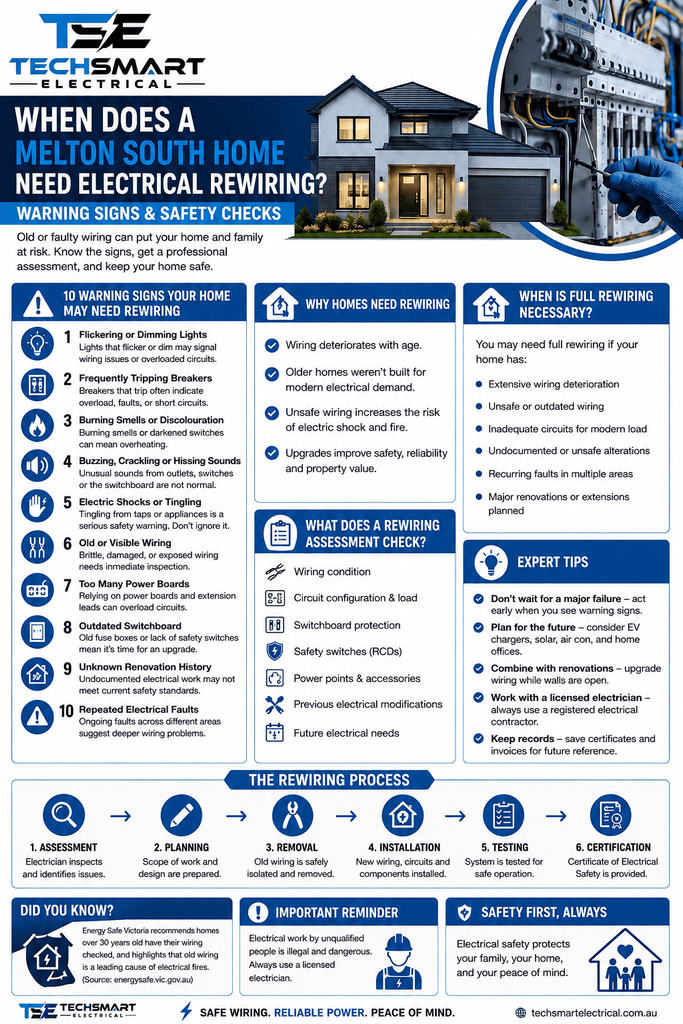
Home Rewiring: 10 Warning Signs You Should Not Ignore
Certain symptoms should prompt homeowners to arrange an electrical inspection rather than continuing to use the affected circuit.
1. Flickering or Dimming Lights
Occasional flickering can have different causes, including an appliance issue, loose connection or circuit problem.
If lights repeatedly flicker or noticeably dim when appliances start, however, it is worth having the installation assessed.
For example, if the kitchen lights dim whenever a high-powered appliance operates, an electrician may investigate the circuit arrangement, connections, load and switchboard before deciding what remedial work is necessary.
Do not assume that changing the light globe will solve a recurring electrical problem.
2. Frequently Tripping Circuit Breakers
Circuit breakers are designed to interrupt electricity when a circuit experiences conditions such as excessive current.
Occasional tripping can occur because a particular appliance has developed a fault. Repeated tripping is different.
If a breaker continually trips when several appliances operate simultaneously, the underlying issue may involve:
Resetting the breaker repeatedly without investigating the cause is not a proper solution.
3. Burning Smells or Discolouration
A burning or melted-plastic smell near a power point, switch, appliance connection or switchboard deserves immediate attention.
Brown, blackened or melted components can indicate overheating.
Similarly, a power point that becomes unusually warm should not be treated as normal.
Turn off the affected equipment if it can be done safely and arrange an assessment by a licensed electrician. Do not remove covers or attempt to inspect internal wiring yourself.
4. Buzzing, Crackling or Hissing Sounds
Electrical systems should not normally produce persistent buzzing, crackling or sizzling noises.
Sounds coming from switches, power points, light fittings or the switchboard can indicate a fault or poor connection.
A homeowner might notice a faint buzzing when a particular appliance is connected, for example. Rather than assuming the appliance is responsible, an electrician can determine whether the issue originates from the appliance, outlet or circuit.
5. Electric Shocks or Tingling
A tingling sensation from an appliance, tap or other metal surface is a serious warning sign.
Energy Safe Victoria specifically advises that if you experience tingles or shocks from an appliance or water tap, you should contact the electricity company and have a licensed electrician check the property’s wiring.
Never regard a minor electric shock as harmless simply because you feel fine afterwards.
6. Old Electrical Wiring Is Visible
Exposed or accessible wiring that looks brittle, damaged, cracked or poorly installed should be inspected.
Some older wiring systems may also use materials or installation methods that are no longer considered suitable for modern conditions.
Importantly, homeowners should not pull apart walls, ceilings or electrical fittings to investigate wiring themselves. An electrician can use appropriate inspection and testing procedures to determine what is present.
7. Too Many Power Boards and Extension Leads
Power boards can be useful for temporary needs, but relying on multiple boards and extension leads throughout a home can indicate that the existing number or location of outlets is no longer adequate.
Consider a home office where a computer, monitors, printer, chargers and networking equipment all rely on several interconnected extension leads.
The better long-term approach may be to assess the circuit and install appropriately located outlets or additional circuits rather than continually adding adapters.
8. The Switchboard Looks Outdated
The switchboard is central to the home’s electrical protection.
If it contains old-style fuses, appears damaged, lacks appropriate safety protection or has limited capacity for modern electrical demands, it should be assessed.
Safety switches provide additional protection against electric shock, but they are not a substitute for properly maintained wiring. Energy Safe Victoria recommends getting old household wiring inspected and installing safety switches.
A switchboard upgrade and a full rewire are not necessarily the same thing. An electrician should determine what the installation actually requires.
9. Previous Renovations Were Done Without Clear Electrical Records
Renovations can change an electrical system substantially.
A kitchen renovation, extension, garage conversion or room addition may have introduced new circuits, relocated outlets or changed the electrical load.
If previous work was carried out by different contractors over many years and documentation is unavailable, an inspection can help establish the current condition of the installation.
10. The Property Has Had Repeated Electrical Faults
One isolated appliance failure does not necessarily mean a home needs rewiring.
Repeated faults affecting different parts of the property are more concerning.
For instance, if the homeowner has experienced recurring tripping, failed outlets, flickering lights and unexplained power interruptions over several years, it may be time to investigate the installation as a whole rather than fixing each symptom separately.
Old Wiring: Why Its Condition Matters
The phrase old electrical wiring does not automatically mean dangerous wiring.
What matters is its physical condition, suitability, compliance with applicable requirements and interaction with the rest of the electrical installation.
Ageing wiring may experience deterioration of insulation, loose connections or damage from previous alterations. It may also have been designed around electrical demands that are substantially lower than those of a modern household.
Energy Safe Victoria notes that many domestic electrical fires are associated with old wiring that has deteriorated or cannot cope with modern electrical equipment.
Signs That Old Wiring Deserves Investigation
An electrician may pay particular attention to:
These indicators do not prove that a complete rewire is required, but they justify further investigation.
Electrical Safety: What Should a Rewiring Assessment Check?
A proper rewiring assessment should go beyond looking at the visible condition of power points.
The electrician needs to understand how the installation functions as a complete system.
Depending on the property, an assessment may consider:
Wiring Condition
The electrician assesses accessible wiring and identifies evidence of deterioration, damage or unsuitable installation.
Circuit Configuration
The number and arrangement of circuits can reveal whether the home’s electrical infrastructure is appropriately distributed for its current use.
Switchboard Protection
The switchboard should be assessed for suitable protection, condition and capacity.
Safety Switches and RCD Protection
Residual current devices, commonly called safety switches, help protect people from electric shock by disconnecting a circuit when leakage current is detected.
Energy Safe Victoria states that safety switches are an additional form of protection and recommends regular testing to ensure they continue to operate correctly.
Power Points and Accessories
Loose, cracked, damaged or heat-affected outlets can indicate local faults or broader electrical problems.
Previous Electrical Modifications
An electrician may identify signs that circuits have been added or modified over the years.
Electrical Load
The assessment should consider whether the current electrical installation is suitable for the property’s actual usage, particularly where high-demand equipment has been added.
When Does a Home Actually Need Rewiring?
Full rewiring becomes more likely when an inspection identifies widespread problems rather than a single isolated defect.
Situations that may justify substantial rewiring include:
A good electrician should explain why rewiring is recommended and distinguish essential safety work from optional improvements.
That distinction matters.
A homeowner should be able to understand what is unsafe, what is outdated, what can remain, what needs replacement and what improvements are being suggested for convenience.
Practical Example: A Typical Melton South Older Home
Imagine a family purchases an older three-bedroom home in Melton South.
The house appears well maintained. The lights work, most outlets operate normally and there are no obvious electrical problems.
However, the family plans to install:
Before proceeding, they arrange a rewiring assessment.
The electrician discovers that some original circuits are still present, the switchboard requires attention, several outlets show signs of wear and the existing circuit arrangement is not ideal for the planned electrical load.
The conclusion is not necessarily “rewire everything.”
Instead, the electrician can identify which wiring requires replacement, whether additional circuits are necessary and what switchboard improvements should accompany the work.
This illustrates why an inspection is more useful than making assumptions based purely on the home’s construction date.
What Homeowners Should Do Before Booking Rewiring Work
If you suspect electrical problems, prepare useful information for the electrician.
Make a simple list of:
This information can help the electrician understand patterns that may not be obvious during a short visit.
Photographs of visible damage can also be useful, provided you do not remove covers or interfere with electrical equipment.
Common Mistakes and Misconceptions
“The House Is Old, So It Definitely Needs a Rewire”
Not necessarily.
Age is an important reason to arrange an inspection, but the decision should be based on the condition and configuration of the electrical installation.
“Nothing Has Gone Wrong, So the Wiring Must Be Safe”
Electrical deterioration is not always visible.
A system can appear to work normally while still containing defects that require attention.
“A Safety Switch Means the Wiring Is Completely Safe”
Safety switches provide important additional protection, but they do not eliminate every electrical hazard and do not replace proper wiring maintenance and inspection.
“Replacing Power Points Fixes Old Wiring”
Replacing outlets can improve individual accessories, but it does not automatically address deteriorated cables, overloaded circuits or other problems elsewhere in the installation.
“I Can Open the Switchboard to Check It”
Do not.
Electrical work should be carried out by appropriately licensed professionals. Energy Safe Victoria states that electrical work by unqualified people is illegal and potentially fatal.
How to Choose a Licensed Electrician Melton South
Rewiring is not the place to choose a contractor based solely on the cheapest quote.
Look for an electrician who:
Energy Safe Victoria advises consumers to ask to see an electrician’s licence and to use a registered electrical contractor. Electrical installation work in Victoria also requires the appropriate Certificate of Electrical Safety.
A trustworthy contractor should be comfortable explaining the reasoning behind their recommendations.
Expert Tips for Safer Home Rewiring
Don’t Wait for a Major Failure
Electrical problems often become more expensive and disruptive when ignored.
If several warning signs are appearing, arranging an inspection early can help identify the problem before it develops into an emergency.
Combine Rewiring With Planned Renovations
If walls or ceilings are already being opened for a major renovation, it may be practical to assess and upgrade electrical wiring at the same time.
This can reduce the need to disturb finished surfaces later.
Think About Future Electrical Demand
A rewiring project should consider how the property will actually be used.
If you are planning an EV charger, induction cooking, air conditioning, solar, battery storage or a home office, tell the electrician before the design is finalised.
The objective should be a safe installation that works for today’s needs without unnecessarily limiting tomorrow’s.
Keep Your Electrical Documentation
After electrical work, retain certificates, invoices and documentation describing major changes.
This information can be useful for future maintenance, renovations, insurance discussions and property transactions.
Don’t Confuse Cleaning With Electrical Safety
Home maintenance often involves several different trades.
For example, someone preparing a property for handover might search for professional vacate cleaners Perth when looking for end-of-lease cleaning information. Cleaning can improve presentation and hygiene, but it cannot identify hidden electrical defects.
Electrical safety requires an appropriately qualified electrical professional.
This distinction is important when preparing any property for sale, rental, renovation or occupancy: visual cleanliness and electrical safety are separate considerations.
A Simple Electrical Safety Checklist for Melton South Homeowners
Use the following checklist as a prompt for arranging an inspection—not as a substitute for professional testing.
If several answers are yes, an electrical safety assessment is a sensible next step.
What to Expect During Home Rewiring
A complete rewire is a substantial project, so homeowners should understand that it may involve access to wall cavities, ceilings, roof spaces and other areas of the property.
The exact process varies depending on the home’s construction and the scope of work.
A typical project may involve:
The amount of disruption depends heavily on the property’s construction and how accessible the wiring is.
A professional electrician should explain these practical considerations before work begins.
Why Electrical Safety Should Come Before Cosmetic Improvements
Homeowners naturally focus on visible improvements. Fresh paint, flooring, lighting, landscaping and cleaning can transform a property quickly.
But hidden infrastructure deserves equal attention.
An older electrical installation can sit behind newly renovated walls for decades. If electrical defects are discovered only after cosmetic work is completed, repairs may become more disruptive.
For homeowners planning a significant renovation in Melton South, considering electrical infrastructure early can therefore make both the safety assessment and the renovation process more efficient.
Conclusion: Don’t Guess About the Wiring Behind Your Walls
The biggest mistake homeowners can make with older electrical systems is waiting for a dramatic failure before taking action.
A Melton South home does not necessarily need a complete rewire simply because it is old. However, ageing wiring, repeated faults, outdated protection, previous renovations and increasing electrical demand are all valid reasons to arrange a professional assessment.
If you are considering home rewiring Melton South, start with an evidence-based inspection. A qualified electrician can determine whether your property needs minor repairs, additional circuits, switchboard improvements or comprehensive rewiring.
Most importantly, treat electrical safety differently from cosmetic maintenance. Whether you are renovating, preparing a property for sale or arranging services such as professional vacate cleaners Perth, a clean and presentable home is valuable—but safe electrical infrastructure is fundamental.
When warning signs appear, don’t rely on guesswork. Have the electrical installation assessed by an appropriately licensed professional and make decisions based on the actual condition of the home.
Frequently Asked Questions
1. How old does a home need to be before it should be rewired?
There is no single age at which every home automatically needs a complete rewire. However, Energy Safe Victoria advises that homes more than 30 years old should have their wiring checked, with particular caution recommended for homes built before the 1980s.
The inspection should determine whether the wiring remains safe and suitable. A property may need only targeted repairs, while another house of the same age may require extensive rewiring.
2. What are the clearest signs that a Melton South home has electrical problems?
Repeated circuit trips, flickering lights, burning smells, warm or discoloured outlets, buzzing sounds, damaged wiring and electric shocks are among the more important warning signs.
The combination of symptoms matters. For example, repeated breaker trips combined with an older switchboard and multiple high-powered appliances warrants more investigation than a single isolated appliance fault.
If you notice signs of overheating, burning or electric shock, do not continue experimenting with the affected circuit. Arrange professional assistance.
3. Does installing a safety switch mean I don’t need rewiring?
No.
A safety switch is an important layer of protection against electric shock, but it does not repair deteriorated wiring, defective connections or overloaded circuits. Energy Safe Victoria specifically describes safety switches as additional protection rather than a replacement for safe electrical installation.
An electrician should assess the wiring and protection systems together.
4. Can I keep some old wiring and replace only the damaged sections?
Sometimes, yes.
Whether partial replacement is appropriate depends on the condition, configuration and characteristics of the existing installation.
A competent electrician should explain whether selective repairs are technically appropriate or whether the condition of the wiring makes a more comprehensive replacement the safer option.
The key is to avoid treating rewiring as an automatic all-or-nothing decision without first assessing the property.
5. What should I ask a licensed electrician before approving rewiring?
Ask the electrician to explain:
In Victoria, electrical installation work requires the appropriate licensing and certification arrangements, so documentation should be part of the conversation from the beginning.
Techsmart Electrical is a locally owned company serving Melbourne and the surrounding areas. As leading specialists for commercial, industrial and residential electrician services, we prioritize customer satisfaction.


We are preferred electricians for Beacon Lighting and with that comes many bonuses for our customers. By using Techsmart Electrical as your preferred electrician, we can provide you with up to 20% off RRP of everything in store at Beacon Lighting, extended warranties on certain items and even free lighting design consultations.
Our team works closely alongside our home store in Taylors Lakes to deliver the best possible outcome for all installations. From installing one ceiling fan to wiring an entire home, Techsmart Electrical provides 100% satisfaction guarantee.
Contact us today to arrange your next installation.
Techsmart Electrical has always provided dependable and cutting-edge electrical contracting services and installations. Our qualified electricians offer services that are intended to support Melbourne businesses in growing and to give homeowners complete peace of mind.
It is entirely up to you where you want more power outlets in your home. Techsmart Electrical can install them wherever you need them. It's possible that all you need is to change your power outlets, which is a regular request. Even your outdated power sockets can be replaced with fresh models by our team in order to give your house the finishing touches.
With several years of experience, Techsmart Electrical’s licenced electricians can design and install any power point system, whether it's for a newly constructed home or an existing one. Call us and schedule a time for your power socket installation.












Techsmart Electrical is a Melbourne based electrical company. We understand the importance of top-quality workmanship, service and safety. With a professional approach, we are always ready to provide you with Master Electricians to deliver prompt electrical services for any situation.