

Buying an electric vehicle (EV) is an exciting step towards more convenient and efficient driving. However, once the vehicle arrives, many homeowners face another important question: what is the best way to charge it at home?
For some households, a standard power outlet may be sufficient for occasional charging. Others may benefit from a dedicated wall-mounted charging unit that delivers faster and more convenient charging overnight. The right choice depends on several factors, including vehicle compatibility, daily travel distance, parking arrangements and the home’s existing electrical system.
Planning EV charger installation Fraser Rise properly can help homeowners avoid unnecessary upgrades, inconvenient cable arrangements and electrical capacity problems. It also makes it easier to choose a charging system that suits current requirements without overlooking future needs.
Whether you have recently purchased an electric vehicle or are preparing your property for one, understanding your options is an important first step. This guide explains how to compare charging systems, assess your property’s electrical capacity and select a practical charging location.
Home charging offers a convenient alternative to relying entirely on public charging stations. Instead of making separate trips to charge your vehicle, you can connect it when you arrive home and allow it to charge while you sleep.
According to Australia’s Department of Climate Change, Energy, the Environment and Water, approximately 80% of reported EV charging in Australia takes place at home. This highlights the importance of suitable residential charging arrangements.
For Fraser Rise homeowners, home EV charging can offer several practical benefits:
However, convenience should not be the only consideration. A charging system must also be compatible with the vehicle and suitable for the property’s electrical infrastructure.
Not every electric vehicle owner needs the same charging equipment. The most suitable option depends on how frequently you drive, how long your vehicle remains parked and how quickly you want to recharge its battery.
Understanding the available charging options helps prevent homeowners from purchasing equipment that is either unnecessarily powerful or unsuitable for their needs.
A standard household power point can provide basic charging for compatible electric vehicles using the manufacturer’s approved portable charging equipment.
This option may suit homeowners who:
However, an ordinary power point should not automatically be considered suitable for continuous EV charging simply because it works with other household appliances.
The outlet, circuit condition, protective devices and intended charging equipment need to be assessed. Extension cords and power boards should not be used as substitutes for a suitable charging arrangement.
For regular charging, homeowners should discuss whether a dedicated circuit and appropriately rated outlet would provide a more suitable solution.
A dedicated wall-mounted charger is often a practical option for households that use an electric vehicle regularly.
These charging units connect directly to the property’s electrical installation through a suitably designed circuit. Depending on the equipment and supply arrangement, residential AC chargers commonly provide outputs between 7 kW and 22 kW.
Their benefits include:
However, selecting a higher-output charger does not automatically mean the vehicle will charge faster.
The vehicle’s onboard AC charging capability, available electrical supply and charger specifications all influence the actual charging rate.
Smart chargers provide additional control over how and when electricity is supplied to an electric vehicle.
Depending on the model, features may include:
For example, a household with rooftop solar may prefer a charger that can use available solar generation when conditions allow. Another household may prioritise scheduling charging during a lower-cost electricity period.
The best option depends on the home’s energy setup and the owner’s charging habits.
One of the most important decisions during Electric Car Charger Installation Fraser Rise is selecting an appropriate charging capacity.
A charger should match the vehicle’s capabilities and the electrical supply available at the property. Choosing equipment based only on its maximum advertised output can lead to unnecessary spending.
Consider these important factors before selecting a unit.
Different electric vehicles support different maximum AC charging rates.
Some vehicles may accept single-phase charging at a lower maximum rate, while others can accommodate higher outputs through three-phase charging.
Before purchasing equipment, check:
For example, installing a 22 kW AC charger will not make a vehicle charge at 22 kW if its onboard charger supports only a lower charging rate.
The vehicle and charging equipment must work together.
Your average daily driving distance is another useful starting point.
A homeowner who travels a short distance to work and returns home every evening may have enough time to recharge overnight using a moderate-capacity system.
However, someone who regularly drives longer distances may prefer a faster dedicated charging setup.
Think about:
The objective is to meet your actual charging requirements rather than automatically choosing the highest available capacity.
An EV charger can draw a substantial amount of electricity for several consecutive hours. This makes the property’s existing electrical capacity an important part of installation planning.
Before recommending equipment, an electrician should consider the home’s electrical load and how other appliances operate throughout the day.
An electrical load assessment evaluates how much electricity a property uses and whether its existing electrical supply can accommodate additional equipment.
Imagine a Fraser Rise household that regularly uses:
If the homeowner also wants to charge an EV overnight, the electrician needs to consider how these appliances affect the property’s available capacity.
The assessment may involve reviewing:
This helps determine whether the proposed charging equipment can be accommodated safely.
Dynamic load management is a feature available with certain EV charging systems.
It monitors household electricity consumption and adjusts the charger’s output according to the available capacity.
For example, imagine your vehicle is charging while the household is using an oven, air conditioner and electric hot-water system. A compatible load management system may temporarily reduce the charging rate to help prevent the combined demand from exceeding the configured limit.
When household demand decreases, charging output can increase again, subject to the system’s settings.
This can be particularly useful for homeowners who want a higher-capacity charger without immediately committing to a larger electricity supply.
However, load management is not a replacement for correct circuit protection or an assessment of the property’s electrical installation.
Not every property needs a switchboard upgrade before installing an EV charger.
Some homes already have suitable electrical infrastructure, while others may require modifications to accommodate additional equipment.
The decision depends on the switchboard’s condition, available capacity, protective devices and the requirements of the selected charger.
A professional assessment should consider:
For instance, a relatively modern home may have sufficient capacity but limited space in its existing switchboard. Another property may have adequate physical space but require improvements to outdated electrical equipment.
These are different situations and should not automatically receive the same recommendation.
An upgrade or modification may be considered when:
Victoria’s energy guidance also recommends considering future electrical requirements when assessing home EV charging and switchboard improvements.
A good assessment should explain exactly why an upgrade is being recommended and whether an alternative configuration is practical.
A dedicated charging circuit is an important part of a properly designed residential EV charging installation.
Unlike ordinary household appliances that may operate for relatively short periods, an EV charger can draw substantial current continuously during a charging session.
A correctly designed circuit helps ensure that the charging equipment has an appropriate electrical supply and protective arrangement.
Depending on the charger and installation requirements, the circuit design may involve:
The required protective devices depend on the EV charger’s internal design and its ability to detect or manage DC residual currents.
An electrician must check the manufacturer’s specifications and applicable Australian electrical requirements before selecting the protection.
Connecting an EV charger to an unsuitable existing circuit can create problems if the combined electrical demand exceeds what the circuit is designed to carry.
A dedicated circuit provides a more appropriate arrangement for regular EV charging.
For example, a homeowner should not assume that a garage outlet is suitable simply because it is physically close to the vehicle.
The outlet’s circuit, cabling, protection and condition need to be checked first.
The location of the charger has a direct effect on everyday convenience.
A technically suitable charger can still become frustrating to use if the cable cannot comfortably reach the vehicle or the equipment obstructs access to the garage.
Before finalising the installation, consider how the vehicle is normally parked.
For many homeowners, the garage is a convenient charging location.
A wall-mounted charger can provide:
The electrician should check the wall structure, cable route, mounting height and clearance around the charging equipment.
Some Fraser Rise properties have open driveways or limited garage space.
An outdoor charging point may be appropriate if the selected equipment is rated for the installation environment.
Important considerations include:
The charger manufacturer’s outdoor installation requirements should always be followed.
Before deciding where to mount the charger, consider the vehicle’s charging port position.
Some vehicles have charging ports at the front, while others have them on the rear quarter or another location.
The cable should reach comfortably without stretching across walking paths or creating trip hazards.
A useful approach is to park the vehicle in its normal position and assess the cable route before selecting the final mounting point.
Practical tip: Plan the installation around the way you actually park, not simply the nearest available wall.
Solar-compatible EV charging can be an attractive option for homeowners with rooftop solar panels.
Rather than relying entirely on electricity imported from the grid, compatible charging equipment can use available solar generation to help charge the vehicle.
However, solar charging performance depends on several factors:
Consider a household that generates electricity during the day while the vehicle is parked at home.
A compatible smart charger may use surplus solar electricity to charge the vehicle, depending on the system configuration.
Some chargers also offer adjustable charging modes, allowing homeowners to choose between solar-only charging, mixed grid-and-solar charging or faster grid-supported charging.
For example, a household may prefer solar charging during weekends when the vehicle remains at home for longer periods.
During weekdays, scheduled overnight charging may be more practical.
It may be worthwhile if you already have solar panels or plan to install them in the future.
Before purchasing, check whether the charger supports your solar inverter or energy monitoring equipment.
It is also worth discussing future battery storage plans, because adding a home battery can change how electricity is distributed between household appliances and EV charging.
Solar compatibility should be considered during the initial charger selection rather than assumed after installation.
Choosing charging equipment is only one part of the process. The property’s physical layout, electrical infrastructure and future requirements should also influence the final decision.
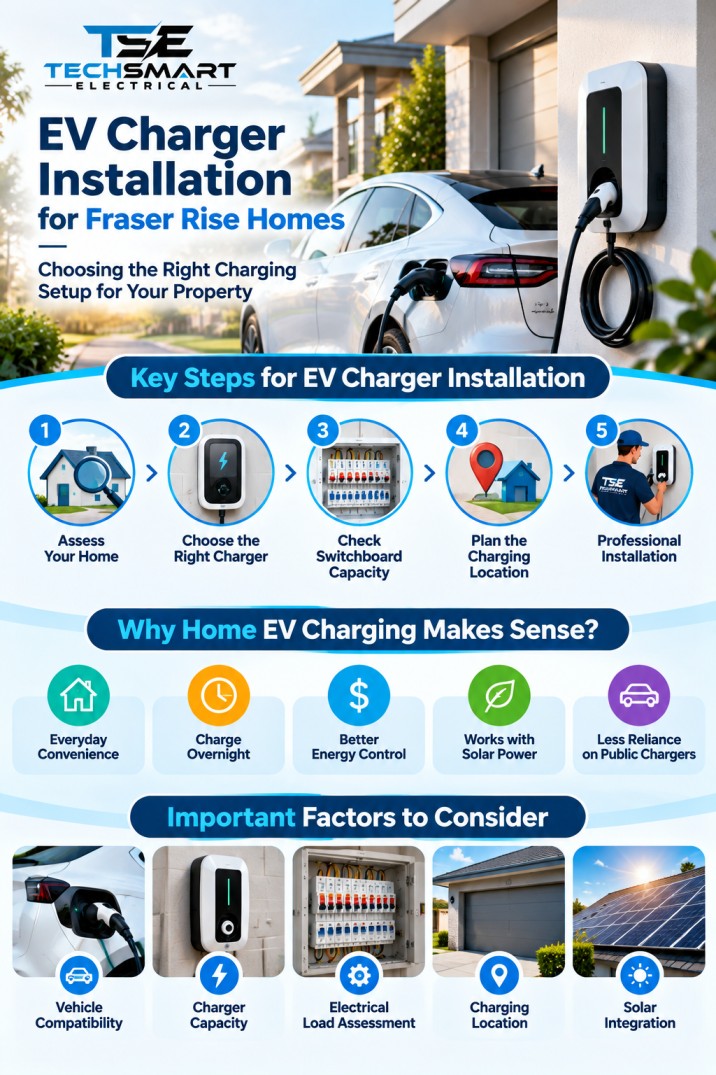
Here is a practical planning checklist.
| Planning area | What to check |
|---|---|
| Vehicle | Maximum AC charging capability |
| Charger | Output, connector and smart features |
| Electrical supply | Single-phase or three-phase |
| Switchboard | Condition, capacity and available space |
| Circuit | Dedicated circuit and protection |
| Location | Garage, driveway or outdoor wall |
| Cable route | Distance, access and cable protection |
| Solar | Compatibility with existing solar equipment |
| Future needs | Additional EVs and household upgrades |
Working through these points before purchasing equipment can help reduce unexpected changes during installation.
Even well-planned EV charging projects can become unnecessarily complicated when important details are overlooked.
Here are some common mistakes homeowners should avoid.
A higher-output charger is not always the better option.
If the vehicle cannot accept the advertised charging rate, or the property cannot support the required electrical arrangement, the extra capacity may provide little practical benefit.
Choose equipment based on compatibility and actual charging requirements.
Household electricity consumption can change significantly throughout the day.
Installing a charger without considering other major appliances may result in an unsuitable configuration.
An electrical load assessment helps identify these limitations before installation begins.
Three-phase power can support higher AC charging outputs when the charger and vehicle are compatible.
However, many households can meet their daily charging requirements with a suitable single-phase installation.
Upgrading the supply solely to obtain a higher charger rating may not be necessary.
A charger installed too far from the vehicle’s charging port can make everyday use difficult.
Always assess the parking position, cable reach and pedestrian access before deciding where the unit should be mounted.
Homeowners planning to purchase another EV, add solar panels or install battery storage should discuss these plans during the initial assessment.
Planning ahead may help avoid unnecessary electrical modifications later.
A properly planned installation involves more than mounting a charging unit and connecting electrical cables.
A qualified electrician should assess the property, confirm the equipment requirements and complete the installation with appropriate testing.
The electrician reviews the existing electrical installation, switchboard, supply capacity and proposed charger location.
They may also ask about your vehicle, typical driving distance and preferred charging times.
Based on the assessment, the electrician can help identify suitable charging equipment.
The recommendation should consider charger capacity, vehicle compatibility, available electrical supply and smart charging requirements.
The installation route is planned between the switchboard and charging location.
Cable sizing, circuit protection, installation conditions and isolation requirements must be considered.
The charging unit is securely mounted and connected according to its manufacturer’s instructions and applicable electrical requirements.
Any required switchboard modifications and protective devices are also completed.
The electrician completes the required electrical testing and verifies that the charger operates correctly.
In Victoria, electrical installation work must be carried out by appropriately licensed electrical workers, and a Certificate of Electrical Safety (COES) must be provided where required. Homeowners should request and retain the relevant certificate and installation documentation.
For homeowners researching EV charger electrician Fraser Rise, checking the electrician’s licensing, relevant installation experience and willingness to explain the proposed electrical work is an important part of selecting the right professional.
At this stage, TechSmart Electrical can be considered as a local electrical service provider when researching residential charging requirements. The important thing is to ensure that the proposed setup is based on the property’s actual electrical conditions rather than assumptions.
A few practical decisions made before installation can make a noticeable difference to everyday charging.
1. Check the vehicle before buying the charger.
Your car’s maximum AC charging rate should influence the equipment you select.
2. Do not overlook overnight charging.
A moderate-capacity charger may be sufficient if the vehicle remains parked for several hours.
3. Consider load management.
It may help households manage EV charging alongside other electrical appliances.
4. Plan for future vehicles.
If another EV is likely, discuss future electrical capacity and cable infrastructure with your electrician.
5. Think about solar compatibility.
A compatible charger may help you use surplus rooftop solar generation.
6. Keep the charging area accessible.
Avoid positioning the charger where doors, storage equipment or parked vehicles obstruct access.
7. Ask for an explanation of proposed upgrades.
If additional electrical work is recommended, ask what limitation it addresses and whether there are suitable alternatives.
8. Keep installation records.
Retain the charger manual, warranty details, electrical certificate and relevant testing documentation.
These small considerations can help homeowners make more informed decisions and avoid choosing equipment that does not suit their property.
Choosing the right charging system involves more than comparing charger specifications. Homeowners need to consider vehicle compatibility, electrical capacity, switchboard condition, charging habits and the property’s physical layout.
A suitable installation should provide enough charging capacity for everyday use without placing unnecessary demands on the home’s electrical infrastructure.
For anyone considering EV charger installation Fraser Rise, the best starting point is a professional electrical assessment. It helps identify whether the existing supply is suitable, whether a dedicated charging circuit is required and which charging equipment will provide the most practical solution.
If you are researching Electric Car Charger Installation Fraser Rise, take time to compare charger specifications and consider future household energy requirements before making a purchase.
TechSmart Electrical can help Fraser Rise homeowners explore suitable electrical installation options and understand the requirements of a residential EV charging setup. A properly planned system can make everyday charging more convenient while supporting your property’s long-term electrical needs.
The best charger depends on your vehicle’s charging capability, daily driving distance and available household electrical capacity.
A standard portable charger may suit occasional low-rate charging, while a dedicated 7 kW wall-mounted charger can be a practical option for many households.
Homeowners with compatible vehicles and three-phase electricity may also consider higher-output AC charging equipment.
The most suitable choice should be confirmed after checking the vehicle specifications and electrical installation.
Charging time depends on battery capacity, the charger’s output, the vehicle’s maximum AC charging rate and the battery’s current charge level.
For example, a 60 kWh battery receiving a consistent 7 kW charging rate would theoretically take approximately 8.6 hours to charge from empty to full.
Actual charging time can be longer because of charging losses, temperature conditions and the vehicle’s charging behaviour.
Most owners do not need to recharge from empty every day, so overnight charging can be sufficient for regular commuting.
No. Some homes already have suitable switchboards and sufficient electrical capacity.
Others may need modifications because of limited circuit space, outdated protective devices or higher existing electricity demand.
An electrician should inspect the installation and explain whether an upgrade is necessary before recommending additional work.
Yes, provided your solar system, EV charger and energy management equipment are compatible.
Some smart chargers can use surplus solar generation to charge the vehicle, while other configurations combine solar and grid electricity.
The amount of solar energy available depends on weather, generation capacity and household electricity consumption.
A compatible system should be selected based on your existing solar equipment and charging preferences.
Yes. A dedicated home EV charging unit involves electrical installation work that must be undertaken by appropriately licensed professionals.
The electrician must assess the circuit requirements, select suitable protective equipment, complete the installation and carry out the required testing.
In Victoria, homeowners should also obtain the applicable Certificate of Electrical Safety after the work is completed.
Techsmart Electrical is a locally owned company serving Melbourne and the surrounding areas. As leading specialists for commercial, industrial and residential electrician services, we prioritize customer satisfaction.


We are preferred electricians for Beacon Lighting and with that comes many bonuses for our customers. By using Techsmart Electrical as your preferred electrician, we can provide you with up to 20% off RRP of everything in store at Beacon Lighting, extended warranties on certain items and even free lighting design consultations.
Our team works closely alongside our home store in Taylors Lakes to deliver the best possible outcome for all installations. From installing one ceiling fan to wiring an entire home, Techsmart Electrical provides 100% satisfaction guarantee.
Contact us today to arrange your next installation.
Techsmart Electrical has always provided dependable and cutting-edge electrical contracting services and installations. Our qualified electricians offer services that are intended to support Melbourne businesses in growing and to give homeowners complete peace of mind.
It is entirely up to you where you want more power outlets in your home. Techsmart Electrical can install them wherever you need them. It's possible that all you need is to change your power outlets, which is a regular request. Even your outdated power sockets can be replaced with fresh models by our team in order to give your house the finishing touches.
With several years of experience, Techsmart Electrical’s licenced electricians can design and install any power point system, whether it's for a newly constructed home or an existing one. Call us and schedule a time for your power socket installation.












Techsmart Electrical is a Melbourne based electrical company. We understand the importance of top-quality workmanship, service and safety. With a professional approach, we are always ready to provide you with Master Electricians to deliver prompt electrical services for any situation.