

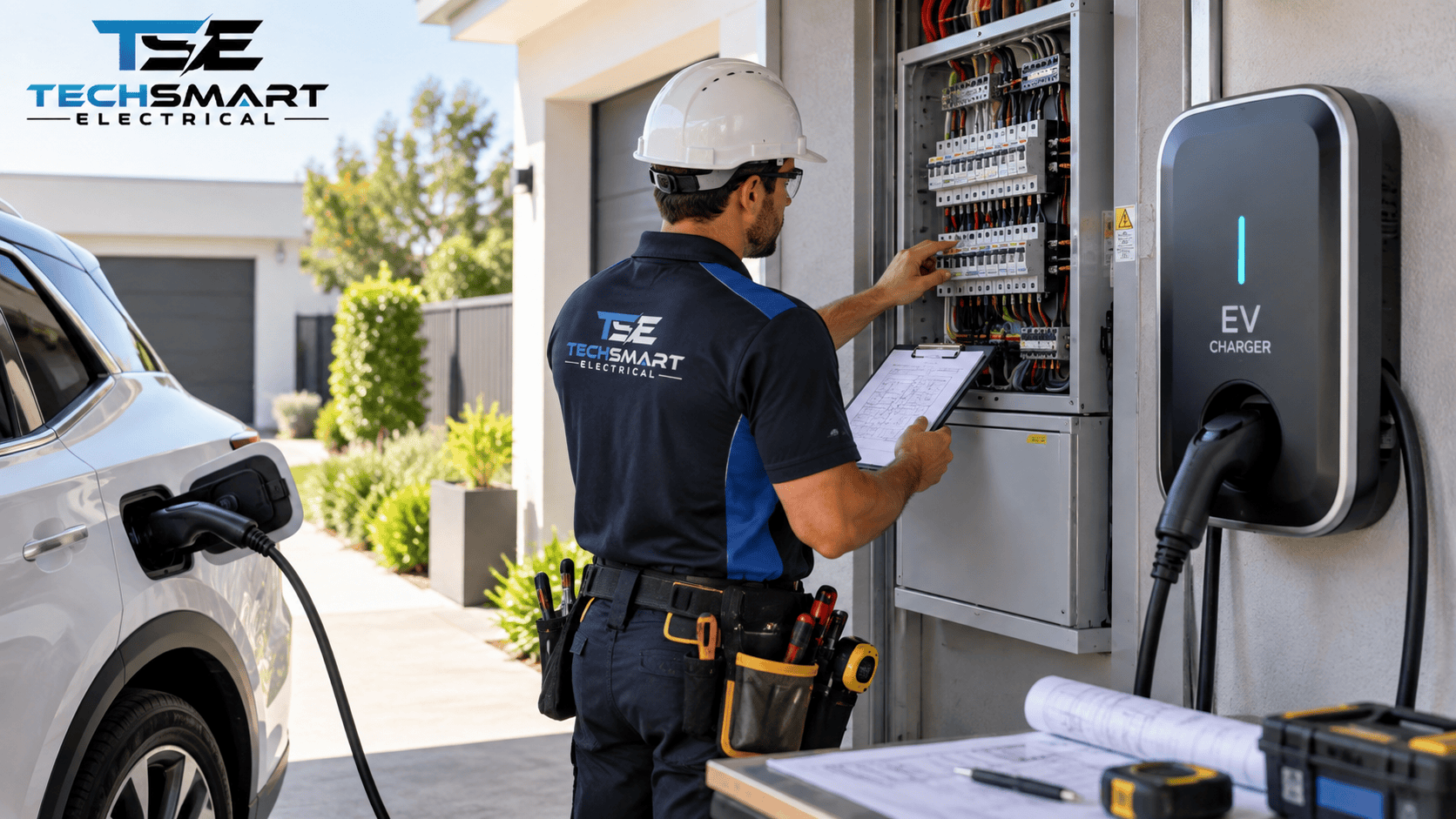
For many households, EV ownership starts with one simple question: where will the car charge overnight? EV charger installation Fraser Rise can be straightforward, but the best result comes from checking the home’s electrical capacity before choosing a charger. A modern wall-mounted charger may look like a simple appliance, yet it can place a steady electrical load on a home for several hours.
A practical installation is not only about getting more charging speed. It is about matching the charger to the vehicle, the home’s supply, the switchboard, the parking location and the family’s normal electricity use. This guide explains what Fraser Rise homeowners should check before installation, where problems commonly occur, and how to plan a safe home charging setup.
Residential EV charger installation Fraser Rise should begin with the property, not the charger catalogue. An electrician needs to understand how the home is supplied and what other equipment is running.
A typical evening might include EV charging, ducted heating or cooling, an electric oven, a hot-water system, an induction cooktop, a dishwasher and other appliances. Each item may work perfectly on its own. The issue is the combined demand.
Victoria’s energy guidance notes that higher-level home charging can require dedicated circuitry and that older homes may need wiring or switchboard upgrades. It also notes that many households can meet daily driving needs with slower charging, depending on their vehicle and travel pattern.
Before selecting equipment, check:
This initial assessment can prevent an expensive mistake: buying a high-powered charger and discovering that the home cannot use it efficiently without further electrical work.
Not every household needs the fastest possible EV charger. The right choice depends on how far the vehicle travels each day and how long it sits at home.
A standard portable charger can use a normal 230-volt outlet. It is convenient for some drivers, particularly those with modest daily mileage and long overnight charging periods. However, the circuit and outlet still need to be suitable for the intended continuous load.
A wall-mounted Level 2 EV charger is a different proposition. It normally uses a dedicated circuit and can deliver substantially more charging power. Victoria’s current energy guidance lists common Level 2 home charger outputs from around 3.6kW upward, with actual charging speed depending on the vehicle and installation.
That is where experience matters. Charging speed should solve a real need, not simply look impressive on a specification sheet.
Home charging changes the way electricity is used in a property. Unlike a kettle that runs for a few minutes, an EV charger can operate for hours.
An electrical load assessment considers the existing and proposed demand. A professional will look at major fixed loads, circuit arrangements, the supply capacity and how the charger can operate alongside other appliances.
Consider a home with:
If several of these operate together, the home’s peak demand can be much higher than the owner expects. That does not automatically mean a supply upgrade is required. Smart charging, charging schedules and suitable charger settings may help manage demand.
For some households, charging after other large loads have reduced can be enough. For others, the electrician may recommend changes to the electrical installation.
A good assessment should answer a simple question: can the charger operate safely and reliably without creating an unacceptable demand on the existing system?
A dedicated circuit gives the EV charger its own electrical path rather than sharing a circuit with ordinary household outlets.
This matters because EV charging is a sustained load. Victoria’s government specifically notes that dedicated circuitry is required for Level 2 wall chargers and that a dedicated circuit can also help avoid overloading existing household circuits.
The circuit design should match the charger’s requirements, cable length, installation conditions and protective devices. The electrician should also follow the charger manufacturer’s installation instructions.
Do not treat an extension lead as a substitute for proper EV charging infrastructure. It may introduce additional connection points, cable management problems and risks that were never part of the original installation design.
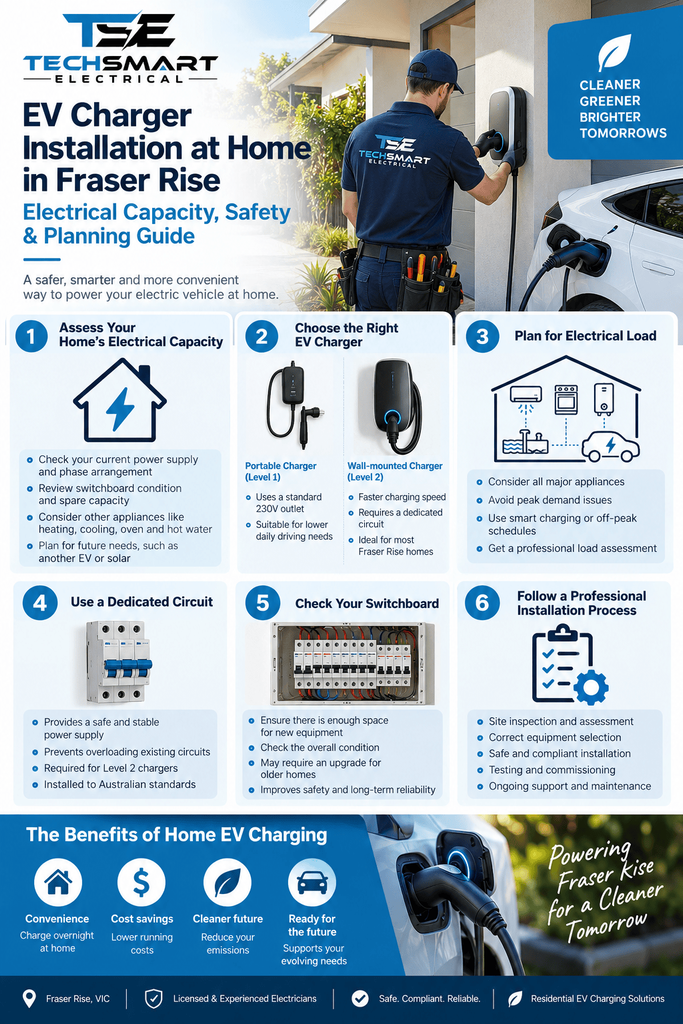
The switchboard is often the part of an EV project that surprises homeowners.
A newer switchboard with available space may make the job relatively simple. An older board, crowded enclosure or installation with limited capacity may require additional work before the charger can be connected.
A proper inspection should consider:
Energy Safe Victoria explains that safety switches protect people from electric shock, while circuit breakers provide protection against short circuits and over-current. They are not interchangeable devices.
If an installation involves prescribed electrical work, the appropriate electrical safety certification and inspection requirements also need to be followed. Homeowners should expect their electrical contractor to provide the required documentation.
Techsmart Electrical recommends looking at the complete electrical setup rather than treating the charger as an isolated appliance. That approach helps identify capacity issues before installation work begins.
The best charging point is usually the one that works naturally with the way the household parks and drives.
Think about the parking position first. The cable should reach the vehicle without creating a trip hazard or forcing the user to stretch it across a walkway.
Outdoor installations also need equipment and installation methods suitable for the environment. Cable protection, weather exposure, mounting surface and physical impact should all be considered.
If the cable route is long, concealed or difficult to access, labour can become a larger part of the project. That is why a proper site assessment is more useful than choosing an installation solely from an advertised package price.
Most problems are easier to prevent than to fix.
A high-output charger is not automatically the best choice. If the home’s supply, wiring or vehicle cannot make useful use of that output, the extra capacity may not justify the cost.
A home can appear to have plenty of capacity until the charger is added to the evening load. Air conditioning, electric cooking and hot water can all contribute to peak demand.
Regular charging should use an installation appropriate for the load and equipment. Avoid improvised setups or poorly managed cables.
A good installation should leave the homeowner understanding what was installed and why.
A qualified Fraser Rise Electrician should be able to assess the property rather than simply quote for fitting a particular model. A residential electrician Fraser Rise can also identify whether the existing installation needs attention before a new charging circuit is added.
Techsmart Electrical takes this assessment-led approach by considering the home’s existing electrical setup, the charging requirement and the practical installation conditions before recommending work.
Good EV charging starts with the house, not the charger. Check the electrical load, understand the switchboard capacity, plan the cable route and choose charging power that matches the vehicle and your daily routine. With that groundwork, EV charger installation Fraser Rise can become a practical long-term improvement rather than an expensive afterthought.
For homeowners planning a new charging point, Techsmart Electrical can assess the existing electrical setup and help determine what type of installation is appropriate. A careful assessment now can make home charging safer, simpler and easier to manage as your electricity needs grow. Consult with us now!
For a dedicated wall-mounted Level 2 charger, dedicated circuitry is generally part of the installation. It allows the charger to have a circuit designed for its expected load instead of sharing a household circuit. The exact arrangement should be determined by a qualified electrician based on the charger and property.
Possibly. It depends on the available capacity, existing loads, switchboard condition, protective equipment and the charger’s power requirements. A site assessment is the safest way to determine whether the existing switchboard can accommodate the additional load or needs modification.
For many households, it can be. The useful charging speed depends on the vehicle, daily kilometres, battery size and how long the car stays parked. A driver who charges overnight may have little practical need for a much faster setup.
Some portable EV charging equipment is designed for a standard 230-volt outlet. However, the outlet, circuit and installation must be suitable for the intended continuous load. If regular home charging is planned, an electrician can advise whether a dedicated circuit or wall charger would be more appropriate.
It can be useful, particularly if you want to schedule charging or make better use of solar generation. The best setup depends on your solar system, electricity plan, vehicle and household demand. Smart charging is a useful option, but it should be chosen for a real household need rather than as a default upgrade.
Techsmart Electrical is a locally owned company serving Melbourne and the surrounding areas. As leading specialists for commercial, industrial and residential electrician services, we prioritize customer satisfaction.


We are preferred electricians for Beacon Lighting and with that comes many bonuses for our customers. By using Techsmart Electrical as your preferred electrician, we can provide you with up to 20% off RRP of everything in store at Beacon Lighting, extended warranties on certain items and even free lighting design consultations.
Our team works closely alongside our home store in Taylors Lakes to deliver the best possible outcome for all installations. From installing one ceiling fan to wiring an entire home, Techsmart Electrical provides 100% satisfaction guarantee.
Contact us today to arrange your next installation.
Techsmart Electrical has always provided dependable and cutting-edge electrical contracting services and installations. Our qualified electricians offer services that are intended to support Melbourne businesses in growing and to give homeowners complete peace of mind.
It is entirely up to you where you want more power outlets in your home. Techsmart Electrical can install them wherever you need them. It's possible that all you need is to change your power outlets, which is a regular request. Even your outdated power sockets can be replaced with fresh models by our team in order to give your house the finishing touches.
With several years of experience, Techsmart Electrical’s licenced electricians can design and install any power point system, whether it's for a newly constructed home or an existing one. Call us and schedule a time for your power socket installation.











Techsmart Electrical is a Melbourne based electrical company. We understand the importance of top-quality workmanship, service and safety. With a professional approach, we are always ready to provide you with Master Electricians to deliver prompt electrical services for any situation.