

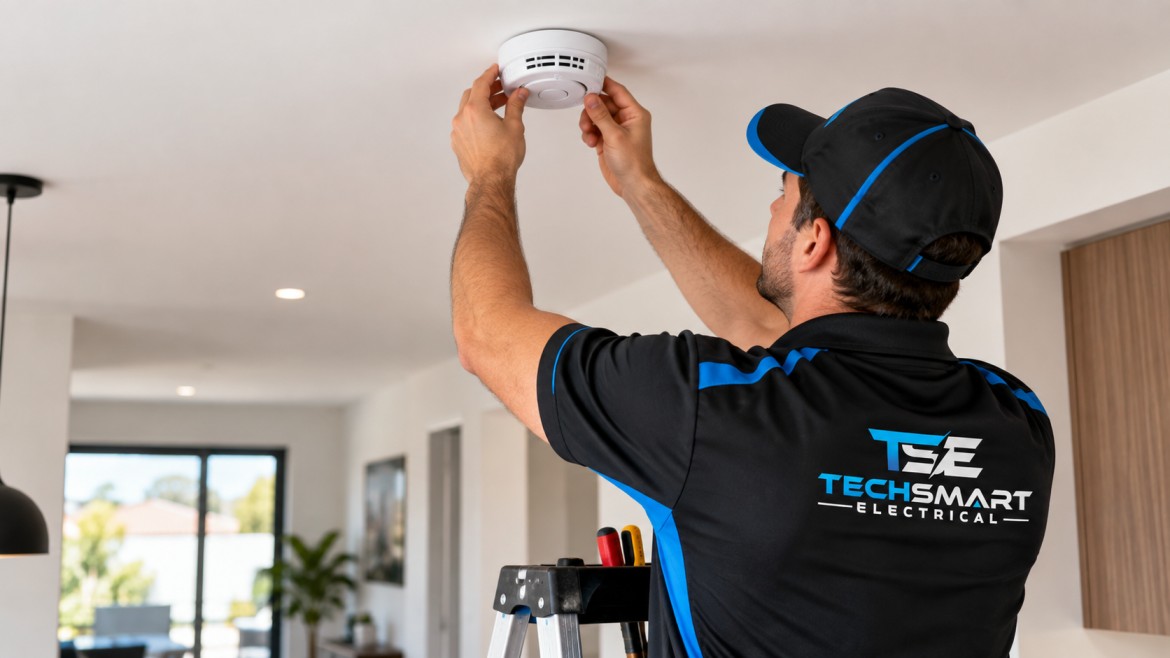
A smoke alarm is easy to overlook when everything at home is working normally. It sits quietly on the ceiling, rarely demanding attention until its battery starts beeping or someone remembers to press the test button.
But when a fire starts, those few seconds of early warning can matter enormously.
For homeowners considering smoke alarm installation Tarneit, the important question is not simply which alarm to buy. It is also about where the alarms should be positioned, whether they should be interconnected, how they should be tested and when professional electrical assistance is appropriate.
Victorian fire authorities recommend smoke alarms in every bedroom and living area, in addition to the minimum legal requirements. They also recommend interconnected alarms so that when one alarm activates, the others sound as well.
This guide explains the practical considerations behind smoke alarm placement, installation and testing, including what Tarneit homeowners should know before upgrading an existing system.
A smoke alarm provides an early warning when smoke from a fire is detected.
That sounds straightforward, but the location of the alarm can make a significant difference. A fire beginning inside a bedroom may not trigger an alarm located only in a hallway quickly enough, particularly when the bedroom door is closed.
That is one reason CFA recommends installing smoke alarms inside bedrooms as well as in living areas.
Modern homes also contain numerous electrical appliances, chargers, heating and cooling equipment, cooking appliances, synthetic furnishings and other materials that can contribute to a fire.
A sensible smoke alarm strategy therefore considers the whole home rather than treating the hallway alarm as the only important device.
For homeowners arranging smoke alarm installation Tarneit, this means looking at sleeping areas, living spaces, floor levels and the way people actually use the home.
Smoke alarms are compulsory in Victorian residential properties, including houses, units, flats and townhouses. They must comply with Australian Standard AS 3786.
The requirements can differ depending on when a property was constructed or significantly renovated.
Generally:
These legal requirements are separate from the recommendations made by Victorian fire authorities for additional protection.
For example, CFA recommends smoke alarms in every bedroom and living area, even though the minimum legal requirements can be narrower.
Because requirements can depend on the property’s construction history and circumstances, homeowners should confirm the applicable requirements rather than assuming every house follows exactly the same configuration.
Smoke alarm placement should be planned around the home’s layout.
The minimum legal requirement includes positioning an alarm between sleeping areas and the remainder of the home and having at least one alarm on each level. Victorian fire authorities recommend broader coverage, including bedrooms, hallways and living areas.
For a typical Tarneit home, a practical assessment may consider:
Imagine a fire starts in a bedroom while someone is asleep.
If the bedroom door is closed, smoke may not reach a hallway alarm immediately. CFA specifically notes that an alarm outside the bedroom may not activate quickly enough in this situation.
Installing an alarm inside the bedroom provides another detection point.
This is particularly relevant for children’s bedrooms, guest rooms and bedrooms located at the opposite end of a large home.
The Victorian Building Authority advises that smoke alarms should generally be installed on the ceiling at least 30 cm from a wall. Where a wall installation is appropriate, the alarm should be at least 30 cm below the ceiling to avoid dead-air areas.
The exact placement should also account for the manufacturer’s installation instructions and the physical layout of the room.
Avoid assuming that the centre of every room is automatically the correct location.
An interconnected smoke alarm system allows alarms to communicate with one another.
If one alarm detects smoke, the other interconnected alarms can sound too.
This is particularly useful in larger homes where bedrooms may be separated from living areas or located on another floor.
Imagine a fire beginning in a downstairs living room while someone is asleep upstairs. A single alarm downstairs may not provide the same level of immediate awareness as a properly interconnected system that activates throughout the home.
CFA recommends interconnected smoke alarms, and Victorian requirements make interconnection mandatory for multiple alarms in new homes and homes undergoing significant renovation after the applicable 2014 changes.
Hardwired smoke alarms use electrical wiring to communicate with one another.
A typical installation involves an additional interconnection conductor installed alongside the mains wiring so that the alarms can communicate.
Because mains-powered electrical work is involved, this type of installation should be completed by an appropriately licensed electrician.
This is where a Tarneit Electrician can be useful when an existing property needs mains-powered alarms installed, replaced or interconnected.
The electrician can assess the existing wiring, determine whether the current system is suitable and install or modify the circuit in accordance with applicable requirements.
Wireless interconnected alarms communicate using radio frequency rather than a dedicated interconnection wire.
CFA notes that wireless interconnected alarms powered by long-life batteries are available and can be easier to install in some existing homes because additional interconnection cabling may not be required.
That does not mean wireless is automatically suitable for every property.
The choice can depend on:
A homeowner should consider the complete system rather than selecting a device based only on its purchase price.
Smart Smoke Alarm Installation takes the basic concept of smoke detection and adds connected functionality.
Depending on the product, smart alarms may offer features such as:
However, “smart” does not automatically mean “safer.”
A connected alarm still needs correct placement, appropriate power, reliable communication and regular testing.
A homeowner should first establish whether the alarm meets the applicable Australian Standard and is suitable for the property’s requirements.
Smart features should be treated as additional functionality rather than a substitute for correct installation and maintenance.
A smoke alarm that has never been tested should not be assumed to be working correctly.
CFA recommends testing smoke alarms monthly by pressing the test button until the alarm sounds. It also recommends cleaning smoke alarms at least once a year and replacing smoke alarms after 10 years.
A practical testing routine can include:
Do not assume that the system is fully operational simply because one alarm sounds.
If interconnected alarms are designed to activate together, a failure to communicate may indicate a battery, power, communication or device problem.
Follow the manufacturer’s troubleshooting instructions and seek professional assistance where electrical or system faults need investigation.
CFA recommends monthly testing.
For rental properties, Victorian rental providers have additional responsibilities. Consumer Affairs Victoria states that rental providers must ensure smoke alarms are correctly installed and working, and that they are tested at least once every 12 months according to the manufacturer’s instructions.
The monthly household test and the formal maintenance requirements for rental properties are not necessarily the same activity.
Homeowners should also follow the manufacturer’s instructions because different alarm models can have specific testing and maintenance procedures.
A proper Installation should consider more than simply attaching a device to a ceiling.
Before installation, the relevant questions include:
After installation, the system should be checked to confirm that the alarms operate as intended.
This approach reduces the risk of installing new devices without addressing shortcomings in the existing system.
There are situations where professional electrical assistance is appropriate.
For example, homeowners may need an electrician when:
A Tarneit Electrician can also help homeowners understand whether the existing installation is suitable for the proposed replacement system.
For battery-only alarms in older homes, installation may be straightforward depending on the product and circumstances. But once mains electrical work is involved, appropriate licensing requirements become particularly important.
Smoke alarms are one part of broader residential electrical safety.
An electrical safety inspection Tarneit homeowners arrange may identify issues elsewhere in the electrical installation, such as deteriorated components, damaged fittings or other safety concerns.
This can be particularly useful when buying an older property, renovating, preparing a rental property or dealing with recurring electrical problems.
However, a general electrical inspection should not be confused with a dedicated smoke alarm compliance or maintenance assessment. The scope of work should be clearly established before the inspection begins.
A single hallway alarm may satisfy some minimum requirements depending on the property, but broader coverage is recommended by Victorian fire authorities.
Bedrooms and living areas deserve particular consideration.
Poor positioning can affect smoke detection.
The VBA advises keeping ceiling-mounted alarms at least 30 cm from walls.
The electrical requirements for a home constructed after 1 August 1997 are different from those applying to an older property.
Before replacing alarms, establish the property’s construction and renovation history.
Connected devices still require testing, cleaning, power and appropriate maintenance.
Technology does not remove the need for basic fire safety checks.
An occasional chirp can indicate a battery issue, fault condition or an alarm that needs replacement.
Do not simply remove the battery and leave the device inactive.
A smoke alarm is one part of a broader fire safety plan.
Homeowners should also consider:
CFA advises households to get down low, stay out of smoke, alert others, leave the building and stay out if a fire occurs. It also advises calling Triple Zero from a safe location.
The purpose of an alarm is not to encourage people to investigate a fire. It is to provide warning so occupants can escape.
Smoke alarms do not last indefinitely.
CFA currently recommends replacing smoke alarms after 10 years.
Before replacing an old unit, check:
Replacing one alarm in a network may also require checking compatibility with the other alarms.
For hardwired interconnected systems, mixing incompatible models can create problems with communication or installation requirements.
Smoke alarm responsibilities in rental properties are particularly important.
Consumer Affairs Victoria states that rental providers must ensure smoke alarms are correctly installed and working. Rental providers also have responsibilities concerning regular testing.
Renters should not remove or disable smoke alarms.
If an alarm is faulty or not working, renters should notify the rental provider or property manager. CFA also advises renters to report faults rather than disconnecting the device.
This distinction matters because a non-functioning alarm can leave occupants without early warning.
A family moves into a newly built two-storey home.
Instead of checking only whether there is an alarm somewhere upstairs and downstairs, they review each bedroom and living area and confirm that the system is appropriately interconnected.
This provides a more complete approach to household fire detection.
A homeowner renovating an older property discovers that the existing smoke alarms are battery-powered and several are approaching the end of their service life.
Rather than replacing them individually without considering the broader system, the homeowner arranges an assessment of the required alarm configuration.
This can prevent compatibility and placement problems later.
A homeowner hears intermittent beeping from a hallway smoke alarm.
They replace the battery where appropriate, but the alarm continues to indicate a fault.
Instead of leaving the device disabled, they check the manufacturer’s instructions and arrange replacement or professional assessment as necessary.
Think about sleeping positions. Ask whether everyone sleeping in the home would hear an alarm from another part of the property.
Prioritise bedrooms. Victorian fire authorities recommend alarms inside bedrooms because hallway detection may not provide enough warning for a fire beginning behind a closed bedroom door.
Interconnect where appropriate. Interconnected alarms provide a whole-home audible warning when one alarm activates.
Do not ignore age. Keep track of installation dates and replace alarms according to their recommended service life.
Test consistently. Monthly testing is a simple habit that confirms the alarm can produce its warning signal.
Keep alarms clean. Dust accumulation can affect device performance, which is why CFA recommends cleaning alarms at least annually.
Treat electrical work seriously. If installation involves mains wiring, use an appropriately licensed electrician.
A practical homeowner checklist can be reviewed once or twice each year.
Placement
System
Testing
Maintenance
Household readiness
This kind of alarm testing routine takes very little time but can prevent an important safety device from being forgotten.
Effective smoke alarm protection involves more than installing a device and assuming the job is finished.
For homeowners researching smoke alarm installation Tarneit, the bigger picture includes correct placement, suitable power arrangements, interconnection, routine testing and timely replacement.
Victorian fire authorities recommend smoke alarms in bedrooms and living areas and encourage interconnected systems because an alarm sounding in one part of the home can alert occupants elsewhere.
A well-planned Smart Smoke Alarm Installation can add useful connected features, but technology should complement rather than replace good placement, testing and maintenance.
Whether you are moving into a new Tarneit property, renovating an older home or replacing ageing alarms, take the opportunity to review the entire system.
A working smoke alarm is not just another item on a home maintenance list. It is an important part of a household’s fire escape strategy.
The appropriate locations depend on the property’s design and applicable requirements. Victorian fire authorities recommend smoke alarms inside every bedroom and living area, as well as between sleeping areas and the rest of the home. At least one alarm is required on each level. Ceiling placement is generally preferred, with the VBA advising at least 30 cm from walls when installed on the ceiling.
For homes constructed or significantly renovated after 1 May 2014, where multiple smoke alarms are required, the alarms must be interconnected. Victorian fire authorities also recommend interconnection more broadly because all connected alarms can sound when one detects smoke.
CFA recommends testing smoke alarms monthly by pressing the test button until the alarm sounds. Smoke alarms should also be cleaned at least once a year, and CFA recommends replacing alarms after 10 years. Always follow the manufacturer’s instructions for the particular model installed.
It depends on the type of alarm and installation. Battery-powered alarms can be installed by homeowners in circumstances where this is permitted and appropriate. Mains-powered smoke alarm installation and changes to fixed electrical wiring require appropriately licensed electrical work. Homes constructed after 1 August 1997 generally require mains-powered smoke alarms with battery backup.
It can be useful to consider smoke alarms alongside broader electrical safety, particularly when buying, renovating or maintaining an older property. However, a general electrical inspection and a dedicated smoke alarm assessment have different scopes. Ask the electrician or inspector exactly what will be checked, including alarm placement, power supply, interconnection, operation and applicable requirements.
Techsmart Electrical is a locally owned company serving Melbourne and the surrounding areas. As leading specialists for commercial, industrial and residential electrician services, we prioritize customer satisfaction.


We are preferred electricians for Beacon Lighting and with that comes many bonuses for our customers. By using Techsmart Electrical as your preferred electrician, we can provide you with up to 20% off RRP of everything in store at Beacon Lighting, extended warranties on certain items and even free lighting design consultations.
Our team works closely alongside our home store in Taylors Lakes to deliver the best possible outcome for all installations. From installing one ceiling fan to wiring an entire home, Techsmart Electrical provides 100% satisfaction guarantee.
Contact us today to arrange your next installation.
Techsmart Electrical has always provided dependable and cutting-edge electrical contracting services and installations. Our qualified electricians offer services that are intended to support Melbourne businesses in growing and to give homeowners complete peace of mind.
It is entirely up to you where you want more power outlets in your home. Techsmart Electrical can install them wherever you need them. It's possible that all you need is to change your power outlets, which is a regular request. Even your outdated power sockets can be replaced with fresh models by our team in order to give your house the finishing touches.
With several years of experience, Techsmart Electrical’s licenced electricians can design and install any power point system, whether it's for a newly constructed home or an existing one. Call us and schedule a time for your power socket installation.












Techsmart Electrical is a Melbourne based electrical company. We understand the importance of top-quality workmanship, service and safety. With a professional approach, we are always ready to provide you with Master Electricians to deliver prompt electrical services for any situation.