

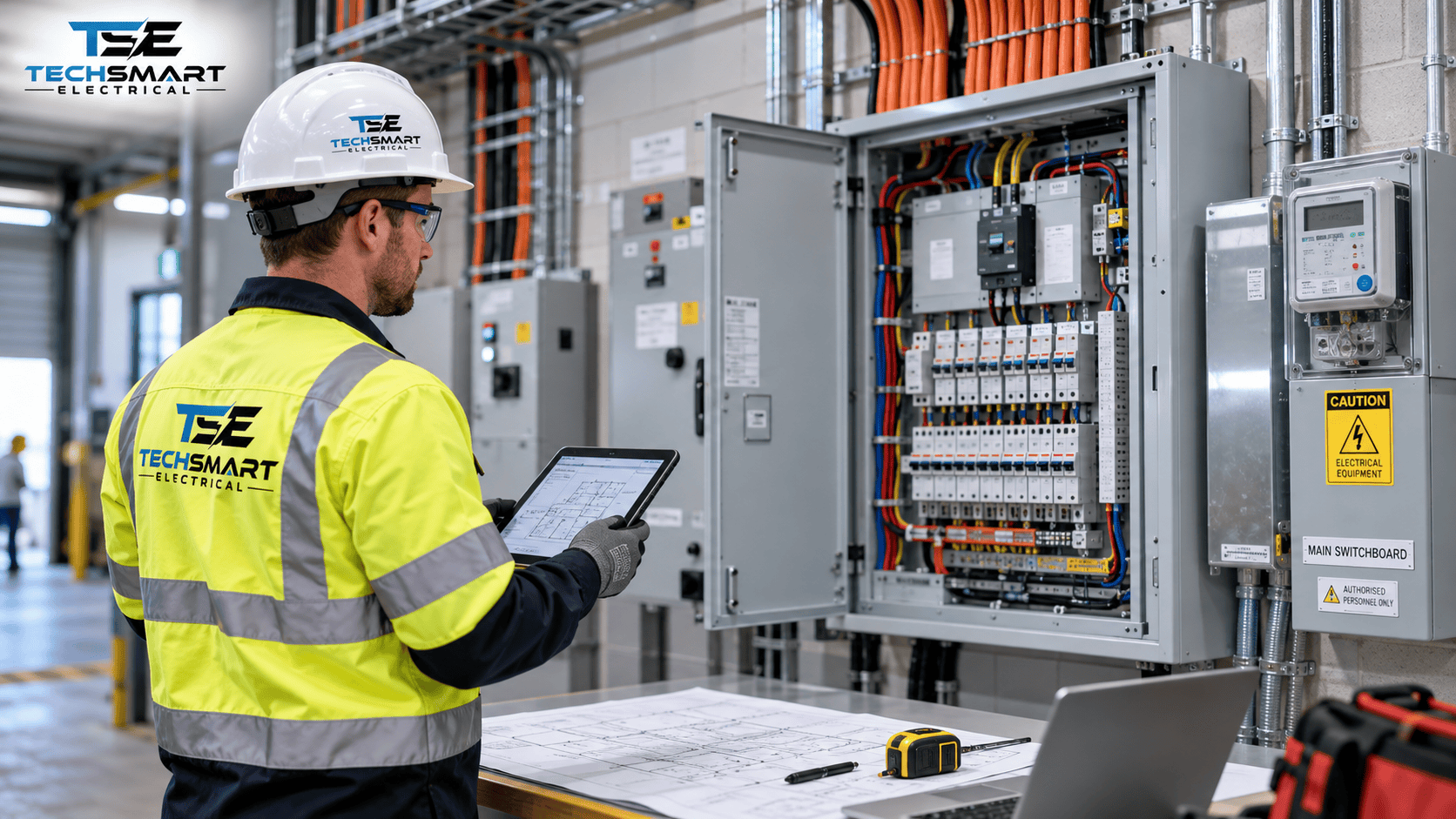
For any warehouse, workshop, retail premises, office, or industrial facility, choosing the right commercial electrician Derrimut businesses can rely on is an important part of maintaining a safe and dependable workplace. Electrical systems operate behind almost every business activity, from warehouse lighting and machinery to computers, refrigeration, security systems, and production equipment. When electrical maintenance is overlooked, seemingly minor problems can develop into equipment failures, operational downtime, electric shock risks, or fire hazards. Regular inspections, testing, maintenance, and timely repairs help businesses identify developing issues before they become expensive or dangerous disruptions.
Electrical safety is not simply about checking whether a light turns on or a machine starts. A commercial electrical installation needs to remain suitable for the demands placed on it. As businesses expand, add machinery, modify workspaces, or increase operating hours, the electrical requirements can change considerably.
For businesses in Derrimut, having a structured approach to electrical safety is particularly important because commercial and industrial properties often involve substantial electrical loads, large working areas, heavy equipment, and busy vehicle or pedestrian movements.
Why Commercial Electrical Safety Should Be a Business Priority
Electricity is essential to modern commercial operations, but electrical faults can create consequences far beyond a simple power interruption.
A fault affecting one circuit might stop machinery. A switchboard problem could interrupt multiple areas of a facility. Poorly maintained lighting could reduce visibility in a warehouse. Damaged cabling in a high-traffic area could create a serious safety hazard.
The potential impact includes:
A useful electrical safety strategy therefore combines prevention, inspection, maintenance, documentation, and prompt response.
Rather than asking only, “Is everything working?”, businesses should also ask:
Is the electrical system still appropriate for how we use the premises today?
That question becomes particularly important when a company has installed new machinery, changed its warehouse layout, added charging equipment, increased staffing, or extended operating hours.
Commercial Electrician: What Should Businesses Monitor?
A Commercial electrician does more than repair a failed power point. Commercial electrical work can involve distribution systems, switchboards, machinery, lighting, safety devices, three-phase supplies, control systems, and complex building infrastructure.
Businesses should encourage employees to report obvious warning signs rather than attempting to diagnose or repair electrical problems themselves.
Watch for unusual electrical behaviour
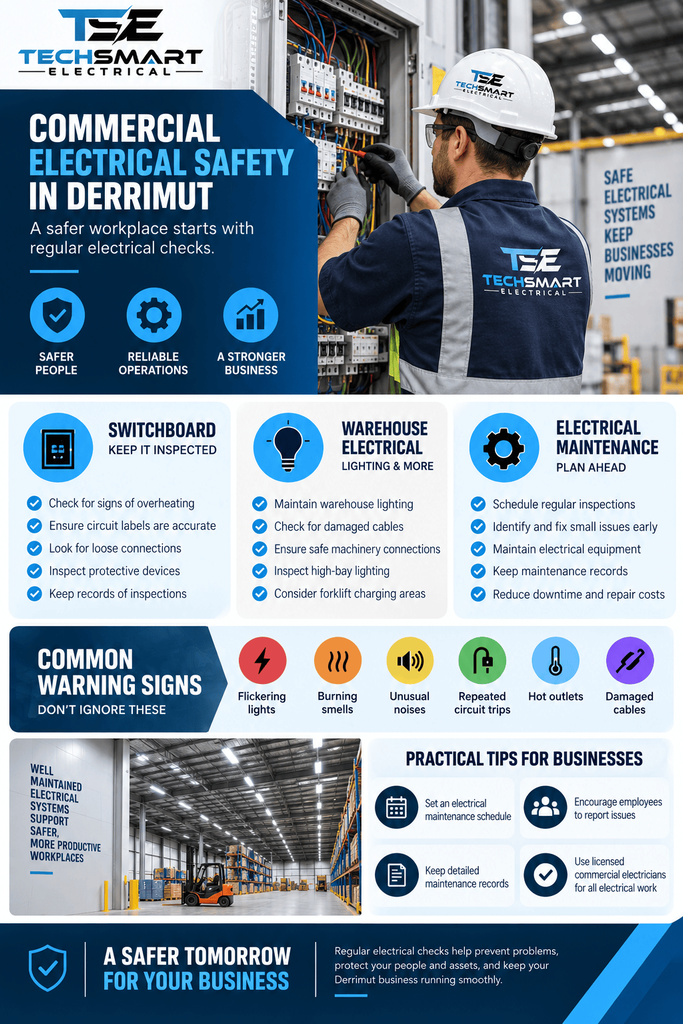
Common warning signs include:
These symptoms should not automatically be treated as isolated equipment problems.
For example, if a particular circuit repeatedly trips after a new machine has been installed, the issue could relate to the equipment, circuit capacity, connections, or another underlying electrical condition.
Repeatedly resetting the breaker without determining why it trips is not a maintenance strategy.
Employees should know what to report
A practical workplace electrical policy should tell employees:
This makes electrical safety part of everyday workplace behaviour rather than something left entirely to maintenance personnel.
Warehouse Electrical: What Makes Warehouses Different?
Warehouses can have demanding electrical environments because several systems often operate simultaneously.
A typical facility might contain:
This means warehouse electrical services Derrimut businesses arrange should consider the entire operating environment.
Warehouse lighting deserves particular attention
Good warehouse lighting is important for visibility and efficient operations.
Employees may need to read labels, identify products, operate forklifts, move pallets, navigate aisles, and work around machinery. Poor illumination can make these tasks more difficult and may contribute to workplace hazards.
During routine checks, businesses should look for:
A lighting problem should also be considered in context.
If the same fitting repeatedly fails, simply replacing the lamp may not address the underlying issue. Investigation may be appropriate to determine whether there is a problem with the fitting, connection, circuit, environmental conditions, or another component.
Switchboard: Why Regular Inspection Matters
The Switchboard is one of the most important components of a commercial electrical installation because it distributes electrical power to different circuits and incorporates protective equipment.
A switchboard that has been operating for years should not simply be assumed to remain in perfect condition.
What can affect a commercial switchboard?
Potential issues can include:
Some of these problems may not be visible to an untrained person.
Switchboard inspection should be performed appropriately
A switchboard inspection may involve visual assessment and relevant electrical testing by a qualified professional.
The exact scope depends on the installation, equipment, condition, and purpose of the inspection.
Businesses should never remove covers or attempt internal switchboard work themselves. Commercial electrical switchboards can contain dangerous voltages even when some circuits have been switched off.
Accurate labelling matters
One simple but valuable maintenance practice is keeping circuit identification accurate.
Consider an emergency where a machine needs to be isolated quickly. If switchboard labels are outdated because equipment was relocated or additional circuits were installed, identifying the correct circuit can take longer than necessary.
Good documentation supports safer maintenance and troubleshooting.
Commercial Electrical Maintenance: A Proactive Approach
A common mistake is to think about electrical maintenance only after something fails.
Reactive maintenance looks like this:
Fault → downtime → emergency call → repair
A proactive approach is different:
Inspection → early detection → planned maintenance → reduced disruption
No maintenance program can guarantee that an electrical fault will never occur. However, planned maintenance gives businesses a better opportunity to identify deterioration and address problems before they cause major disruption.
What should maintenance records contain?
Businesses can maintain records covering:
These records can also reveal patterns.
Suppose a warehouse experiences repeated faults affecting the same circuit every few months. If each incident is repaired independently, the business may continue experiencing the same disruption.
A maintenance history makes recurring problems easier to identify and investigate.
Electrical Equipment Should Not Be Forgotten
Fixed wiring and switchboards receive considerable attention, but connected equipment also deserves regular consideration.
Commercial electrical equipment can deteriorate because of:
For example, equipment used near a loading dock may be exposed to conditions very different from equipment inside an air-conditioned office.
Employees should report damaged electrical equipment rather than continuing to use it simply because it still operates.
A machine that “still works” can nevertheless have a damaged cable, plug, enclosure, or internal component that creates a safety concern.
Safety Switches and Protective Devices
Protective devices are an important part of electrical safety, but businesses should understand that different protective devices serve different purposes.
Circuit breakers and residual-current devices (RCDs), for example, perform different protective functions.
The correct protection depends on the electrical installation and its intended use.
Businesses should not assume:
“We have safety switches, so everything is automatically safe.”
Protection systems still need to be appropriately installed, maintained, and tested where required.
Where a protective device repeatedly operates, the cause should be investigated rather than simply resetting it each time.
Practical Electrical Safety Checklist for Derrimut Businesses
A simple checklist can help management and employees identify issues that require attention.
Routine workplace observations
Employees should watch for:
Periodic management checks
Management should review:
Professional assessment
Where electrical inspection, testing, repair, installation, fault finding, or modification is required, businesses should engage an appropriately licensed electrician.
The required inspection and testing frequency depends on the workplace, installation, equipment, environmental conditions, and applicable Australian requirements.
Common Electrical Safety Mistakes Businesses Should Avoid
Ignoring repeated circuit trips
A breaker that repeatedly trips is a warning that deserves investigation.
Resetting it repeatedly without finding the cause can allow an electrical problem to continue.
Using extension leads as permanent infrastructure
Extension leads can be useful in appropriate circumstances, but continually relying on them because fixed outlets are inconveniently located may indicate that the electrical layout needs review.
Overloading power boards
Connecting multiple high-demand appliances to one power board can create excessive loading.
Equipment should be supplied through electrical circuits and connection arrangements appropriate for its electrical demand.
Delaying repairs because equipment still works
Electrical defects do not always cause immediate failure.
A damaged cable may continue supplying power while creating an increasing safety risk.
Allowing unqualified people to perform electrical work
Electrical installation and repair are not ordinary DIY maintenance activities.
Commercial electrical work should be undertaken by appropriately licensed professionals.
How Businesses Can Build a Better Electrical Safety Routine
An effective program does not need to be complicated.
Step 1: Identify electrical assets
Create a basic inventory of major electrical systems and equipment.
Include:
Step 2: Identify higher-risk areas
Consider locations where electrical equipment is exposed to:
These environments may require additional attention.
Step 3: Record faults
Do not rely on memory.
Document recurring faults and repairs so that patterns become visible.
Step 4: Schedule appropriate maintenance
Use the property’s actual electrical requirements and risk profile to determine suitable inspection and maintenance intervals.
Step 5: Review changes
Whenever a business adds significant equipment, expands an area, changes machinery, or modifies its layout, consider whether the electrical infrastructure remains appropriate.
This is one area where experienced commercial electrical contractors Derrimut businesses engage can provide useful practical input.
Expert Advice: Think About Electrical Safety Before Expansion
One of the most overlooked electrical issues occurs when a business grows.
A warehouse might initially have sufficient electrical capacity for its equipment. Several years later, the business adds additional machinery, refrigeration, chargers, computers, extraction equipment, or lighting.
The original electrical design may no longer reflect the current load.
Before significant changes are made, businesses should consider the electrical implications.
For example, installing several new high-demand machines should not be treated simply as “adding more outlets.” The electrical supply, circuits, protective devices, distribution equipment, and installation requirements may all need consideration.
Planning electrical requirements before equipment arrives can be considerably easier than discovering capacity or installation issues after the new equipment is already installed.
What Should Happen During an Electrical Emergency?
If an electrical hazard occurs, protecting people should come before protecting equipment or maintaining production.
Depending on the situation:
Employees should never be encouraged to investigate live electrical faults.
A clear emergency procedure is especially important for warehouses and businesses operating outside normal office hours.
When Should a Business Contact a Commercial Electrician?
Businesses should seek qualified electrical assistance when they encounter problems involving the electrical installation or when new electrical work is required.
Examples include:
Using the appropriate licensed professional helps ensure the work is performed in accordance with relevant requirements.
Businesses should also retain relevant documentation from completed electrical work where applicable.
Conclusion
For businesses operating in Derrimut, electrical safety should be treated as an ongoing operational responsibility rather than a task that only matters after something breaks. A reliable commercial electrician Derrimut businesses work with can help identify electrical issues, assess changing requirements, perform appropriate maintenance, and address faults before they become larger problems.
Regular attention should include commercial electrical maintenance, warehouse lighting, electrical equipment, protective devices, cabling, outlets, and switchboard inspection where appropriate. Businesses should also maintain clear records, encourage employees to report warning signs, and review their electrical requirements whenever equipment or operations change.
Most importantly, do not wait for a major failure before taking electrical safety seriously. A planned approach to inspection and maintenance can help businesses reduce avoidable disruption, identify developing risks, and maintain a safer working environment.
The goal is not simply to keep the power on. It is to keep the electrical system appropriate, maintained, and safe for the way the business actually operates.
Frequently Asked Questions
1. How often should a commercial electrical installation in Derrimut be inspected?
There is no single inspection frequency suitable for every commercial property. The appropriate approach depends on factors such as the type of business, electrical installation, equipment, operating hours, environmental conditions, previous faults, and applicable Australian requirements.
A busy warehouse containing machinery and charging equipment may require a different maintenance regime from a small office. A qualified electrician can help establish an appropriate inspection and maintenance schedule based on the actual installation.
2. What are the first signs that a commercial electrical system may have a problem?
Repeated breaker trips, flickering lights, unusual smells, buzzing noises, hot outlets, discolouration, damaged cables, sparks, and unexplained equipment shutdowns are important warning signs.
The visible symptom does not necessarily identify the underlying cause. For instance, repeatedly failing lights may involve more than a faulty lamp. If a problem keeps returning, it is better to investigate the cause rather than repeatedly replacing the visible component.
3. Why is warehouse electrical maintenance particularly important?
Warehouses often combine large lighting systems, machinery, charging equipment, offices, loading areas, and outdoor electrical installations. Electrical components can also be exposed to dust, vibration, vehicle traffic, physical impact, and long operating hours.
A suitable maintenance program should therefore consider both the electrical system and the environment in which that system operates.
4. What does a switchboard inspection involve?
The exact scope varies according to the installation and purpose of the inspection. It may include visual assessment and appropriate electrical testing of relevant components and protective devices.
The condition of the enclosure, circuit identification, signs of overheating, protective equipment, connections, and other relevant factors may need consideration.
Businesses should not open switchboards themselves. Internal switchboard work should be left to appropriately qualified electrical professionals.
5. Is preventive commercial electrical maintenance really necessary if everything is working?
Yes. Electrical systems can deteriorate without producing an obvious failure immediately.
Preventive maintenance provides an opportunity to identify developing defects, investigate recurring problems, maintain equipment appropriately, and plan repairs before an issue causes significant disruption. It does not eliminate every possible electrical failure, but it can make electrical problems easier to identify and manage.
Techsmart Electrical is a locally owned company serving Melbourne and the surrounding areas. As leading specialists for commercial, industrial and residential electrician services, we prioritize customer satisfaction.


We are preferred electricians for Beacon Lighting and with that comes many bonuses for our customers. By using Techsmart Electrical as your preferred electrician, we can provide you with up to 20% off RRP of everything in store at Beacon Lighting, extended warranties on certain items and even free lighting design consultations.
Our team works closely alongside our home store in Taylors Lakes to deliver the best possible outcome for all installations. From installing one ceiling fan to wiring an entire home, Techsmart Electrical provides 100% satisfaction guarantee.
Contact us today to arrange your next installation.
Techsmart Electrical has always provided dependable and cutting-edge electrical contracting services and installations. Our qualified electricians offer services that are intended to support Melbourne businesses in growing and to give homeowners complete peace of mind.
It is entirely up to you where you want more power outlets in your home. Techsmart Electrical can install them wherever you need them. It's possible that all you need is to change your power outlets, which is a regular request. Even your outdated power sockets can be replaced with fresh models by our team in order to give your house the finishing touches.
With several years of experience, Techsmart Electrical’s licenced electricians can design and install any power point system, whether it's for a newly constructed home or an existing one. Call us and schedule a time for your power socket installation.












Techsmart Electrical is a Melbourne based electrical company. We understand the importance of top-quality workmanship, service and safety. With a professional approach, we are always ready to provide you with Master Electricians to deliver prompt electrical services for any situation.