

Managing a rental property involves more than collecting rent, arranging repairs and organising routine inspections. Electrical safety also needs regular attention. A faulty power point, a tripping circuit breaker or a smoke alarm that fails to operate can create safety risks, inconvenience tenants and lead to expensive repairs if the problem is ignored.
For property managers, electrical maintenance in Tarneit is about identifying potential problems early, arranging qualified electrical work and keeping reliable records of inspections and repairs. A preventive approach can help reduce unexpected breakdowns, improve tenant confidence and make property maintenance easier to manage across multiple rental homes.
This guide explains how to build a practical electrical maintenance routine for residential properties in Tarneit, Victoria. It covers inspection priorities, switchboard checks, safety switches, lighting faults, rental inspections, maintenance records, and the warning signs that require a licensed electrician.
The aim is simple: help property managers make informed decisions, respond to electrical concerns promptly and maintain safer rental properties without relying on last-minute repairs.
Electrical systems work quietly in the background until something goes wrong. Tenants may use power points, lights, kitchen appliances, heating equipment and hot water systems every day without noticing early signs of deterioration.
For a property manager overseeing several homes, small electrical issues can easily go unnoticed unless there is a clear maintenance process.
Regular property electrical maintenance helps property managers:
For example, imagine a tenant reports that a kitchen power point feels unusually warm. The issue may appear minor, but heat, discolouration or a burning smell can indicate a dangerous fault. Promptly arranging an electrical assessment is more appropriate than waiting until the next scheduled inspection.
Preventive maintenance does not eliminate every breakdown. Its value lies in recognising warning signs, documenting concerns and responding before a manageable problem becomes a more serious one.
A useful maintenance routine should be straightforward enough to follow consistently. Rather than relying on memory, property managers can use a written checklist that covers tenant reports, routine inspections, safety devices and professional electrical assessments.
The following Electrical Maintenance Tips for Homes in Tarneit provide a starting point for managing residential properties throughout the year.
Tenants are often the first to notice changes in an electrical system because they use the property every day.
Property managers should provide a clear process for reporting issues such as:
Record the date, location, reported symptoms and action taken. Ask tenants to describe what happened rather than encouraging them to investigate the fault themselves.
If a tenant reports smoke, sparks, an electrical burning smell or a hot or damaged outlet, treat the situation as urgent. Advise them to keep clear of the affected area and avoid touching or using the equipment. If there is an immediate danger, arrange emergency assistance. Do not ask tenants to remove switchboard covers or attempt electrical repairs.
Not every rental property has the same electrical risks. A newer townhouse may have a different switchboard arrangement from an older detached home. Properties with outdoor entertaining areas, older wiring or extensive electrical appliances may also need different inspection priorities.
Create a property profile that records:
This information helps property managers identify repeat problems and provide useful background to the electrician before a visit.
Routine property inspections and formal electrical safety checks serve different purposes. A property manager may notice visible damage during a rental inspection, but that does not replace the inspection and testing required from a licensed electrician.
Under Victorian rental requirements, rental providers must arrange an electrical safety check of the property’s electrical installations and fittings at least every two years. Where the required check has not occurred within the previous two years when a renter occupies the property, it must be arranged as soon as possible. These obligations are explained by Consumer Affairs Victoria.
During a normal property inspection, look for visible warning signs without dismantling or testing electrical equipment.
Check for:
Document the location and condition of each concern. Photographs can help communicate visible defects to the landlord and electrician, provided taking them is appropriate and respects tenant privacy.
A formal electrical inspection involves assessment and testing by a suitably licensed or registered electrician. The electrician examines the installation and its fittings in accordance with the applicable requirements, including AS/NZS 3019 for periodic assessment of electrical installations.
The inspection may identify damaged fittings, inadequate circuit protection, deterioration or other defects requiring attention. The electrician should document findings and recommend appropriate corrective work.
Property managers should avoid describing a visual rental inspection as an electrical safety certification. These activities have different purposes and levels of technical assessment.
The switchboard is one of the most important parts of a property’s electrical safety system. It distributes electricity to different circuits and houses protective devices designed to reduce specific electrical risks.
A switchboard that looks tidy is not necessarily compliant or safe. Its condition, circuit protection and suitability must be assessed by a qualified professional.
During a routine property inspection, property managers can check whether the switchboard enclosure appears damaged, whether its cover is intact, and whether tenants have reported repeated circuit interruptions.
Do not open the switchboard or remove covers to inspect internal components.
Arrange professional assessment if you notice:
In Victoria, rental properties must meet applicable electrical safety minimum standards. These include appropriate circuit breakers and residual current device protection for power outlets and lighting circuits. An electrician can determine whether the existing arrangement meets the relevant requirements and what changes, if any, are needed.
Safety switches, also known as residual current devices (RCDs), monitor electrical current and disconnect power when they detect certain current leakage conditions. They help reduce the risk of electric shock, but they do not eliminate every electrical hazard.
Property managers should confirm that safety-switch protection has been assessed as part of the formal electrical safety check. They should also keep records of any identified defects and subsequent repairs.
Never assume that a circuit breaker and a safety switch provide identical protection. Circuit breakers primarily protect against overcurrent conditions, while RCDs provide protection against particular leakage-current conditions. Some devices combine both functions.
Tenants should not be asked to remove switchboard covers or perform electrical testing. Where a device trips repeatedly, an electrician should investigate the underlying cause rather than simply resetting it again and again.
Lighting problems can affect safety, tenant comfort and the usability of a property. A flickering bedroom light might have a simple cause, but recurring flickering, burning smells or buzzing noises should not be dismissed as ordinary wear and tear.
Ask the tenant to describe when the issue occurs and whether it affects one fitting or several rooms.
For example:
These are possible explanations, not definitive diagnoses. Only an appropriate assessment can establish the cause.
Property managers can include the following items in their records:
If a light fitting is hot, sparking, or producing a burning smell, treat the issue as a safety concern. Do not instruct a tenant to remove the fitting or investigate the wiring.
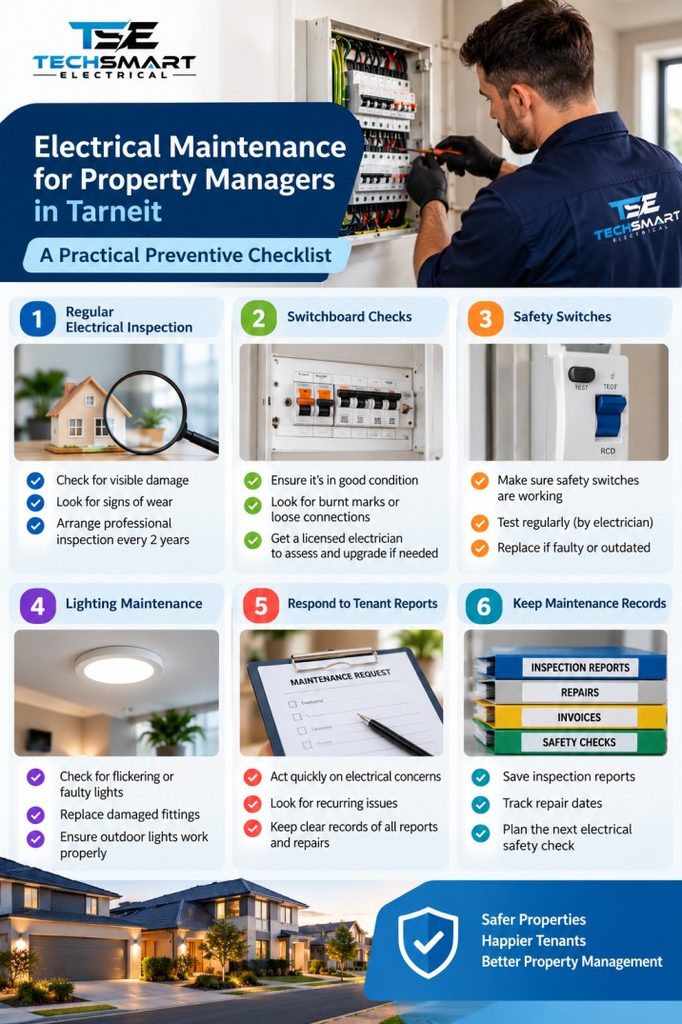
A preventive checklist is most effective when every task has a clear trigger, responsible person, and record of completion. The following framework can be adapted for individual houses, townhouses and larger rental portfolios.
Record visible electrical damage, tenant complaints, lighting problems, damaged smoke alarms and any obvious signs of water ingress near electrical fittings. Arrange professional help where needed.
Review the latest electrical safety check, outstanding recommendations and available maintenance history. Arrange the required check promptly if the applicable deadline has been missedz
Ensure the required electrical safety check is completed by a suitably licensed or registered electrician. Track the next due date and retain the report.
Assess the urgency, communicate safety instructions, arrange the appropriate trade and record the outcome. Do not wait for the next routine inspection when a safety concern has been reported.
Save the electrician’s report, invoice, repair details, and any applicable certificate of electrical safety. Update the property’s maintenance history and follow up on outstanding recommendations.
For property managers coordinating electrical maintenance in Tarneit, working with an appropriately licensed electrical contractor can help establish a consistent process for inspections, repairs and follow-up. TechSmart Electrical can be considered as a provider to contact for information about its services, availability, and suitability for a property’s requirements.
Before arranging work, confirm the contractor’s current licensing or registration, the scope of the inspection, expected documentation, and whether the proposed work addresses the identified problem. This keeps the maintenance process focused on safety and verifiable outcomes rather than assumptions about what a contractor offers.
Accurate maintenance records help property managers demonstrate what was inspected, which defects were identified, and how those defects were addressed. They also reduce the risk of missed deadlines when staff members change, or multiple properties are managed simultaneously.
Keep a separate digital record for each property, including:
Victorian requirements specify that the most recent electrical safety check record must be retained until a record of the next check is created. A copy must also be provided to the renter within seven days after the rental provider receives a written request. The record should contain the information required by the applicable rules.
A spreadsheet or property management system can help track each property’s status. Useful fields include the last inspection date, next due date, outstanding defects, assigned contractor, and repair completion date.
Consider using three practical priority levels:
These are internal management categories, not substitutes for Victoria’s legal repair classifications or statutory timeframes. Property managers must still comply with applicable urgent-repair obligations and respond according to the circumstances.
Even well-organised property managers can overlook important details when managing multiple homes. The following mistakes are worth addressing in the maintenance process.
A scheduled electrical safety check assesses the installation at the time of inspection. A fault can develop afterwards. Continue to respond to tenant reports and arrange additional assessment when circumstances warrant it.
A light that turns on does not prove that its wiring, protective devices or connections are safe. Visual checks help identify warning signs, but they cannot replace the required professional assessment.
A safety switch or circuit breaker that trips repeatedly may be responding to a genuine problem. Do not advise tenants to keep resetting it. Arrange an electrician to investigate.
A damaged power point or burning smell should not sit in a routine maintenance queue. Assess the reported risk immediately and follow the applicable urgent-repair process.
An inspection report may list several issues, but receiving the report is only the first step. Assign each recommendation, obtain the required approval, arrange repairs and confirm completion with supporting documentation.
The most effective maintenance systems combine scheduled checks with a clear process for dealing with unexpected faults.
First, prioritise evidence over assumptions. If a property has an older switchboard, incomplete records or recurring electrical complaints, arrange an appropriate assessment instead of assuming that everything is compliant.
Second, use repeat complaints as a signal. Three reports about the same light, circuit or outlet may indicate a persistent problem. Review the history before booking another isolated repair.
Third, coordinate access carefully. Explain why the electrician needs access, communicate the proposed appointment, and keep a record of access arrangements. Clear communication helps avoid unnecessary delays.
Fourth, close the loop with tenants and landlords. Confirm when a repair has been completed, explain any continuing restrictions, and retain the electrician’s findings. If further work is recommended, make sure responsibility and timing are clear.
Finally, review the entire portfolio regularly. A monthly or quarterly review of overdue checks, recurring faults and outstanding repairs can reveal gaps that are difficult to spot when each property is managed separately.
These measures make property electrical maintenance more consistent and help managers make better decisions about safety, repairs and maintenance budgets.
Effective electrical maintenance starts with a clear checklist, accurate records and a process for responding quickly when tenants report a problem. Regular rental inspections can reveal visible warning signs, while formal electrical safety checks help assess the condition of installations, fittings and protective devices.
For property managers, electrical maintenance in Tarneit should be treated as an ongoing responsibility rather than a task reserved for emergencies. Track inspection dates, review switchboard and safety-switch findings, follow up on lighting faults, and ensure that recommended repairs are completed and documented.
Use Electrical Maintenance Tips for Homes in Tarneit as a starting point for building a practical maintenance schedule across your rental portfolio. When professional assessment or repairs are needed, contact an appropriately licensed electrical contractor and verify the work and documentation provided. Property managers considering TechSmart Electrical can enquire about its services and confirm that the proposed work meets the property’s specific maintenance and safety requirements.
Victorian rental providers must arrange an electrical safety check at least every two years under the applicable rental requirements. If a required check has not occurred within the previous two years when a renter occupies the property, it must be arranged as soon as possible. A suitably licensed or registered electrician must conduct the check, and the property manager should retain the report and track the next due date.
Look for visible damage to power points, light switches, light fittings and accessible electrical equipment. Record reports of flickering lights, recurring power interruptions, burning smells and damaged smoke alarms. Check for visible water damage around electrical fittings, too.
These checks help identify warning signs, but they do not replace a formal electrical safety inspection. Never remove electrical covers or attempt to test wiring unless appropriately qualified.
Treat repeated tripping as a potential fault rather than an inconvenience. Ask the tenant to stop using the affected equipment or circuit where it is safe to do so, and arrange an electrician to investigate. If there is smoke, sparking, a burning smell or another immediate danger, keep people away and arrange emergency assistance as appropriate.
Do not ask tenants to open the switchboard, investigate wiring or repeatedly reset the device without understanding the cause.
Maintain the latest electrical safety check report, the electrician’s identifying and licensing details, inspection dates, findings, recommended repairs and evidence of completed work. Keep invoices and applicable certificates, and record outstanding recommendations with their assigned actions.
Victorian requirements also specify that the latest safety-check record must be retained until the next record is created. A copy must be provided within seven days of receiving a renter’s written request.
No. A routine property inspection can identify visible problems, but it is not a substitute for the formal electrical safety check required under Victorian rental regulations. That check must be performed by a suitably licensed or registered electrician.
Property managers can coordinate appointments, collect tenant reports, review documentation, and follow up on repairs. Electrical testing, diagnosis and repair work should be assigned to appropriately qualified professionals.
Techsmart Electrical is a locally owned company serving Melbourne and the surrounding areas. As leading specialists for commercial, industrial and residential electrician services, we prioritize customer satisfaction.


We are preferred electricians for Beacon Lighting and with that comes many bonuses for our customers. By using Techsmart Electrical as your preferred electrician, we can provide you with up to 20% off RRP of everything in store at Beacon Lighting, extended warranties on certain items and even free lighting design consultations.
Our team works closely alongside our home store in Taylors Lakes to deliver the best possible outcome for all installations. From installing one ceiling fan to wiring an entire home, Techsmart Electrical provides 100% satisfaction guarantee.
Contact us today to arrange your next installation.
Techsmart Electrical has always provided dependable and cutting-edge electrical contracting services and installations. Our qualified electricians offer services that are intended to support Melbourne businesses in growing and to give homeowners complete peace of mind.
It is entirely up to you where you want more power outlets in your home. Techsmart Electrical can install them wherever you need them. It's possible that all you need is to change your power outlets, which is a regular request. Even your outdated power sockets can be replaced with fresh models by our team in order to give your house the finishing touches.
With several years of experience, Techsmart Electrical’s licenced electricians can design and install any power point system, whether it's for a newly constructed home or an existing one. Call us and schedule a time for your power socket installation.












Techsmart Electrical is a Melbourne based electrical company. We understand the importance of top-quality workmanship, service and safety. With a professional approach, we are always ready to provide you with Master Electricians to deliver prompt electrical services for any situation.